
In This Article
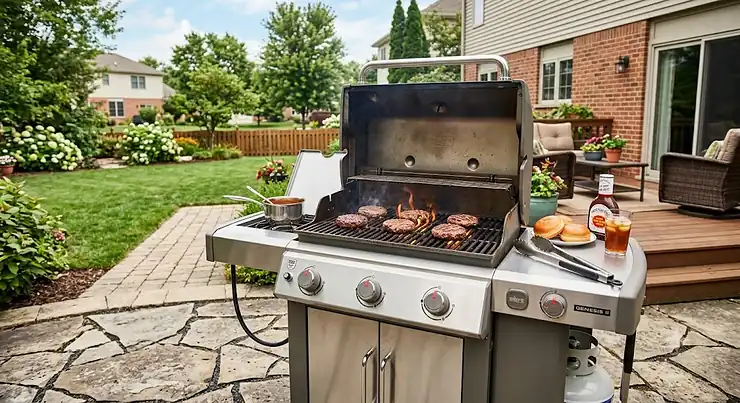
Somewhere between the smell of charcoal fluid and the beep of a microwave sits the best propane grill — the one appliance that turns a random Tuesday into an event. A propane grill is an outdoor cooking appliance that burns liquefied petroleum (LP) gas through a regulator and burner system to deliver instant, adjustable heat, and its popularity comes down to one simple trade: you give up a little smoke flavor and get back speed, consistency, and zero charcoal-related arm workouts. If you’ve ever stood in a grill aisle staring at a wall of boxes that all promise “restaurant-quality searing” and “family-sized cooking,” you already know the real problem isn’t finding a propane grill. It’s finding the right one for your patio, your budget, and the way you actually cook.
That’s what this guide is for. Instead of regurgitating spec sheets, we pulled together seven real, currently available models — spanning true budget workhorses to genuine backyard showpieces — and broke down what each one is actually good at, who it fits, and where it falls short. We’ll walk through a quick comparison table, a deep dive on all seven grills, a plain-English guide to hooking up your propane tank correctly, and the buying mistakes that quietly wreck people’s first summer with a new grill. Some ultra-premium propane grills on the market can generate an intense 1,100 degrees of cooking performance, but most backyard cooks never need anywhere near that — which is exactly the kind of nuance we’ll keep coming back to. By the end, you’ll know exactly which grill deserves a spot on your patio.
Quick Comparison Table
Before we go deep on all seven, here’s the 30-second version. This table is built for skimming — find your budget row, note the standout feature, and jump straight to that product’s full write-up below.
| Grill | Burners / BTU | Cooking Area | Price Range | Best For |
|---|---|---|---|---|
| Weber Genesis E-325s | 3 burners, 39,000 BTU | 669 sq in | $900–$1,100 | Best overall backyard grill |
| Weber Spirit II E-310 | 3 burners, 30,000 BTU | 529 sq in | $500–$600 | Best value for most families |
| Napoleon Prestige Pro 500 | 4 burners + infrared, 72,000 BTU | 1,000+ sq in | $1,800–$2,200 | Best for serious entertaining |
| Monument Grills Mesa II | 4 burners + sear zone | 600 sq in | $350–$450 | Best sear-for-the-dollar |
| Char-Broil Performance 4-Burner | 4 burners, 36,000 BTU | 475 sq in | $250–$350 | Best budget backyard pick |
| Nexgrill 4-Burner with Side Burner | 4 burners + side burner | 500 sq in | $250–$300 | Most affordable reliable option |
| Coleman RoadTrip 285 | 3 burners, 20,000 BTU | 285 sq in | $200–$260 | Best portable propane grill |
A pattern jumps out fast: cooking area and BTU output climb almost in lockstep with price, but the relationship isn’t perfectly linear — the Monument Grills Mesa II punches well above its price bracket on sear performance, while the Napoleon Prestige Pro 500 charges a real premium for build quality and storage features that casual cooks may never use. If portability matters more than backyard square footage, the Coleman RoadTrip 285 is really in a different category altogether, built for tailgates and campsites rather than nightly dinner duty.
💬 Already have a favorite from the table above? Jump down to its full review — or keep reading for the details that actually decide which one comes home with you.
Top 7 Propane Grills: Expert Analysis
We picked these seven to cover every realistic buyer: the family that grills three nights a week, the first-time homeowner working with a starter budget, the host who wants a showpiece, and the camper who wants flame-grilled food two states from home. Every product below gets the same honest treatment — real specs, what those specs mean in practice, and where the aggregated reviews land.
1. Weber Genesis E-325s — best overall backyard grill
The Genesis E-325s has been Weber’s flagship three-burner for years, and the reputation is earned rather than inherited. Its 39,000 BTU output across three burners and 669 square inches of total cooking space (including the warming rack) means you can run a two-zone setup — hot on one side for searing, gentler heat on the other for chicken thighs that need to cook through without torching the skin — without crowding the grate. The GS4 grilling system routes grease away from the burner tubes through angled Flavorizer bars, which in practice means fewer flare-ups and a burner assembly that isn’t clogged with grease sludge by August.
Based on the spec comparison against similarly priced competitors, this is the grill for someone who cooks often enough that reliability and even heat distribution matter more than flashy extras. It’s widely regarded as one of the best propane grill brands you can buy, and that reputation shows up in how consistently Weber owners report years of trouble-free use rather than a few good seasons followed by a burner replacement. Reviewers consistently note that the porcelain-enameled cast-iron grates hold heat exceptionally well for searing, though a few mention the assembly instructions could be clearer for first-timers.
Pros:
- ✅ Even heat distribution across the full cooking surface
- ✅ GS4 system reduces flare-ups and burner clogging
- ✅ Ten-year warranty backs long-term reliability
Cons:
- ❌ Premium price compared to similarly sized rivals
- ❌ Assembly takes longer than budget alternatives
Expect to pay in the $900–$1,100 range depending on retailer and current promotions — always check current price before buying, since availability shifts. For anyone who grills weekly and wants to stop thinking about their grill entirely, this is the easiest recommendation on the list.
2. Weber Spirit II E-310 — best value three-burner
If the Genesis is the grill you buy once and forget about, the Spirit II E-310 is what most households actually need. Its 30,000 BTU output and 529 square inches of cooking space (including warming rack) cover a standard family cookout — four to six burgers plus a side of vegetables — without the premium price tag of its bigger sibling. It shares the same GS4 grease-management system as the Genesis line, so the flare-up control and burner longevity carry over even though the price doesn’t.
What most buyers overlook about this model is that “entry-level Weber” still means Weber-grade engineering underneath a smaller footprint — the porcelain-enameled grates, the infinite ignition system, and the sealed valve system are the same technology found on grills costing twice as much. It’s the grill we’d point a first-time homeowner toward, since the learning curve is gentle and the parts are widely available if something ever needs replacing. Aggregated review sentiment consistently praises the even heat and easy startup, with the most common complaint being the smaller side shelf compared to four-burner competitors.
Pros:
- ✅ Shares Genesis-level grease management at a lower price
- ✅ Compact footprint fits small patios and townhome decks
- ✅ Wide availability of replacement parts long-term
Cons:
- ❌ Smaller side shelf space than 4-burner rivals
- ❌ Less total cooking area for larger gatherings
Priced in the $500–$600 range, this is the model we’d call the most reliable propane grill for typical use — not because it’s flashy, but because Weber’s mid-tier engineering rarely lets people down.
3. Napoleon Prestige Pro 500 — most feature-packed for entertaining
This is the grill for people who host. The Prestige Pro 500 pairs four main stainless steel burners with an infrared rear rotisserie burner and an infrared side burner, pushing combined output past 72,000 BTU across more than 1,000 square inches of total cooking surface. Napoleon’s grills are known for innovative accessories and integrated functionality, and that shows up here in soft-close storage doors, built-in shelving inside the cabinet, condiment racks, tool hooks, and a bottle opener with a cap catcher — small touches that read as gimmicky on paper but genuinely change how usable the cart is during a real party.
Based on the spec comparison, the infrared rear burner is the standout: it’s built for slow-turning a rotisserie chicken or a leg of lamb with radiant heat rather than direct flame, something none of the other six grills on this list can do out of the box. Reviewers consistently point to the lifetime warranty on the cast aluminum frame and lid as a signal of how confident Napoleon is in the build. The trade-off is obvious — this is the most expensive grill here by a wide margin, and casual cooks who grill hot dogs twice a summer will never use half of what’s on this cart.
Pros:
- ✅ Infrared rear burner enables true rotisserie cooking
- ✅ Lifetime warranty on frame and lid construction
- ✅ Soft-close storage and integrated cabinet organization
Cons:
- ❌ Highest price point of any grill on this list
- ❌ Overkill for casual or occasional grillers
Expect a price range in the $1,800–$2,200 zone, positioning this squarely as an investment piece rather than an impulse buy — check current price and any bundled accessory promotions before committing.
4. Monument Grills Mesa II — best sear-for-the-dollar
Monument is a newer name in the category, and the Mesa II is the model responsible for the brand’s growing reputation. Its Advanced Broil Zone sear station rivals sear stations on grills costing twice as much, and independent testing found it reaches 500°F in under five minutes — faster than a lot of indoor ovens preheat. That kind of heat-up speed matters more than people expect: it’s the difference between grilling on a whim after work and having to plan a 20-minute warm-up window first.
Here’s what the spec sheet won’t tell you, but reviewers note: the 304 stainless steel burners are genuinely built to resist corrosion, and the enameled cast-iron grates distribute heat more evenly than the stamped grates found on similarly priced grills. Customer service also receives consistent praise, which matters for a newer brand still building trust with first-time buyers. The enclosed cabinet keeps the propane tank shielded from weather, and folding side shelves make it workable on tighter patios. Assembly is straightforward, though a few owners note the included instructions are sparser than legacy brands provide.
Pros:
- ✅ Sear station performance rivals grills twice the price
- ✅ Fast preheat time under five minutes to 500°F
- ✅ Enclosed cabinet protects the propane tank from weather
Cons:
- ❌ Assembly instructions are thinner than established brands
- ❌ Newer brand means a smaller long-term track record
At $350–$450, the Mesa II is the clearest “why spend more” argument on this list for anyone whose top priority is a hard, fast sear rather than cabinet luxury.
5. Char-Broil Performance Series 4-Burner — best budget backyard pick
Char-Broil built its reputation on making gas grilling accessible, and the Performance Series 4-Burner is the clearest expression of that mission. Four burners deliver roughly 36,000 BTU across 475 square inches of primary cooking space, enough for two dozen burgers or a dozen steaks in one pass. A 10,000 BTU side burner lets you keep barbecue sauce warm or sauté onions without shuffling pans on and off the main grate — a small feature that ends up used constantly once people have it.
For most shoppers comparing Char-Broil’s lineup, the Performance Series is exactly where they should be looking, since the higher Commercial and Professional tiers step up to infrared cooking and heavier steel at a meaningfully higher price most casual buyers don’t need. Reviewers consistently describe it as a strong beginner grill, with independent lab evaluation finding very good preheat performance — meaning it climbs to cooking temperature quickly and doesn’t waste propane idling. The porcelain-coated cast-iron grates hold up well against rust, though the lack of tool hooks is a recurring minor gripe in aggregated feedback.
Pros:
- ✅ Strong preheat speed conserves propane and time
- ✅ Side burner adds real everyday cooking flexibility
- ✅ Porcelain-coated grates resist rust over years of use
Cons:
- ❌ No built-in tool hooks for hanging accessories
- ❌ Cooking area runs smaller than 4-burner rivals
Priced in the $250–$350 range, this is the propane grill for backyard cooks who want dependable performance without financing a patio appliance.
6. Nexgrill 4-Burner Gas Grill with Side Burner — most affordable reliable option
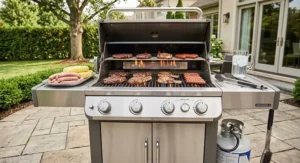
The Nexgrill 4-Burner is the grill that shows up on “best budget” lists for a reason: it stacks a genuinely usable feature set — four main burners plus a dedicated side burner — into one of the lowest price points in this entire roundup. Combined output lands north of 50,000 BTU across roughly 500 square inches of primary space, numbers that would have been mid-tier just a few years ago and are now available at true entry-level pricing.
What most buyers overlook about budget grills in general is that ignition reliability, not raw BTU count, is usually what separates a good cheap grill from a frustrating one — and the Nexgrill’s electronic ignition system is where it earns its keep, lighting consistently without the repeated clicking that plagues cheaper analog igniters. The stainless steel lid and control panel also read as more premium than the price suggests, even if the porcelain-coated cast-iron grates aren’t quite as thick as what you’d find on a Weber. Aggregated review sentiment is broadly positive on value, with the most common critique centering on thinner-gauge side shelves that feel less sturdy under heavy pans.
Pros:
- ✅ Electronic ignition lights reliably every time
- ✅ Side burner included at an entry-level price point
- ✅ Stainless lid and control panel feel above its price
Cons:
- ❌ Side shelves feel thinner under heavier cookware
- ❌ Grates run less thick than premium competitors
At roughly $250–$300, this is the most affordable grill here that doesn’t feel like a compromise — a strong pick for a first apartment patio or a rental property upgrade.
7. Coleman RoadTrip 285 — best portable propane grill
Every list like this needs one grill that isn’t trying to be a backyard centerpiece, and the RoadTrip 285 is that grill. It folds down into a wheeled, suitcase-style unit, runs on either small 16.4 oz propane cylinders or a full 20-pound tank through a hose adapter, and still delivers 20,000 BTUs across a total output that heats surprisingly fast for something you can roll into a trunk. Independent testing clocked it at 450°F within five minutes of ignition, which is genuinely impressive for a portable unit and puts it ahead of most tailgate-grade competitors.
Based on the spec comparison, the three independently adjustable burners are the real differentiator versus cheaper single-burner portables — you can run a hot zone and a cooler holding zone even on a grill this size, which most tabletop propane grills simply can’t do. Owners consistently highlight the easy assembly and the interchangeable griddle accessory as reasons it earns repeat use well beyond the first camping trip. The most consistent criticism in aggregated feedback involves build durability on handles and hardware, so buyers should handle the folding mechanism gently rather than forcing it.
Pros:
- ✅ Three independent burners for real temperature zoning
- ✅ Reaches 450°F in about five minutes
- ✅ Folds into a wheeled cart for true portability
Cons:
- ❌ Smaller total cooking area than any backyard option here
- ❌ Handle hardware needs gentle, careful handling
Priced around $200–$260, this is the pick for tailgates, campsites, and anyone who wants flame-grilled food without a fixed grilling station at home.
💬 Found the one that fits your backyard? Check today’s price and current availability before it changes!
✨ Don’t Miss These Exclusive Deals!
🔍 Take your outdoor cooking to the next level with the propane grills above. Click on any highlighted model to check current pricing and availability. The right grill turns weeknight dinners into something worth looking forward to. 🔥
How to Connect & Set Up Your Propane Grill
Buying the right grill is only half the job — a shockingly large share of “this grill doesn’t work right” complaints trace back to a bad LP gas connection rather than a defective grill. Here’s the setup sequence that actually prevents problems.
Start with propane tank compatibility: your grill’s regulator is designed for a specific tank type, almost always a standard 20-pound vertical LP tank with an OPD (overfill prevention device) valve — the three-pronged handle that’s been standard since the mid-2000s. If your tank still has the older five-pronged handle, most propane exchange stations will swap it for a compliant one at low or no cost, and it’s worth doing before your first cookout rather than during it. Propane is denser than air, which is exactly why a secure connection matters more than it might seem.
Next comes the regulator hose assembly itself. Attach the regulator to the tank valve by hand, turning clockwise until snug — never use tools, which risk overtightening and damaging the seal. Open the tank valve slowly, a quarter turn at a time, and check every connection point with a soapy water solution: brush it onto the hose, the regulator, and the tank valve, then watch for bubbles, which indicate a leak that needs to be fixed before lighting anything. Once connections test clean, open the grill lid before igniting — lighting with the lid closed lets gas pool inside and creates a dangerous flare when it finally catches.
For the first thirty days, run the grill on high for ten to fifteen minutes before your first real cook to burn off manufacturing residue, and inspect the hose and connections every few uses for cracking or brittleness rather than waiting for an annual check. The most common early mistake isn’t a mechanical failure at all — it’s leaving the tank valve fully cranked open at “max” out of habit, which does nothing for heat output but does wear the valve seal faster than necessary.
Real-World Scenarios: Matching the Best Propane Grill to Your Backyard
Specs only tell half the story, so here’s how three common buyer profiles map onto the lineup above.
Consider a young family in a suburban house who grills two or three nights a week and hosts a handful of backyard birthday parties each summer. Budget matters, but so does not replacing a grill every two years. The Weber Spirit II E-310 is the natural fit here — enough cooking area for a family of five plus a couple of guests, and reliable enough that it becomes a background appliance rather than a recurring project.
Now picture a college student or young professional in an apartment with a small balcony or shared patio, cooking mostly for one or two people a couple times a week on a tight budget. The Nexgrill 4-Burner or the Char-Broil Performance Series 4-Burner both make sense here — genuinely capable cooking without a four-figure commitment, and compact enough for a smaller footprint.
Finally, think about someone who hosts frequently — holidays, game days, extended family gatherings of fifteen or more — and wants the grill itself to be part of the experience. The Napoleon Prestige Pro 500 earns its price tag in this scenario specifically, since the rotisserie function and massive cooking area solve a real logistical problem (cooking for a crowd in one pass) that smaller grills simply can’t.
Common Propane Grill Problems and How to Fix Them
Even a great grill runs into hiccups. Here are the five most common propane grill problems and the fixes that actually resolve them, rather than just masking the symptom.
Weak or yellow flame instead of a strong blue one usually means a clogged burner tube, often from spider webs or food debris — clear it with a pipe cleaner or thin wire run through the venturi tube, following the same inspection routine the Consumer Product Safety Commission recommends checking before every grilling season. A grill that won’t reach high heat despite a full tank frequently points to a partially closed regulator, which can happen after an “OPD lockup” — disconnect the hose fully, reconnect slowly, and open the valve gradually rather than all at once.
Uneven cooking across the grate, hot on one side and lukewarm on the other, is often a burner alignment issue rather than a design flaw — check that burner tubes are seated correctly over the gas ports after any cleaning or maintenance. A propane smell during operation (beyond the initial light-up whiff) is never something to troubleshoot casually — turn off the gas immediately, don’t attempt to light it, and run the soapy-water leak test described earlier before using the grill again. Rust developing on grates faster than expected usually comes down to skipping the post-cook burn-off and cover routine — a quick high-heat burn after cooking, followed by a light oil coat on cast iron grates, adds years to their life.
How to Choose the Best Propane Grill
Cutting through marketing claims, here’s the actual decision framework that matters.
- Match cooking area to your real household size, not your aspirational hosting fantasy — 400-500 square inches comfortably covers four to six people, while anything under a dozen guests rarely needs the four-figure grills.
- Prioritize BTU-per-square-inch over total BTU, since a grill with more burners spread over more space can have a higher total BTU number while actually running cooler per square inch than a tighter, smaller grill.
- Check the grate material and coating, since porcelain-enameled cast iron holds heat for searing far better than thin stamped steel, even when the specs otherwise look similar.
- Weigh warranty length against brand track record, because a long warranty on burners and construction from an established brand is a genuinely useful signal — a wide, tight-fitting lid and an easily accessible grease pan are also worth checking in person if possible.
- Confirm propane tank compatibility before buying, especially for portable models, since some smaller units are built specifically for 1-pound cylinders rather than standard 20-pound tanks.
- Read aggregated review sentiment, not just star averages, since a 4.3-star grill with consistent praise for specific features often outperforms a 4.6-star grill with scattered, vague five-star reviews.
- Decide on cabinet vs. cart style based on your climate, since enclosed cabinets protect the propane tank and internal components from weather better than open-cart designs in humid or coastal regions.
For a broader look at how testers evaluate performance criteria like heat distribution and flare-up control, Consumer Reports’ annual gas grill testing is a useful independent reference point worth checking before you commit to a model.
What Actually Predicts a Reliable Propane Grill
“Most reliable propane grill” gets thrown around loosely in marketing copy, so it’s worth being specific about what reliability actually correlates with in aggregated ownership data. Burner material is the single biggest factor — 304-grade stainless steel resists the corrosion that eventually causes uneven flame and burner failure, while lower-grade steel burners tend to develop hot spots and rust-through within a few seasons of regular use.
Valve and regulator quality matters just as much, even though it’s the part buyers think about least. A well-sealed valve system prevents the slow leaks that cause inconsistent flame and premature ignition failure, which is exactly why brands with a long production history — Weber and Napoleon among them — tend to show up disproportionately in long-term reliability data compared to newer entrants. That’s not a knock on newer brands like Monument, which are closing the gap fast on build quality, but track record still counts for something when you’re trying to predict how a grill performs in year six rather than month six.
Propane Grill vs Natural Gas Grill: Which Should You Buy
Propane and natural gas grills look nearly identical and often run on the same base model with a different regulator and orifice size, but the practical differences matter more than they seem.
| Factor | Propane Grill | Natural Gas Grill |
|---|---|---|
| Fuel source | Portable refillable tank | Fixed line, requires plumbing |
| Setup cost | Lower upfront, tank refills add up | Higher install cost, cheaper per-use |
| Mobility | Fully portable | Fixed to gas line location |
| Runs out mid-cook | Yes, tanks deplete | Never, continuous supply |
| Best for | Renters, movers, most homeowners | Permanent outdoor kitchens |
The core trade-off is portability versus never running out mid-cook. Propane wins for anyone who might move, doesn’t want to hire a plumber, or simply wants the option to relocate the grill around the yard, while natural gas wins for a fixed, permanent outdoor kitchen where running a gas line is already part of the build. If you don’t already have a gas line run to your patio, propane remains simpler to set up and far more widely available — which is exactly why the vast majority of residential grill sales in the U.S. are propane rather than natural gas.
Common Mistakes When Buying a Propane Grill
The single most frequent mistake is buying based on total BTU output alone, ignoring how that heat is distributed across the cooking surface — a grill with fewer total BTUs spread more evenly often out-cooks a higher-BTU grill with hot and cold zones. A close second is skipping the propane tank compatibility check on portable and tabletop models, only to discover after purchase that the unit requires small disposable cylinders rather than a standard 20-pound tank, turning every cookout into an extra errand.
Buyers also frequently underestimate assembly time and skip reading reviews specifically about the assembly process, which is often where budget grills lose points even when their cooking performance is solid. Finally, a lot of people buy grates based on appearance rather than material — stainless steel wire grates look sleek in photos but hold heat far worse than cast iron for actual searing, a detail that never shows up in a product listing photo.
Propane Tank Compatibility & Regulator Hose Assembly Explained
This is worth its own section because it’s the part of grill ownership that generates the most confusion and, occasionally, the most risk. Standard backyard grills use a Type 1 (POL) connection paired with an OPD-equipped tank — again, the three-pronged valve handle. If you’re shopping secondhand or inherited an older tank, verify the valve type before assuming it’ll work with a new grill’s regulator hose assembly, since mismatched connections simply won’t seal properly.
The regulator itself is a low-pressure device, typically stepping propane down to around 11 inches of water column pressure for residential grill burners — far lower than the pressure inside the tank itself, which is what makes the regulator a safety-critical component rather than a simple fitting. Hoses should be inspected for cracking or brittleness at the start of every season, and replaced immediately if you notice any softening, discoloration, or the soapy-water test reveals bubbling anywhere along the line. For anyone installing a fixed propane setup or wanting the full regulatory detail behind these standards, the NFPA 58 Liquefied Petroleum Gas Code is the governing U.S. safety standard for LP-gas storage, handling, and connection requirements.
One frequently missed detail: never store a spare, full propane tank near or under the grill itself. Keep spare tanks upright, outdoors, and away from any heat source — a habit that costs nothing and meaningfully reduces risk.
Long-Term Cost & Maintenance of a Propane Grill
The sticker price is only the opening bid. A 20-pound propane tank typically costs $15-$20 to refill and lasts roughly 18-20 hours of total cooking time on a mid-sized grill, meaning even a family that grills twice a week burns through a tank every six to eight weeks in peak season — call it $100-$150 a year in fuel for a typical household. Add in occasional replacement parts: burner tubes and igniters every few years on budget models, grates and flavor bars roughly every three to five years depending on maintenance habits.
Where the math shifts is upfront quality versus long-term part costs. A $280 grill with generic, hard-to-source burner parts can end up costing more over five years than a $550 Weber whose parts are stocked at every hardware store and sized to fit the original unit indefinitely. That’s the real argument for spending more upfront on an established brand: it’s not about status, it’s about avoiding a mid-life crisis where a $40 part is either unavailable or costs $120 because it’s proprietary and scarce.
Features That Actually Matter (And Those That Don’t)
Marketing copy loves to pile on feature lists, but not all of them move the needle on actual cooking experience. Grease management systems, porcelain-enameled cast-iron grates, and a well-sealed valve system genuinely matter — they directly affect flare-ups, sear quality, and long-term reliability. A side burner matters more than it sounds like it should, since keeping sauces and sides warm without shuffling pans on and off the main grate ends up used constantly once people have it.
On the other hand, built-in LED knob lighting, illuminated cooking surfaces, and app connectivity look impressive on a showroom floor but rarely change how good the food tastes or how long the grill lasts. Extra side shelf space is nice, but it’s the single easiest feature to add after the fact with an inexpensive add-on table, so it shouldn’t be a deciding factor between two otherwise similar grills.
Best Propane Grill for Backyard Entertaining
If regular entertaining is the priority rather than everyday family dinners, the calculus shifts toward total cooking area and secondary features over pure value. The Napoleon Prestige Pro 500 is purpose-built for this — the infrared rotisserie burner alone solves the “cooking for fifteen people” problem that smaller grills simply can’t handle gracefully, and the integrated storage keeps sauces, tools, and serving trays within arm’s reach during a hectic afternoon.
For hosts on a tighter budget, the Weber Genesis E-325s still delivers enough cooking area for a real party — 20-25 guests across a couple of grilling rounds — without the four-figure investment. And for anyone whose entertaining happens away from home, at tailgates or lake houses, the Coleman RoadTrip 285 turns “let’s grill” into something that doesn’t require a fixed address.
Frequently Asked Questions
❓ What size propane tank does a backyard grill use?
❓ How long does a 20 lb propane tank last on a grill?
❓ Can I use any propane tank with any grill?
❓ How do I know if my propane grill regulator is bad?
❓ Is a propane grill cheaper to run than a natural gas grill?
Conclusion
The best propane grill isn’t a single model — it’s whichever one matches how you actually cook, host, and live. For most households, the Weber Spirit II E-310 hits the sweet spot of reliability and price, while the Weber Genesis E-325s is the upgrade pick for anyone who grills often enough to justify it. Budget-conscious buyers get real value from the Char-Broil Performance Series 4-Burner and the Nexgrill 4-Burner, hosts who go big should look hard at the Napoleon Prestige Pro 500, sear-focused cooks should give the Monument Grills Mesa II a serious look, and anyone who grills on the move needs the Coleman RoadTrip 285 in the trunk.
Whichever one you choose, the setup steps matter as much as the model — a correct LP gas connection and a verified regulator hose assembly are what turn a good grill into a safe, dependable one for years. Following basic safety checks each season, like inspecting hoses for cracking and confirming there are no recalls on your model, costs a few minutes and prevents most of the incidents that make headlines.
Now it’s just a matter of firing one up.
✨ Ready to Upgrade Your Backyard?
🔍 Check today’s price and current availability on the model that fits your grilling style best. The right propane grill turns an ordinary weeknight into a reason to be outside. 🔥
Recommended for You
- 7 Best Premium Gas Grill Picks of 2026 (Tested Specs, Real Prices)
- 6 Burner Gas Grill: 7 Best Picks for 2026, Ranked & Reviewed
- Best Gas Grill for Large Family: 7 Top Picks for 2026
Disclaimer: This article contains affiliate links. As an Amazon Associate, I earn from qualifying purchases. If you purchase products through these links, we may earn a small commission at no additional cost to you.
✨ Found this helpful? Share it with your friends! 💬🤗
