
In This Article
Somewhere between the $300 big-box grill that rusts through by year three and the $12,000 outdoor kitchen centerpiece your neighbor won’t stop mentioning, there’s a category that actually makes financial and culinary sense for most serious home cooks. That’s the premium gas grill — the tier where stainless steel stops being a marketing word and starts being an actual material spec, where warranties measure in decades instead of months, and where a Tuesday-night ribeye starts tasting like something a steakhouse would sign its name to.
A premium gas grill, in practical terms, is a unit built from 304-grade stainless steel or better, running commercial-caliber burners (typically 15,000+ BTUs per burner), backed by a warranty of ten years or longer on the core components, and engineered to survive a decade or more of regular outdoor exposure without the firebox rusting out from underneath the grates. That’s the line separating “premium” from “big box.”
This guide breaks down seven real, currently available models spanning the full spectrum of the category — from the most accessible entry point in the “affordable luxury” tier all the way up to hand-welded, California-built units that professional chefs actually spec for their own backyards. You’ll get honest analysis grounded in real specifications and aggregated owner feedback, not recycled spec sheets. We’ll walk through what each grill’s numbers actually mean at the grate, where the real value trade-offs sit, and how to avoid the expensive mistakes that trip up first-time premium buyers. According to Consumer Reports’ annual grill testing, sizing and heat distribution — not brand name alone — are what actually separate a satisfying grill from a frustrating one, and that principle holds all the way up the price ladder.
Quick Comparison Table
| Grill | Best For | Main Burner Output | Warranty Highlight |
|---|---|---|---|
| Weber Summit S-470 | Tech-forward grillers | 48,800 BTU | 10-year burner/body |
| Napoleon Prestige Pro 500 RSIB | Rotisserie fans | 80,000 BTU (total) | Lifetime burners |
| Broil King Regal S590 Pro IR | Two-zone entertaining | 55,000 BTU | 15-year burners |
| Coyote C-Series | Entry-level luxury | 100,000 BTU (5-burner) | Lifetime burners/body |
| Fire Magic Echelon Diamond E1060s | Big-capacity searing | 99,000 BTU | Limited lifetime |
| DCS Series 9 36″ | Full-surface sear | Dual IR + main burners | Lifetime burners/housing |
| Lynx Professional 36″ | Buy-it-for-life builders | 50,000 BTU (2-burner ProSear) | Lifetime body/burners |
Looking at the spread above, notice how price and burner count don’t move in lockstep — the Coyote C-Series actually out-BTUs several grills that cost twice as much, while the Lynx Professional 36″ proves that fewer, better-engineered ceramic burners can outperform a higher raw BTU count. Warranty length is the more reliable premium signal here: every grill on this list backs its burners for at least a decade, and four of the seven back them for life. That’s the real dividing line between this tier and the grills sold at hardware stores.
💬 Bookmark this table now — you’ll want to scroll back to it once you see the full breakdowns below!
Top 7 Premium Gas Grills: Expert Analysis
1. Weber Summit S-470 — smartest premium grill with Connect app monitoring
The standout here is Weber’s Connect smart technology, which pairs a meat probe and internal sensors with a companion app so you can track internal temperature from your kitchen instead of hovering over the grill. Six burners, including a dedicated sear station and a separate smoker burner, push a combined 48,800 BTUs across 580 square inches of primary cooking space — enough to run three different cooking zones simultaneously without one dish stealing heat from another. What that means in practice: you can hold chicken thighs on indirect low heat, sear a steak on the dedicated station, and keep corn warm on the back rack, all at once, without babysitting three separate temperature swings.
Based on the spec comparison against other mainstream premium grills, the Summit’s biggest edge isn’t raw firepower — several grills on this list out-BTU it — it’s the software layer and Weber’s decades-deep dealer and parts network, something newer premium brands simply can’t match yet. Reviewers consistently report that the LED knobs and rotisserie system add genuine convenience rather than gimmick value, and that the porcelain-enameled cast-iron grates hold heat well through repeated lid-opening. A common thread in aggregated feedback is that buyers moving up from a Weber Genesis find the jump in build quality and cooking control immediately noticeable, though a few owners note the app occasionally lags behind the actual grill temperature by a minute or so.
Pros:
- ✅ Weber Connect app gives real remote temperature monitoring
- ✅ Six burners cover three independent cooking zones at once
- ✅ Enormous dealer and replacement-parts network nationwide
Cons:
- ❌ Costs more than rivals with comparable raw BTU output
- ❌ App occasionally lags a minute behind actual grill temp
Weber Summit S-470 typically lands in the $1,600-$2,200 range depending on retailer and configuration — check current price before buying, since Weber periodically rotates promotional bundles. For grillers who want smart-home integration without stepping into a boutique brand, it’s a genuinely strong value at this tier.
2. Napoleon Prestige Pro 500 RSIB — rotisserie and infrared sear included standard
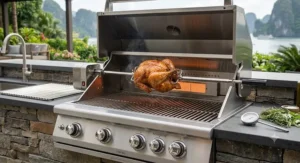
What jumps out immediately is that Napoleon includes a full rotisserie kit and a dedicated infrared rear burner as standard equipment, where competitors like Weber often charge extra for the same setup. Four 12,000-BTU stainless steel main burners combine with an 18,000-BTU rear rotisserie burner and a 14,000-BTU side infrared burner for roughly 80,000 total BTUs across 900 square inches of grilling area, and the 9.5mm-thick WAVE-pattern cooking grids are heavy enough to hold sear marks that thinner grates simply can’t replicate.
Here’s what most buyers overlook about this model: the rear infrared burner sits horizontally at the back of the cooking chamber rather than pointed down from above, which bathes rotating food in radiant heat from behind and below simultaneously. In practice, that translates to noticeably more even browning on a whole chicken or a leg of lamb, with fewer cold patches than you’d get from a vertically mounted rotisserie burner. Reviewers consistently note the illuminated SafetyGlow knobs make a real difference for evening cookouts, and aggregated owner sentiment describes the fit-and-finish as “above average for the price,” with the one recurring complaint being that the cabinet doors can be fiddly to hang during initial assembly.
Pros:
- ✅ Rotisserie kit and infrared sear burner included at no extra cost
- ✅ Heavy 9.5mm WAVE grids hold heat through repeated lid-opening
- ✅ Illuminated knobs genuinely useful for after-dark grilling
Cons:
- ❌ Cabinet doors can be tricky during initial assembly
- ❌ No smart-app connectivity like the Weber Connect ecosystem
Expect Napoleon Prestige Pro 500 RSIB pricing in the $1,600-$1,900 range at the time of research, positioning it as a genuine middle ground between mainstream premium and true luxury tiers. If rotisserie cooking is a real use case for you rather than an occasional novelty, this is one of the strongest values on this list.
3. Broil King Regal S590 Pro IR — dual-tube burners with 15-year warranty
The Regal S590’s patented Dual-Tube burners are the standout feature — each burner runs two independent rows of flame ports rather than one, which Broil King’s engineering claims (and aggregated owner reports back up) delivers steadier heat and fewer cold spots than a standard single-tube design. Five burners deliver roughly 55,000 BTUs across a cooking surface built around thick 9mm stainless steel rod grates, and the whole package ships with a rear rotisserie burner and rotisserie kit included standard, matching Napoleon’s approach rather than Weber’s à la carte model.
Based on the spec comparison against the step-down Baron series, the Regal’s thicker cooking grids are the detail that matters most in daily use — they retain heat noticeably longer through repeated lid-opening, which is exactly when cheaper grates lose their edge and stop delivering consistent sear marks. What the spec sheet won’t tell you, but owner reports consistently mention, is how much the 15-year burner warranty changes the ownership calculus: that’s five years longer than most rivals in this price band, and it signals real confidence in the Dual-Tube design’s long-term durability. A few aggregated reviews flag that the flagship six-burner Regal is genuinely heavy and benefits from two people during assembly.
Pros:
- ✅ Dual-Tube burners deliver steadier heat than single-tube designs
- ✅ 15-year burner warranty, longer than most direct competitors
- ✅ Rotisserie kit included standard, no upsell required
Cons:
- ❌ Six-burner flagship models are heavy and awkward to assemble solo
- ❌ Less brand recognition than Weber among casual buyers
Broil King Regal S590 Pro IR generally runs in the $1,800-$2,400 range — always confirm current pricing, since Broil King’s built-in and freestanding configurations price differently. For buyers who prioritize burner engineering and warranty length over app connectivity, this is a genuinely underrated pick.
4. Coyote C-Series — full 304 stainless at the most accessible premium price
Coyote’s standout move is using true 304-grade stainless steel throughout the entire grill — burners, firebox, frame, and hood — rather than the common industry practice of dressing up a 430-stainless exterior over a cheaper interior firebox where heat and grease actually do their damage. Depending on configuration, C-Series models run three to five Infinity burners rated around 20,000 BTUs each, with the largest five-burner build pushing roughly 100,000 total BTUs across nearly 1,000 square inches of cooking area.
Here’s what that stainless steel choice means in practice: 304-grade alloy carries meaningfully more nickel and chromium than the 430-grade steel many “premium-adjacent” grills use on hidden interior surfaces, which is the difference between a firebox that still looks new after eight coastal summers and one that develops surface rust exactly where you can’t easily clean it. Aggregated owner sentiment consistently praises the fit and finish for the price point, with reviewers noting the internal halogen lighting and heat-control grids feel like features borrowed from grills costing considerably more. The honest caveat, which several comparative reviews raise directly, is that Coyote’s grills are designed in Texas but manufactured overseas — a trade-off that keeps the price down without necessarily compromising the metal quality, but one that brand-loyalty buyers should know going in.
Pros:
- ✅ True 304 stainless steel construction inside and out
- ✅ Strong BTU-per-dollar ratio versus comparably priced rivals
- ✅ Lifetime warranty on burners, housing, and grates
Cons:
- ❌ Manufactured overseas, unlike some US-built competitors
- ❌ Fewer standard accessories than Napoleon or Broil King at this tier
Coyote C-Series pricing runs roughly $1,700-$2,700 depending on burner count and built-in versus cart configuration — treat these as starting points and check current price, since size options shift the total meaningfully. This is arguably the smartest entry point into genuinely premium construction without stretching into four-figure-plus territory.
5. Fire Magic Echelon Diamond E1060s — hand-welded commercial-grade firepower
The number that jumps off the spec sheet is 99,000 total BTUs from eight burners across 1,056 square inches of cooking space — genuinely commercial-scale capacity in a residential unit. Fire Magic hand-welds the body construction rather than using stamped or bolted assembly, and the brand is frequently cross-shopped directly against Lynx, with comparative reviews often favoring Fire Magic specifically for heat retention and overall build density.
What most buyers overlook about a grill in this capacity class is that it isn’t really built for the household cooking four burgers on a Tuesday — it’s engineered for the household that regularly hosts fifteen to twenty people and needs multiple simultaneous cooking zones without waiting for one batch to finish before starting the next. Based on the spec comparison with other large-format grills on this list, the Echelon Diamond’s advantage is heat consistency across that entire 1,056-square-inch surface rather than just raw output; several smaller grills can technically hit similar peak temperatures but can’t sustain them evenly across that much real estate. Reviewers consistently frame the value proposition around exactly that use case — for anyone hosting large groups regularly, the throughput genuinely changes how entertaining works. For an occasional-use household, this capacity is likely overkill.
Pros:
- ✅ 99,000 BTU output across a genuinely commercial-scale surface
- ✅ Hand-welded construction rather than stamped or bolted assembly
- ✅ Excellent heat retention across the full cooking area
Cons:
- ❌ Overkill capacity for smaller households or occasional grillers
- ❌ Among the highest price points on this list
Fire Magic Echelon Diamond E1060s commands roughly $4,000-$5,000+ depending on cart configuration and accessories — verify current pricing directly, as Fire Magic’s modular options shift the total considerably. If you regularly host large groups, the throughput justifies the investment; if you don’t, a smaller grill on this list will serve you just as well for considerably less.
6. DCS Series 9 36″ — dual ceramic infrared for full-surface searing
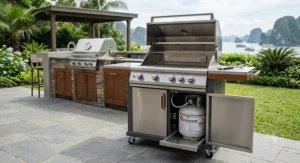
Most premium grills include one infrared burner, typically dedicated to the rotisserie. The DCS Series 9’s standout feature is running two — one at the rear for rotisserie duty and a second mounted specifically for searing — both firing ceramic infrared elements in the 18,000-20,000 BTU range that radiate heat directly at food rather than simply heating the surrounding air. DCS also publishes its firebox wall thickness, a transparency most competitors skip, with the Series 9 running a notably thick 16-gauge 304 stainless housing.
Based on the spec comparison, that dual-infrared setup is what “full-surface searing” actually means in practice: surface temperatures at the grate can exceed 1,000°F, which is what lets a thick-cut ribeye develop a genuine restaurant-grade crust in roughly ninety seconds per side instead of the several minutes a standard burner setup requires. What the spec sheet won’t tell you, but comparative reviews consistently note, is that DCS keeps its outdoor grill manufacturing in Huntington Beach, California, even though the parent company’s kitchen appliances are built overseas — a detail serious buyers researching provenance specifically look for. Aggregated owner feedback frequently mentions the jump in sear quality being immediately noticeable coming from a standard single-burner grill, with the main hesitation being the step up in price from the brand’s own Series 7 line.
Pros:
- ✅ Dual ceramic infrared burners enable true full-surface searing
- ✅ Thick 16-gauge 304 stainless firebox, unusually transparent spec
- ✅ California-built, unlike much of the parent brand’s other lines
Cons:
- ❌ Meaningfully pricier than the brand’s own Series 7 lineup
- ❌ Overkill for cooks who rarely sear steaks at high heat
DCS Series 9 36″ generally prices in the $4,500-$6,500 range depending on dealer and installation requirements — always check current price, since built-in units often quote installation separately from the grill head itself. For anyone who sears steaks regularly and wants the entire cooking surface capable of it, this is one of the most technically interesting grills in the category.
7. Lynx Professional 36″ All-Sear — California-built ceramic burners with lifetime coverage
Lynx’s standout is its proprietary ceramic burner technology — cast from cordierite ceramic, the same material used in kiln and commercial-oven construction — delivering up to 25,000 BTUs per burner with heat retention and radiant distribution that traditional metal burners can’t match. Two ProSear ceramic burners combine for roughly 50,000 BTUs on the 36″ model, and because ceramic doesn’t corrode the way steel burners eventually can, the components carry some of the longest warranty terms in the entire category.
Here’s what that ceramic choice means at the grate: the burners retain and radiate heat more evenly than metal equivalents, which is why Lynx is frequently the brand professional chefs mention by name when asked what they’d install in their own backyard. Reviewers consistently point to the lifetime warranty on the stainless body, burners, and grates — with Lynx explicitly covering parts, labor, and shipping for the first year, an unusually complete first-year package. Lynx also remains one of the few premium brands still manufacturing at scale domestically, in California, which aggregated owner sentiment frequently cites as a reason for brand loyalty even against lower-priced rivals. The honest trade-off: ceramic burners are more delicate than steel during handling, and Lynx’s price sits meaningfully above every other grill on this list.
Pros:
- ✅ Ceramic burners retain and radiate heat better than steel equivalents
- ✅ Lifetime warranty on body, burners, and grates
- ✅ Domestic manufacturing at scale in California
Cons:
- ❌ Highest price point of any grill on this list
- ❌ Ceramic burners require more careful handling than metal ones
Lynx Professional 36″ All-Sear typically runs $7,000-$9,000 depending on rotisserie and cart configuration — this is a genuine investment purchase, so check current price and compare configurations carefully before committing. For buyers who see this as the last grill they’ll ever need to buy, the math works out over a couple of decades of use.
✨ Ready to compare these side by side? Check current availability and pricing before your next cookout!
Practical Usage Guide: Your First 30 Days With a Premium Gas Grill
The first month with a premium gas grill is when most of the expensive mistakes happen, and almost all of them are avoidable. Start with a proper burn-in: run every burner on high for 15-20 minutes before the first real cook to burn off manufacturing residue and factory oils, then let the grill cool completely before scrubbing the grates with a stainless brush. Skipping this step is the single most common reason new owners complain about “off” flavors during the first few cooks.
Calibrate your expectations around heat zones early. Premium grills with 5-6 burners are built for multi-zone cooking — direct high heat on one side, indirect low heat on the other — and treating the whole surface as one uniform temperature wastes the exact capability you paid for. Spend your first two weeks deliberately practicing two-zone setups on simple proteins like chicken thighs before attempting something more technical like a whole beef tenderloin.
Set a maintenance rhythm from day one rather than waiting for a problem. Wipe down grease trays after every third or fourth cook, check burner ports for insect blockage monthly (spiders are a genuinely common cause of uneven flame on grills left idle over winter), and inspect the gas hose for cracking or brittleness each time you reconnect a propane tank. The most common first-30-days mistake is leaving the cover off during a stretch of bad weather — even 304 stainless resists corrosion better than it eliminates it entirely, and a $30 cover protects a multi-thousand-dollar investment.
Real-World Scenarios: Matching the Right Premium Grill to Your Life
The weeknight entertainer. Someone who grills three to four nights a week for a family of four, occasionally hosting six to eight people on weekends, doesn’t need commercial-scale capacity — they need reliability and smart zone control. The Weber Summit S-470 fits this profile well: the app-based monitoring means dinner doesn’t require standing at the grill the entire time, and six burners comfortably handle a mixed protein night without one dish sacrificing heat for another.
The rotisserie enthusiast. A cook who wants whole chickens, pork loins, and holiday roasts to be a regular feature, not a special occasion, should weight the decision toward standard-included rotisserie hardware rather than paying extra later. Both the Napoleon Prestige Pro 500 RSIB and Broil King Regal S590 Pro IR ship with full rotisserie kits, and the Napoleon’s horizontally mounted rear infrared burner specifically targets more even browning on rotating cuts.
The frequent host with a large yard. For households that genuinely entertain fifteen-plus people on a regular basis — think monthly gatherings rather than an annual Fourth of July cookout — the math changes. The Fire Magic Echelon Diamond E1060s and its 1,056 square inches of cooking surface stop being excessive and start being the actual bottleneck-remover that keeps a big party fed without a two-hour rotating queue at the grill.
How to Choose a Premium Gas Grill: 7 Expert Criteria
Choosing among premium gas grills comes down to weighing seven factors against your actual cooking habits, not just comparing spec sheets side by side.
- Stainless steel grade throughout, not just the exterior. Ask specifically whether 304-grade stainless extends to the firebox interior, not only the visible hood and cart — that’s where corrosion actually starts.
- BTU-per-square-inch, not total BTU. A grill’s heat flux — BTU output divided by cooking surface — is a far better predictor of real searing power than the total BTU number alone.
- Warranty structure on burners specifically. Burners are the component most likely to fail first; a lifetime burner warranty matters more than a lifetime warranty on the cart or side shelves.
- Rotisserie inclusion versus upsell. If rotisserie cooking matters to you, factor in whether it ships standard or costs extra, since that gap can run several hundred dollars.
- Realistic capacity for your actual entertaining frequency. Buying for the one party a year you might host at maximum capacity usually means overpaying for surface area you’ll rarely use.
- Domestic versus overseas manufacturing, if provenance matters to you. This affects parts availability and service turnaround as much as it affects any perceived prestige.
- Smart features versus mechanical reliability. Weigh whether app connectivity adds genuine value to your cooking routine or whether you’d rather have that budget in burner quality and warranty length instead.
Top of the Line Propane Grill vs Natural Gas: What Changes at the Premium Tier
The propane-versus-natural-gas decision matters more at the premium tier than it does with entry-level grills, because premium models are frequently purpose-built for one fuel type rather than offering an easy conversion kit. A top of the line propane grill offers mobility — you can relocate it, take it to a second property, or run it during a natural gas line outage — but you’re managing tank swaps and refills, and running a large multi-burner grill hard can burn through a standard 20-pound tank faster than casual grillers expect.
Natural gas, by contrast, means unlimited run time as long as your home’s gas line is connected, which matters enormously for anyone doing long, slow rotisserie cooks or hosting all-day gatherings. The trade-off is installation cost — running a dedicated gas line to an outdoor kitchen isn’t cheap — and reduced portability, since a natural gas grill is essentially a permanent fixture once plumbed in. Several grills on this list, including the Napoleon Prestige Pro 500 and the Lynx Professional 36″, ship in both configurations with no field-conversion kit available, meaning this decision needs to happen before you order, not after.
For most buyers without an existing outdoor gas line, propane remains the more practical starting point, particularly for freestanding cart models. Built-in installations tied to a permanent outdoor kitchen are where natural gas earns its higher upfront cost back over years of convenience.
Long-Term Cost & Maintenance: The Real Total Cost of Ownership
The sticker price on a premium gas grill is only the entry fee. Over a decade of ownership, expect to budget for periodic burner replacement (even lifetime-warrantied burners typically only cover parts, not labor, after the first year or two), grill covers (replace roughly every 3-5 years as UV exposure degrades the fabric), and propane or natural gas consumption, which scales directly with how often you cook and how many burners you run simultaneously.
Grates and flame tamers see the heaviest wear and are worth budgeting for separately, since most warranties cover them for a shorter window than the main burners or housing. A frequent grill user — three or more cooks per week — should expect to replace a set of grates roughly once every five to eight years even on a well-maintained premium unit, though the ceramic burners on grills like the Lynx Professional resist this kind of wear noticeably better than standard steel components.
Safety-related maintenance isn’t optional at this investment level. Gas hoses degrade over time regardless of grill quality, and the U.S. Consumer Product Safety Commission recommends checking burner tubes for insect or debris blockage and inspecting hoses for cracking or brittleness every time you reconnect a propane tank — a five-minute habit that prevents the overwhelming majority of gas grill fire incidents reported annually.
High End Gas Grill Brands: What Actually Separates Them
The high end gas grill brands segment splits cleanly into two tiers once you look past marketing language. The first tier — Weber, Napoleon, and Broil King — represents what the industry sometimes calls “accessible premium”: genuinely well-built grills in the $1,500-$2,500 range with strong dealer networks, widely available replacement parts, and warranties in the 10-15-year range on core components. The second tier — Lynx, Fire Magic, and DCS — operates in true luxury territory, often starting where the first tier tops out and running considerably higher, with hand-welded or ceramic-burner construction, lifetime warranties as standard rather than exception, and manufacturing frequently kept domestic in California.
Coyote occupies an interesting middle position: full 304 stainless construction and lifetime component warranties that rival the luxury tier, at pricing that undercuts even the accessible-premium brands in some configurations. What separates these brands in practice isn’t just the metal — it’s depth of engineering in less visible places: burner port design, firebox wall thickness, ignition system reliability, and how well a company’s dealer network can actually service a grill five or ten years down the road when a part eventually needs replacing.
Luxury Outdoor Gas Grill Features Worth Paying For (And Ones That Aren’t)
Not every feature marketed on a luxury outdoor gas grill actually earns its place in the price tag. Worth paying for: genuine infrared searing burners (not just an infrared-branded standard burner), thick cooking grates in the 8-9.5mm range that hold heat through repeated lid-opening, and a rotisserie system with a real motor rather than a hand-crank accessory. These features change how the grill actually cooks, night after night.
Less essential, depending on your habits: interior grill lighting is genuinely convenient for evening cooks but rarely a dealbreaker if you already grill mostly in daylight. Smart app connectivity is a legitimate value-add for the tech-forward cook but adds little for someone who’s grilled the same way for twenty years and prefers a physical thermometer. Built-in bottle openers, condiment caddies, and other cart-mounted accessories are pleasant but shouldn’t factor into a comparison between otherwise similar grills — they rarely reflect anything about the actual cooking performance of the unit.
The filtering question worth asking about any advertised feature: does this change what happens on the cooking surface, or does it just change what the grill looks like in a showroom? Features that pass that test are worth the premium; features that don’t are marketing.
Best Professional Gas Grill for Home Use: Matching Grills to Real Kitchens
Finding the best professional gas grill for home use means translating commercial-kitchen features into something that actually fits a residential footprint and cooking frequency. Professional and commercial kitchens prioritize raw throughput and simultaneous zone count because they’re feeding dozens of covers an hour; most home cooks, even serious ones, are feeding a family of four to eight people at a time. That mismatch is exactly why the Fire Magic Echelon Diamond E1060s and DCS Series 9 36″ — both genuinely commercial-caliber in construction — make more sense for households that entertain frequently and at scale than for the average weeknight cook.
For home cooks who want professional-grade construction quality without professional-scale capacity, the sweet spot sits closer to the Broil King Regal S590 Pro IR or Napoleon Prestige Pro 500 RSIB — both borrow real engineering (dual-tube burners, thick cooking grids, infrared sear stations) from the professional-grill playbook, scaled to a size and price point that fits an actual backyard rather than a restaurant patio. The lesson: “professional-grade” should describe the build quality and engineering pedigree you’re getting, not necessarily the physical size you need.
Premium Grill Warranty: How to Read the Fine Print
A premium grill warranty is only as good as what it actually covers, and the fine print varies more than most buyers expect. Lifetime warranties almost always apply to specific components — typically the stainless body, burners, and cooking grates — while ignition systems, valves, and electronic components are commonly covered for a much shorter window, often just one to two years. Labor and shipping coverage is the detail buyers miss most often: several brands, including Lynx, cover parts, labor, and shipping in full only during the first year, after which you’re responsible for shipping costs and installation labor even on a still-warrantied part.
Registration requirements matter too. Some brands require product registration within a set window after purchase to activate the full warranty term, and skipping that step can quietly reduce your coverage to a shorter default period. Before buying, it’s worth confirming three things directly with the manufacturer or dealer: which specific components carry the longest coverage, whether labor is included and for how long, and whether commercial use voids the warranty (most residential grill warranties, including DCS’s, explicitly exclude commercial or restaurant use).
Stainless Steel Grill Hood: 304 vs 430 and Why It Matters
The stainless steel grill hood is often the first thing buyers evaluate by touch and shine, but the alloy grade underneath that finish matters more than the polish. Grade 304 stainless steel contains meaningfully more chromium and, critically, added nickel compared to grade 430, and that nickel content is what gives 304 its superior long-term corrosion resistance in outdoor, weather-exposed conditions. According to a detailed metals-industry comparison of the two grades, 430 stainless still resists corrosion reasonably well but is more commonly used for interior kitchen-exhaust applications than for surfaces that face direct year-round weather exposure.
In practice, this is why several grills on this list — Coyote, Lynx, and DCS specifically — advertise 304-grade stainless not just on the visible hood but throughout the firebox interior, where heat, grease, and moisture do the most damage over time. A grill hood that looks identical in a showroom can behave very differently after five coastal summers depending on which grade sits underneath the finish, which is exactly why it’s worth asking the specific question rather than assuming “stainless steel” means the same thing across every brand.
Restaurant-Grade Outdoor Grill: What “Commercial-Inspired” Really Means
A restaurant-grade outdoor grill claim usually points to one or more of three specific engineering choices: hand-welded (rather than stamped or bolted) body construction, burner output and cooking surface scaled for continuous high-volume use, and materials chosen for decades of daily commercial wear rather than occasional weekend use. Fire Magic’s hand-welded Echelon Diamond line and the DCS Series 9’s thick 16-gauge firebox are both genuine examples of this philosophy applied to a residential product.
What “commercial-inspired” shouldn’t mean, and sometimes does in marketing copy, is simply a larger cooking surface with standard consumer-grade internals underneath. The honest test is whether a grill’s burner and firebox construction could plausibly survive genuine daily commercial use, not whether it merely has enough surface area to look like it could. Buyers chasing this specific claim should prioritize brands that are transparent about gauge thickness and burner material — the details that actually separate a grill built for occasional weekend use from one engineered for genuinely heavy, continuous cooking.
Common Mistakes When Buying a Premium Gas Grill
The most common mistake is buying based on total BTU count alone rather than BTU-per-square-inch, which leads buyers toward grills that sound powerful on paper but distribute that heat unevenly across too much surface area. A close second is skipping the firebox-material question entirely — checking that the visible hood is stainless while never asking what grade of steel sits inside where corrosion actually starts.
Buyers also frequently underestimate installation costs for built-in and natural-gas-plumbed models, treating the grill price as the total project cost when professional installation, gas line work, and any structural cutout can add a meaningful percentage on top. Finally, many first-time premium buyers skip reading warranty fine print until something breaks, at which point they discover labor and shipping weren’t covered past year one — a detail that’s far easier to plan around before purchase than to negotiate after a burner fails.
Problem → Solution: Fixing the Most Common Premium Grill Headaches
Problem: Uneven heat across the cooking surface. This is almost always caused by clogged burner ports, frequently from spiders nesting in venturi tubes during winter storage. Solution: clean burner ports with a stiff wire or pipe cleaner every spring before first use, and consider a bug screen for the venturi openings if the grill sits idle for extended periods.
Problem: Persistent flare-ups during high-fat cooks. Solution: check that flame tamers or heat control grids are properly seated and not warped, since their job is specifically to redirect drippings away from direct flame contact; a warped or misaligned tamer is the most common root cause.
Problem: Grease buildup causing smoky, off-tasting food. Solution: empty and clean the grease tray after every third or fourth cook rather than waiting until it’s visibly full — residue left too long can carbonize and affect flavor even after the tray itself is emptied.
Problem: Rust spots appearing despite “stainless steel” construction. Solution: this typically signals lower-grade 430 stainless in a hidden area, or surface contamination from carbon steel tools or wire brushes leaving embedded particles that then rust; switch to a stainless or nylon brush and address spots immediately with a stainless-rated cleaner before they spread.
Problem: Ignition failing intermittently. Solution: check battery contacts for corrosion first, since this is the single most common ignition failure point across nearly every brand, and confirm the igniter electrode gap hasn’t shifted from repeated cleaning.

FAQ
❓ How long does a premium gas grill actually last?
❓ Is a premium gas grill worth it for occasional grillers?
❓ What's the difference between 304 and 430 stainless steel on a grill?
❓ Do premium gas grills need a natural gas line, or does propane work?
❓ Does a bigger BTU number always mean a better sear?
Conclusion
Choosing among premium gas grills really comes down to matching real cooking habits to genuine engineering differences, not chasing the highest spec sheet number. The Weber Summit S-470 and Napoleon Prestige Pro 500 RSIB cover most households well at the accessible-premium tier, the Broil King Regal S590 Pro IR and Coyote C-Series offer strong engineering-per-dollar value, and the Fire Magic Echelon Diamond E1060s, DCS Series 9 36″, and Lynx Professional 36″ represent the true luxury ceiling for buyers who cook seriously and often enough to justify it.
Whichever direction you go, prioritize firebox stainless grade, burner warranty length, and realistic capacity for how often you actually entertain over marketing language about “commercial-grade” or “restaurant-inspired” performance. A grill that matches your real cooking frequency will outperform a bigger, more expensive one that mostly sits half-used in your backyard. Take the comparison table back to the top of this guide, match your own habits against the seven criteria above, and you’ll land on the right grill for your kitchen — not just the most impressive one on paper.
✨ Don’t Miss These Exclusive Deals!
🔍 Take your outdoor cooking setup to the next level with these carefully selected premium grills. Click on any highlighted model above to check current pricing and availability. The right grill will help you create the kind of backyard cookouts your family actually looks forward to!
Recommended for You
- 6 Burner Gas Grill: 7 Best Picks for 2026, Ranked & Reviewed
- Best Gas Grill for Large Family: 7 Top Picks for 2026
- 5 Burner Gas Grill: 7 Best Picks Reviewed for 2026
Disclaimer: This article contains affiliate links. As an Amazon Associate, I earn from qualifying purchases. If you purchase products through these links, we may earn a small commission at no additional cost to you.
✨ Found this helpful? Share it with your friends! 💬🤗
