
In This Article
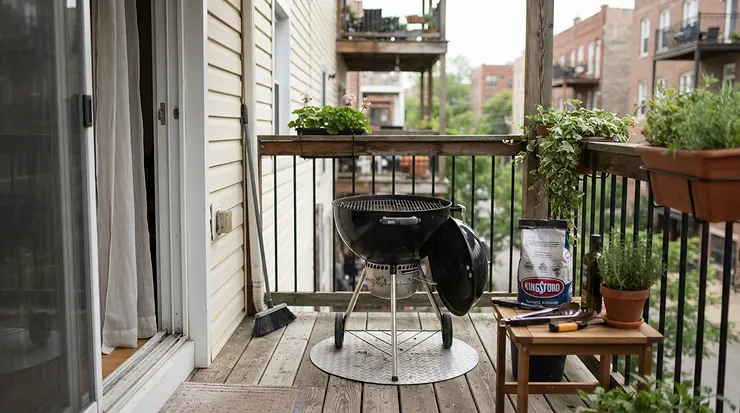
Here’s the uncomfortable truth, and it may save you a few hundred dollars and a lease violation. In most U.S. multifamily buildings, a charcoal grill for apartment balconies is not legal to light on the balcony itself. Section 308.1.4 of the International Fire Code bars charcoal burners and other open-flame cooking devices from combustible balconies. It also bars them from anywhere within 10 feet of combustible construction. Most cities adopt some version of that rule.
So does the dream die here? Not quite. It just means you shop in a different order. Rules first, grill second.
The smartest buyer of a compact charcoal grill for apartments picks the smallest, sturdiest, most stable grill for the spot where charcoal is allowed. That might be a ground-floor patio 10 feet off the wall, a sprinklered property with a landlord’s written yes, a shared courtyard, or a park down the road.
This guide covers fire code grill restrictions, balcony grilling rules and safety, and how to pursue an HOA-approved outdoor grill. It also covers balcony ventilation and seven mini charcoal grill options. One transparency note: I haven’t fired any of these grills on your balcony. Everything below rests on published specs, fire-code documents, and aggregated tester and buyer reports. Prices are ranges, so check current pricing before you buy.
Quick Comparison Table: 7 Compact Charcoal Grills at a Glance
| Grill | Cooking Area | Weight | Price Range* | Best For |
|---|---|---|---|---|
| Weber Smokey Joe 14-Inch | ~150 sq in | ~10 lb | Under ~$75 | Tightest budgets, solo cooks |
| Weber Go-Anywhere | 160 sq in | ~11.5–15 lb | ~$70–$110 | Storage-limited renters |
| Weber Jumbo Joe 18-Inch | 240 sq in | ~17–18 lb | ~$80–$150 | Best all-rounder for 2–4 people |
| Lodge Sportsman’s Grill (L410) | 17.25 x 9 in grate | ~32 lb | ~$100–$150 | Cast-iron sear, tiny footprint |
| Oklahoma Joe’s Rambler | 218 sq in | 48.5 lb | ~$120–$200 | Grilling plus low-and-slow |
| Char-Griller Akorn Jr. | 153 sq in | ~37–40 lb | ~$150–$220 | Fuel-efficient kamado on a budget |
| Kamado Joe Joe Jr. | 13.5-in ceramic | ~68 lb | ~$280–$400 | Premium heat retention |
*Ranges at the time of research; prices vary, so check current price.
Look at the weight column before anything else. On a balcony, or a patio near a shared wall, a lighter grill is easier to move to a compliant spot. The Weber Jumbo Joe 18-Inch gives you the most cooking surface per pound in this group. The Kamado Joe Joe Jr. cooks beautifully but is really a fixed installation. Budget shoppers should note that the Weber Smokey Joe 14-Inch gives up capacity, not construction quality.
💬 Just one click — help others make better buying decisions too!😊
What Is a Charcoal Grill for Apartment Balconies?
A charcoal grill for apartment balconies is a compact, low-profile grill, usually 14 to 18 inches wide and under about 20 pounds, designed for small outdoor spaces. It burns briquettes or lump charcoal for smoky flavor. Whether it may be used on a balcony depends on local fire code, your lease, and your HOA rules.
Note the last sentence. “Designed for balconies” is a size category, not a legal status. No grill is magically exempt from the code. A mini charcoal grill can be perfect for a patio, a courtyard, or a camping trip and still be off-limits on your third-floor balcony.
Small grills do have real advantages. They light faster and use less fuel, and they tuck into a closet between cookouts. Roundups of small charcoal grills describe heat-up times of roughly 15 to 20 minutes and only a few pounds of charcoal per session. They also cost less than a fancy gas setup. The trade-off is capacity: a 150-square-inch grate feeds two people comfortably, not a block party.
Top 7 Charcoal Grills for Apartment Balconies: Expert Analysis
1. Weber Smokey Joe 14-Inch — cheapest way into real charcoal
The 14-inch kettle shape is the classic mini charcoal grill. A porcelain-enameled bowl and lid resist rust and hold heat, and the aluminum dampers won’t corrode. At roughly 10 pounds, one hand can carry it. That matters when the compliant spot is 10 feet from your door rather than on your balcony.
The grate is about 150 square inches, which testers say fits roughly six burgers. That suits solo cooks and couples. On paper, a small grate means you’ll cook in batches for guests. What the spec sheet won’t say is that the tiny fire box burns hot and fast, which favors quick-cook foods over ribs.
Reviewers consistently call it a solid beginner grill. One 2026 portable-grill roundup notes it lacks a built-in thermometer and cooks slower than high-powered propane.
Pros:
- ✅ Lightest, cheapest kettle in this lineup
- ✅ Porcelain-enameled bowl resists rust
- ✅ Fits a closet shelf between uses
Cons:
- ❌ Small grate forces batch cooking
- ❌ No built-in thermometer
Price range: under roughly $75. Value verdict: unbeatable as a first grill, less so as a hosting grill.
2. Weber Go-Anywhere — rectangular fold-and-lock storage design
Its rectangular shape sets it apart. Two folding legs pivot over the lid to lock it shut, so the whole grill packs like a lunchbox. You get 160 square inches under a porcelain-enameled finish. Weber’s spec sheet lists about 11.5 pounds, though some reviewers report figures closer to 15.
The two-piece grate means you can add coals mid-cook without lifting the food off. The six bowl vents and two lid dampers give real airflow control. In practice, you can set up a hot side and a cooler side, which the round Smokey Joe can’t do as neatly. For a small closet, the flat rectangular silhouette stores easily.
Home Depot reviewers praise the portability and how quickly it cools. Their common complaints are that the legs are awkward to fold with one hand and that the plastic handle covers can feel slightly loose.
Pros:
- ✅ Legs lock the lid for one-hand carrying
- ✅ Two-piece grate for mid-cook refueling
- ✅ Char-rail insert supports indirect cooking
Cons:
- ❌ Leg-folding takes two hands
- ❌ Handle covers can wobble
Price range: roughly $70–$110. Value verdict: an excellent pick for renters who store the grill indoors between cookouts.
3. Weber Jumbo Joe 18-Inch — most cooking area under 20 pounds
This is the “real kettle, scaled down” option. A 240-square-inch grate (about 18.5 inches across) sits over an aluminum ash catcher under a porcelain-enameled lid. Testers put the weight around 17 to 18 pounds. That is enough surface for four to six people without buying a full-size 22-inch kettle.
The Tuck-N-Carry lid lock doubles as a lid holder while you cook. The lid and bowl dampers make it easy to hold steady heat. Weber’s 10-year limited warranty is also the strongest in this group. Because it’s built like a big kettle, it can handle indirect cooking as well as searing.
Multiple 2026 roundups named it the best overall portable charcoal grill. Reviewers cite its heat retention and sturdy construction. The 20-inch footprint is bigger than the 14-inch models and can crowd a compact patio.
Pros:
- ✅ 240 square inches feeds four to six people
- ✅ Ash catcher and dual dampers for control
- ✅ Strongest warranty in this lineup
Cons:
- ❌ Wider footprint than 14-inch grills
- ❌ Plated-steel grate sears less than cast iron
Price range: roughly $80–$150. Value verdict: the best all-round buy here for most apartment dwellers with a legal spot.
4. Lodge Sportsman’s Grill (L410) — cast-iron hibachi with tiny footprint
Cast iron changes the equation. The grate measures about 17.25 by 9 inches, and the whole grill is about 19 by 10 inches and 8 inches tall. It’s long and low and can sit on a small table or bench. Two adjustable grate heights and a draft door give you heat control. The flip-down door lets you reach coals from the side.
Cast iron holds heat, so it needs less charcoal and delivers strong sear marks. The catch is weight, about 32 pounds. That makes it a “set it and leave it” grill rather than a carry-it-daily grill. What most buyers overlook is that it’s also nearly indestructible, so you’ll likely pass it down before wearing it out.
Reviewers highlight durability and sear quality. The recurring complaints are weight and rust if you skip seasoning and drying.
Pros:
- ✅ Cast-iron heat retention and deep sear
- ✅ Very low, stable profile
- ✅ Limited lifetime warranty
Cons:
- ❌ Heavy at roughly 32 pounds
- ❌ Needs seasoning to prevent rust
Price range: around $100–$150. Value verdict: great for two people who want sear over capacity.
5. Oklahoma Joe’s Rambler — height-adjustable tray for hot or slow
The Rambler is more grill than “portable” suggests. Steel construction, thick cast-iron grates, and 218 square inches can hold up to six burgers or four steaks. A height-adjustable charcoal tray raises or lowers the fire toward the grate, and a removable ash pan simplifies cleanup. A lid-mounted temperature gauge gives you numbers instead of guesses.
At 48.5 pounds, this is a “tabletop” grill in name only. Plan on a sturdy surface and a permanent spot. In practice, the tray lets you sear hot or run gentler heat for longer cooks. That’s a flexibility the lighter Weber kettles can’t match.
Reviewers and roundups like its cast-iron grates and adjustable tray, and one roundup crowned it best for camping. The manufacturer’s warranty is two years, shorter than Weber’s.
Pros:
- ✅ Adjustable tray for hot or low-and-slow
- ✅ Cast-iron grates and built-in thermometer
- ✅ Removable ash pan for easy cleanup
Cons:
- ❌ Heavy at 48.5 pounds
- ❌ Two-year warranty is short
Price range: roughly $120–$200. Value verdict: worth it if you want versatility and have a permanent legal spot.

6. Char-Griller Akorn Jr. (E06614) — insulated steel kamado on a budget
Kamado-style cooking usually means ceramic and a big price tag. The Akorn Jr. swaps in triple-wall insulated steel, so it holds temperature well and costs far less. Its cast-iron grate offers 153 square inches, with a center hole for adding coals without removing food. The dual dampers (bottom slide, top round) allow steady low temperatures for smoking as well as high heat. Char-Griller claims a range of about 200 to 700°F.
Weight listings vary from about 27 to 40 pounds, with 37 the most common figure. Because of the insulation, it also uses less charcoal per cook than a thin-walled kettle.
Reviewers praise efficiency and versatility, and one tailgating site noted it would fit on a balcony physically. Fire code is a separate question, so see the rules sections below. Common complaints are no wheels and that steel bodies can eventually rust.
Pros:
- ✅ Insulated walls stretch each load of charcoal
- ✅ Holds low temps for smoking
- ✅ Center hole for adding coals mid-cook
Cons:
- ❌ Steel shell can rust over time
- ❌ No wheels and moderate weight
Price range: roughly $150–$220. Value verdict: the best “kamado feel” per dollar.
7. Kamado Joe Joe Jr. (KJ13RH) — premium ceramic heat retention
The Joe Jr. is the premium pick. A thick ceramic shell locks in heat and moisture. Its 13.5-inch grate is small, but ceramic’s steady heat makes it a fine mini charcoal grill for steaks, chops, and small roasts. The catch is weight: about 68 pounds. Ceramic also takes patience to come up to temperature, though airflow through the top and bottom vents stays strong once it does.
Ceramic doesn’t move easily, so it suits a permanent legal spot rather than an occasional relocation. On balcony-load questions, that mass also means you should confirm structural rules with your building manager before adding it anywhere.
Reviewers on a major retailer page rate it very highly, with many owners calling it their go-to for small cooks. At least one buyer says they put it on a balcony, but that’s a personal choice, not a code endorsement.
Pros:
- ✅ Ceramic locks in heat and moisture
- ✅ Very steady temperatures once heated
- ✅ Efficient with small fuel loads
Cons:
- ❌ Heavy at about 68 pounds
- ❌ Slow to reach cooking temperature
Price range: roughly $280–$400. Value verdict: a lifetime grill if you have the right permanent spot.
Fire Code Grill Restrictions: What Applies to Your Building
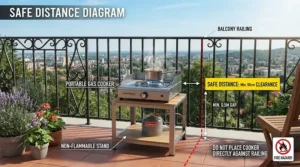
Start with what the codes actually say. IFC 308.1.4 prohibits operating charcoal burners and other open-flame cooking devices on combustible balconies or within 10 feet of combustible construction. NFPA 1 goes further. In its 2024-era guidance summarized by fire-safety publishers, it says that for anything other than one- and two-family dwellings, hibachis, grills, and similar devices shouldn’t be used on any balcony, under an overhang, or within 10 feet of a structure.
The rules mostly target multifamily buildings, meaning anything larger than a duplex. New York State’s Division of Building Standards and Codes published a technical bulletin clarifying how the “one- and two-family dwellings” exception is defined. It hinges on the code’s definition of a dwelling as a building with one or two dwelling units. A townhouse with shared walls can therefore land on either side, depending on local adoption.
There are narrow exceptions. The IFC includes an exception where an automatic sprinkler system protects the deck or balcony. Some fire marshals interpret it strictly, so ask yours. Electric grills are often the code-friendly alternative. Some fire departments explicitly say only electric grills comply on upper-floor balconies.
Because adoption varies by city and state, treat these fire code grill restrictions as a starting point. Call your local fire marshal’s office before you buy.

Balcony Grilling Rules and Safety: A Step-by-Step Guide
Assume you’ve confirmed your grilling spot is legal, whether that’s a ground-floor patio, a courtyard, or a sprinklered balcony with written permission. This is the practical routine for balcony grilling rules and safety. It’s the kind of guidance Amazon listings never give you.
Before you light:
- Confirm the spot is 10 feet from siding, railings, and overhangs, or that you have written approval.
- Place the grill on a stable, non-combustible surface, away from foot traffic.
- Check wind. Never light in gusts that could carry embers.
- Keep a bucket of water, sand, or a fire extinguisher within reach.
While cooking:
- Use a chimney starter, not lighter fluid, so you avoid flare-ups.
- Keep kids and pets at least three feet from the grill, per NFPA guidance.
- Never leave it unattended, and never move a hot grill.
After cooking:
- Let coals cool completely, then dispose of them in a metal container with a lid.
- Clean grease off the grate and tray regularly. NFPA notes that about 20% of gas grill fires involved an uncleaned grill, a reminder that grease matters on any grill.
The stakes are real. NFPA’s grilling resources report that CPSC data show an average of over 21,000 emergency room visits per year involving grills from 2020 to 2024. An older NFPA analysis found 29% of home structure grill fires started on an exterior balcony or open porch. Balconies are where the fire risk concentrates, which is exactly why the codes exist.
HOA-Approved Outdoor Grill: How to Get a Yes From Your Board
Here’s a plain-language reality check. There is no universal “HOA-approved outdoor grill,” because approval depends on your governing documents, fire code, and insurance. A lease or association rule can be stricter than fire code, and a lease that bans grills on balconies is enforceable even if your city would otherwise allow a small propane or electric model.
A decision framework helps.
- If your building is sprinklered and your HOA permits open flame in writing: ask for specifics on grill type, location, and fuel storage before buying.
- If your HOA bans balcony grills: ask whether there are shared grills in a common area, or whether a ground-level spot 10 feet from the building is allowed.
- If you’re renting: get the answer in writing from your landlord. Verbal approvals disappear fast.
- If everything says no: an electric grill is usually the compliant substitute.
Insurance matters too. A grill fire that violates a known, posted rule may not void coverage. However, the association’s insurer can pursue the resident whose grill caused it. Some condo rules also ban even storing charcoal, lighter fluid, or grease trays on balconies. Include those in your request.
When you ask the board, frame it around safety: name the specific grill model, describe your setup, and offer to follow their conditions. Boards say yes more often to a specific, safe plan than to a vague request.
Balcony Ventilation: Smoke, Carbon Monoxide, and Neighbors
Balcony ventilation is the topic people most often get wrong. A balcony is not “outdoors enough” just because it’s open on one side. Burning charcoal produces carbon monoxide, which is odorless and colorless. According to the CDC, burning charcoal of any color gives off CO, and you should never burn charcoal indoors. Symptoms include headache, dizziness, weakness, upset stomach, and confusion.
That’s why enclosed and screened porches are off the table. Safety guidance is explicit that outdoor-rated grills don’t belong in enclosed spaces, and consumer-safety guidance says charcoal grills should never be used indoors even with ventilation. Opening a window or door doesn’t turn a room into an outdoor space.
The practical rules for balcony ventilation:
- Keep the grill well away from doors, windows, and vents so smoke and CO can’t drift inside.
- Grill on the leeward side, and check where the wind carries smoke before you light.
- Install working CO alarms in the unit, especially near bedrooms.
- Be a good neighbor: smoke drifting into the unit above you is a common complaint, and it’s how many grill rules get written in the first place.
Compact Charcoal Grill for Apartments: How to Choose
A compact charcoal grill for apartments comes down to a short list of criteria. Here they are in priority order, with reasoning.
- Confirm the legal spot first. Everything else is moot if you can’t use it where you live.
- Weight and portability. If you’ll carry the grill to a compliant spot, under 20 pounds is practical. Anything heavier stays put.
- Cooking area. About 150 square inches feeds two people. Around 240 feeds four to six.
- Airflow control. Dampers on both the lid and the bowl let you regulate temperature. Without them, you’re stuck at whatever heat the coals give you.
- Ash management. A removable ash pan or catcher keeps mess off patios and shared surfaces.
- Stability. A low, wide base is safer than a tall, narrow one.
- Warranty. Weber’s 10-year limited warranty on the Jumbo Joe and Go-Anywhere beats the two-year term on the Rambler.
Every one of these criteria has a trade-off. Lighter grills cook less and lose heat faster in wind. Heavier grills hold temperature better but resist moving. That’s the core tension in this category.
Mini Charcoal Grill vs. Electric Grill: Which Fits Apartment Life?
Both cook dinner. Only one avoids most of the legal headaches. This is the honest trade-off.
| Factor | Mini Charcoal Grill | Electric Grill |
|---|---|---|
| Fire code on upper balconies | Usually prohibited | Often accepted |
| Flavor | Smoky, authentic | Milder |
| Setup speed | 15–20 minutes | Minutes |
| Smoke and CO | Yes, needs open air | Little to none |
| Best For | Ground-floor patio, courtyard, park | Upper-floor balcony with an outlet |
The table makes the choice clear. If your only option is an upper-floor balcony, electric wins on legality and convenience, and some fire departments say so explicitly. Even then, use a grounded outlet with GFCI protection and avoid running an extension cord through the door.
If you can grill on a legal ground-level patio or in a common area, a mini charcoal grill gives you flavor an electric can’t match. Think of it as choosing between convenience and ritual. Pick honestly and you’ll stop resenting the grill you own.
Real-World Scenarios: Three Apartment Profiles
Scenario 1: Ground-floor renter with a concrete patio. You have a patio 12 feet from the building wall and a landlord who’s fine with grills. You cook twice a week for two or three people. The Weber Jumbo Joe 18-Inch is the sensible pick: it feeds a small crowd and stores in a closet.
Scenario 2: Third-floor condo in a sprinklered building. Your balcony is above ground level. Unless the fire marshal and your HOA both approve in writing, charcoal is a no. Consider an electric grill or a shared common-area grill. If approval comes through, choose the lightest, most stable model, like the Weber Go-Anywhere, and follow the safety steps above.
Scenario 3: Roommates near a park with grill stands. You grill about once a week on weekends, transporting the grill by car. A low, stable Lodge Sportsman’s Grill (L410) delivers sear at a fraction of a big grill’s cost, and the weight isn’t a problem when the car does the hauling.
Notice the pattern. The right grill is the one that fits the legal location, not the one with the best spec sheet.
Common Mistakes When Buying a Charcoal Grill for Apartment Balconies
- Buying first, checking rules second. This is the number one mistake. Read your lease and call the fire marshal before ordering anything.
- Assuming “portable” means “balcony-approved.” It only means it’s light. The Smokey Joe is light. That doesn’t change what your building allows.
- Ignoring weight. A 68-pound Joe Jr. isn’t a casual purchase. Confirm your setup and any structural limits first.
- Using lighter fluid in a tight space. A chimney starter is cleaner and safer.
- Storing charcoal and fluid on the balcony. Some HOA rules ban even storage. Ask before you stash.
- Forgetting ash disposal. Hot ash in a plastic bin is how small fires start. Use a metal container with a lid.
Long-Term Cost and Maintenance
The purchase price is the smallest part of ownership. Charcoal is a recurring cost, but small grills use only a few pounds per session, so it’s a handful of dollars per cook. Insulated designs like the Akorn Jr. and ceramic ones like the Joe Jr. stretch each load further than thin-walled kettles.
Durability differs. Porcelain-enameled Weber bowls resist rust, and Weber’s 10-year warranty covers rust-through and burn-through on cookbox and lid. Cast-iron grills like the Lodge L410 last generations if you keep them seasoned and dry. Steel kamados can rust with age, though replacement parts are available from the maker.
| Tier | Grills | Price Range | Value Verdict |
|---|---|---|---|
| Budget | Smokey Joe, Go-Anywhere | ~$40–$110 | Best entry cost, easy storage |
| Mid-range | Jumbo Joe, Lodge L410, Rambler | ~$80–$200 | Most capacity or sear per dollar |
| Premium | Akorn Jr., Joe Jr. | ~$150–$400 | Fuel efficiency, heat retention |
Value depends on how often you’ll use it. If you grill monthly, the cheapest Weber wins. If you grill weekly for years, spending more on insulation and durability pays back in fuel and longevity.

FAQ
❓ Can you buy a charcoal grill for apartment balconies if your building bans them?
❓ Which compact charcoal grill for apartments is easiest to store?
❓ How far does a grill need to be from an apartment building under fire code grill restrictions?
❓ Does balcony ventilation make charcoal grilling safe?
❓ Is there a single HOA-approved outdoor grill I can just order?
Conclusion
A charcoal grill for apartment balconies is a fantastic idea in the wrong order and a smart purchase in the right one. Start with the rules: fire codes, your lease, your HOA, and your insurer. Then choose the grill that fits the legal spot you actually have.
If you want the best all-rounder, the Weber Jumbo Joe 18-Inch offers the most cooking area under 20 pounds. For a tight budget, the Weber Smokey Joe 14-Inch is the cheapest way to real charcoal flavor. The Weber Go-Anywhere is the storage champion, and the Lodge Sportsman’s Grill (L410) delivers cast-iron sear. If you want versatility, the Oklahoma Joe’s Rambler and the Char-Griller Akorn Jr. stretch further. The Kamado Joe Joe Jr. is a lifetime purchase if you have the permanent spot.
And if the answer for your balcony is “no charcoal,” an electric grill is a respectable plan B, not a defeat.
Recommended for You
- Barrel Drum Charcoal Grill For Low And Slow Smoking: 7 Best In 2026
- Charcoal Grill Under $500 For Backyard Parties: 7 Top Picks 2026
- Top 7 Charcoal Grill Under $200 For A Small Family (2026)
Disclaimer: This article contains affiliate links. As an Amazon Associate, I earn from qualifying purchases. If you purchase products through these links, we may earn a small commission at no additional cost to you.
✨ Found this helpful? Share it with your friends! 💬🤗
