In This Article
A portable pellet grill for camping and tailgating is a compact, tabletop-style wood pellet smoker-grill that usually weighs somewhere between 40 and 65 pounds. It feeds hardwood pellets into the fire with an auger and runs on 120V power, or on a 12V battery through an inverter. It trades size for flexibility, so you can smoke, roast, and sear almost anywhere.
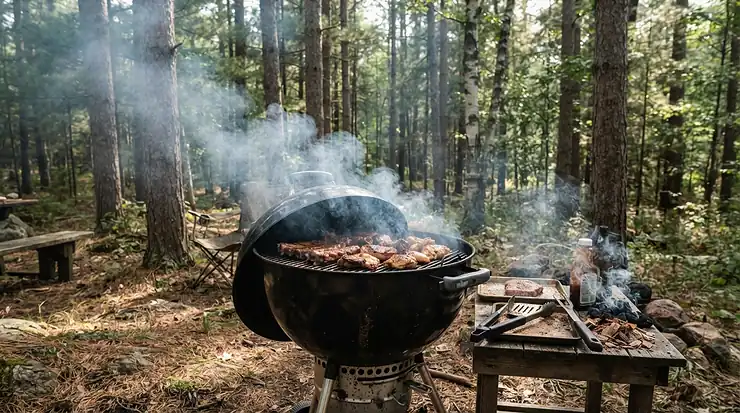
Picture the usual tailgate: a parking lot, a cooler of brats, and one guy hunched over a charcoal kettle, fighting the wind. Now picture setting a digital dial to 225°F, going to throw a football, and coming back to ribs. That’s the pitch. It’s also why a portable pellet grill for camping and tailgating has gone from a niche curiosity to a car-trunk staple.
There’s a catch, and the roundups tend to whisper it. Pellet grills need electricity, and campsites and stadium lots rarely hand it out. One portable pellet grill roundup from The Barbecue Lab points out that only a couple of models take DC power directly, so most buyers end up shopping for an inverter or battery too. That’s why this guide spends serious time on the 12V power source for pellet grill setups, not just the grills.
A quick word on how I approached this. Everything below comes from spec sheets, retailer listings, and the aggregated opinions of published reviews and owners. I haven’t personally cooked on these units, so I won’t pretend otherwise. What I can do is read the numbers for you and tell you what they mean for a Saturday in a stadium lot or a Sunday morning at a forest campsite.
Here’s the plan:
- A fast comparison table
- Seven grills, each with an honest take
- A power-setup walkthrough for tailgating and camping
- Scenario matches, safety rules, and the mistakes that cost people money
Let’s get cooking.
Portable Pellet Grill for Camping and Tailgating: Quick Comparison
Skim this first. Details follow. Prices are rough ranges at the time of research and change often, so check current price before you buy.
| Product | Cooking Area | Power | Standout | Price Range | Best For |
|---|---|---|---|---|---|
| Traeger Ranger | ~184 sq in | 120V AC | Included cast iron griddle | $350–$500 | Griddle fans, brand loyalists |
| Pit Boss 150 | 256 sq in | 120V AC | Flame broiler, 5-year warranty | $250–$400 | Budget tailgaters |
| Z Grills Cruiser 200A Pro | ~200 sq in class | 120V AC (inverter-friendly) | Camping-focused design | $250–$400 | Value-driven campers |
| Green Mountain Grills Trek Prime 2.0 | 219 sq in plus upper rack | AC + 12V DC | Direct 12V option | $400–$650 | Off-grid and RV trips |
| Camp Chef Pursuit 20 | Compact tabletop | 120V AC | Strong high-heat reputation | $300–$450 | Searing-minded cooks |
| Cuisinart CPG-256 | ~256 sq in | 120V AC | Lightest in one roundup | $250–$350 | Weight-conscious buyers |
| Traeger Tailgater 20 | ~429 sq in | 120V AC | Biggest grate, steady temps | $400–$550 | Crowds and real smoking |
Here’s how to read it. The Pit Boss 150 and Cuisinart CPG-256 hit the lowest entry price, so they suit people who want to try the category without a big commitment. The Green Mountain Grills Trek Prime 2.0 costs more, but it’s the only one here with a native 12V pathway, which matters if the nearest outlet is a mile away. And the Traeger Tailgater 20 earns its premium with the largest cooking surface of the group, so it’s the pick when you’re feeding eight instead of three.
💬 Just one click — help others make better buying decisions too!😊
Top 7 Portable Pellet Grills for Camping and Tailgating: Expert Analysis
I picked these across three tiers: budget, mid-range, and premium. Each entry includes the real-world meaning of its specs, and the review sentiment is aggregated from published reviews, not invented.
1. Traeger Ranger — griddle-included versatility for small crews
The Traeger Ranger gives you more than a smoker. It ships with a cast iron griddle, so breakfast sausage and smash burgers are on the menu next to brisket flat.
It offers roughly 184 square inches of cooking space, which sounds tiny until you do the math: about two racks of ribs or a handful of burgers at once. It’s also heavy for a tabletop at around 60 pounds, so count on a two-handed lift.
On paper, the Ranger suits anyone who wants simple controls and repeatable results. Traeger’s digital controller handles temperature while you handle the beer. It’s one of the more convenient picks for a camping pellet cooker, because there’s very little to babysit. A reviewer at Gear Patrol called it a strong value travel smoker for occasional use, and the model has stayed a default recommendation in portable pellet circles for years.
Reviewers consistently praise the temperature steadiness. A common complaint is the modest grate size and the price premium over Pit Boss and Z Grills alternatives.
Pros:
- ✅ Included cast iron griddle adds real range
- ✅ Simple, consistent digital temperature control
- ✅ Solid brand support and accessory ecosystem
Cons:
- ❌ Small grate for groups larger than four
- ❌ Heavy for its footprint
Price range: roughly the $350–$500 bracket depending on retailer. Verdict: pay up for polish and the griddle, not for capacity.

2. Pit Boss 150 — big grate, longest warranty on the list
The Pit Boss 150 wins on value. You get 256 square inches, a flame broiler for direct-flame searing, and a latch-lock lid so it doesn’t flap around the trunk.
The standout spec is the 7-pound hopper. In practice, that’s enough fuel for a long low-and-slow session at modest temps, but you’ll top it up on an all-day brisket. The 5-year warranty is double what most portable rivals offer, and for something that rattles around in a truck bed, that’s genuine peace of mind.
Here’s the analytical take: it’s the best budget tailgate pellet smoker setup for people who want size without a Traeger tax. The controller is simpler than Traeger’s, so don’t expect smartphone gadgets. What it lacks in polish it makes up for in cooking room. Tabletop Pit Boss models in this class weigh around 42 pounds in at least one review, so it’s easier to lift than a Ranger.
Owners and reviewers repeatedly highlight value for money. The recurring complaint is a less refined control experience, with some temperature swing.
Pros:
- ✅ Largest grate in the budget tier
- ✅ Flame broiler for open-fire searing
- ✅ Five-year warranty
Cons:
- ❌ Basic controller, wider temperature swings
- ❌ Small hopper for marathon cooks
Price range: in the $250–$400 range. Verdict: the pick for most first-timers.
3. Z Grills Cruiser 200A Pro — camping-first design at a friendly cost
The Z Grills Cruiser 200A Pro was built with campers in mind. That shows in how Z Grills publishes its own power guidance for it, which is rare among grill makers.
Expect cooking space in the roughly 200 square inch class, enough for a family dinner but not a block party. Z Grills says the Cruiser needs a power source capable of at least 300 watts, so it works with a 12V-to-110V inverter on a leisure or car battery. That’s a big deal. It means a Cruiser camper has a documented route to cooking off-grid.
Honest analysis: this is a lightweight pellet grill camping candidate for people who value a documented power path over brand prestige. It’s compact enough for a hatchback, and it plays nicely with the battery setups covered later in this guide.
Early user sentiment, as reported in roundup reviews, is that it performs well on repeated camping and tailgating trips. As always with budget grills, check current review counts yourself before buying.
Pros:
- ✅ Documented inverter and battery guidance
- ✅ Compact for small cars and RVs
- ✅ Strong value at its price tier
Cons:
- ❌ Smaller grate than some budget rivals
- ❌ Fewer premium convenience features
Price range: typically $250–$400. Verdict: a smart pick if your campsite has no outlet.
4. Green Mountain Grills Trek Prime 2.0 — native 12V power for off-grid cooks
The Green Mountain Grills Trek Prime 2.0 is the only grill in this roundup that takes DC power directly. In a category where nearly everyone else needs an inverter, that’s the headline.
It lists 219 square inches of main cooking space plus an upper rack, with some retailers quoting a larger total. The weight lands around 63 pounds, and the hopper holds roughly 9-10 pounds. One catch: recent listings note the DC cable is no longer included, so budget for it.
Why it matters: a direct 12V route skips the inverter conversion loss and one extra gadget to pack. It also adds Wi-Fi control, a 150–550°F range, and a RACKT system for extra racks. It’s the most RV-friendly pick here.
Reviewers like the DC convenience and the app. The most common drawbacks are the weight and the price once you add cable and accessories.
Pros:
- ✅ Native 12V DC plus 120V AC power
- ✅ Wi-Fi app control and wide temperature range
- ✅ Stands out for RV and boondocking use
Cons:
- ❌ DC cable may be sold separately
- ❌ Priciest of the compact group
Price range: roughly $400–$650 depending on bundle and seller. Verdict: worth it if off-grid is your regular reality.
5. Camp Chef Pursuit 20 — high-heat chops in a compact shell
The Camp Chef Pursuit 20 is the pick for people who want their pellet grill to sear, not just smoke. One roundup singled it out as best for high-heat grilling, which is the weak spot of most portable pellet units.
Camp Chef built its reputation on outdoor cooking gear, and the brand is widely noted for its customer service. For a camper, that history matters. It means the Pursuit sits inside a bigger camp cooking gear ecosystem of stoves, griddles, and accessories you may already own.
My read of the spec comparison: the Pursuit suits the person who wants a steak crust and not just smoke rings. Pellet grills can struggle to hit steakhouse heat, so a model known for hotter performance earns real attention. Pair it with a cast iron pan on the grate for extra sear.
I couldn’t verify a large volume of current Pursuit reviews in my research, so check listings for fresh owner feedback before purchasing.
Pros:
- ✅ Reputation for stronger high-heat cooking
- ✅ Fits neatly into Camp Chef accessory lineups
- ✅ Respected brand support
Cons:
- ❌ Fewer fresh reviews found during research
- ❌ Pricier than the budget leaders
Price range: usually $300–$450. Verdict: choose it for searing ambitions.

6. Cuisinart CPG-256 — the lightest budget pick
The Cuisinart CPG-256 is the weight-conscious pick. One roundup named it the lightest portable pellet grill on its list, and that matters when you’re hauling it from a truck to a campsite picnic table.
The 256 in the model name points to roughly 256 square inches of cooking space, matching the Pit Boss at a gentler price. It’s a tidy, no-drama entry into the category.
Analytical takeaway: this is a decent compact pellet grill for travel if you hate lifting heavy gear. Lighter weight usually means lighter steel, so it may lose heat faster in wind or cold. Plan for a windbreak on chilly autumn tailgates.
Reviewers tend to praise its affordability and portability. A frequent concern is build quality versus pricier brands, which is typical for the tier.
Pros:
- ✅ Lightest unit in one comparison roundup
- ✅ Good grate size for the cost
- ✅ Easy first step into pellet cooking
Cons:
- ❌ Lighter build may lose heat in wind
- ❌ Less refined controller experience
Price range: around $250–$350. Verdict: a solid bargain for casual outings.
7. Traeger Tailgater 20 — largest grate, steadiest temps
The Traeger Tailgater 20 has the most cooking room in this lineup, at around 429 square inches. SmokedBBQSource ranked it the best portable pellet grill for smoking thanks to that surface and its temperature consistency.
Folding legs make it truly mobile, doubling as a tabletop when you need them to. At that size, you can cook for a crowd: four racks of ribs, a pork shoulder plus sides, or burgers for a whole tailgate cooler crew.
My analysis: the Tailgater is the choice if smoking is the point and portability a close second. It’s heavier than the small tabletop grills, so you want a hatchback or SUV and a second person to help unload.
Reviewers consistently note steady temperature performance. The usual complaint is the price and bulk.
Pros:
- ✅ Biggest cooking surface in the lineup
- ✅ Consistent temps for long smokes
- ✅ Folding legs for flexible setup
Cons:
- ❌ Bulkiest and heaviest of the group
- ❌ Highest price tier
Price range: roughly $400–$550. Verdict: best for feeding a crowd.
How to Choose a Portable Pellet Grill for Camping and Tailgating
What is the best way to choose a portable pellet grill for camping and tailgating? Match cooking area, weight, hopper size, and power source to your trip style. Start with how you’ll power it, then size for your headcount, then weigh portability and budget.
- Decide the power plan first. If your campsite has no outlets, look at the GMG Trek Prime’s DC route or plan an inverter and battery. Everything else depends on this.
- Count the mouths. Around 200 square inches serves two to four; 250-plus handles a family; 400-plus handles a tailgate group.
- Check actual weight. Forty pounds feels very different from sixty-five when you’re hoisting it into a trunk.
- Look at hopper size. Seven to eleven pounds is typical, and the hopper decides how long you can leave the grill unattended on a low smoke.
- Check temperature range. If you want steak sears, look for strong high-heat reputation; if you want smoke flavor, a low 180–225°F range matters.
- Weigh warranty and support. Portable grills take abuse. A five-year warranty is serious reassurance.
- Budget for accessories. Inverter, battery, cover, and wind protection add to the bottom line.
12V Power Source for Pellet Grill: A Practical Setup Guide
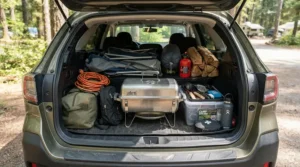
Here’s the part Amazon listings never explain. A pellet grill doesn’t heat with electricity; it only needs power for the auger, fan, and igniter. That’s why the draw is surprisingly small.
How much power does it really take? Traeger’s inverter listing notes its grill pulls about 300 watts during the first four minutes of startup and about 50 watts afterward. Z Grills says its Cruiser needs a source capable of at least 300 watts. In plain terms, you need an inverter rated for the startup surge, not for the steady-state cooking.
Choosing an inverter
A 400-watt inverter, like the units Traeger and Grilla sell in the $60–$70 range, covers the startup load of most compact grills. Bigger units give more headroom, but they aren’t necessary. Clamp it to the battery posts when possible, because Z Grills’ guide to portable pellet grill power setups warns that running through a cigarette-lighter port makes it easier to drain the vehicle’s battery and strand yourself.
Pellet grill car battery: should you use it?
I’d avoid it as your first choice. Using the same battery that starts your car invites a dead-battery afternoon. If you must, do it with the engine off only for short cooks and monitor voltage.
A better move is a dedicated 12V deep-cycle, marine, or leisure battery. Z Grills notes that a battery rated for roughly 200 minutes at 23 amps can run its camping grill for around 15 hours before needing a recharge. One owner on Traeger’s inverter page described smoking ribs for six hours on battery power. These are vendor and owner reports, so treat the runtime as a rough guide and check your own battery’s capacity.
A simple power kit
- A deep-cycle 12V battery (leisure or marine)
- A 400-watt inverter with alligator clips
- A battery box to protect terminals
- A heavy-duty outdoor extension cord (short as possible)
Direct 12V grills
Only the Green Mountain Grills Trek Prime 2.0 here skips the inverter. If you camp off-grid often, that convenience can justify the higher price, but verify whether the DC cable is included.
Tailgate Pellet Smoker Setup: Step-by-Step for Game Day
Anyone can fire a grill up at home. A parking lot is different, so a good tailgate pellet smoker setup is about routine.
- Arrive early and claim flat ground. Level matters; a tilted grill misfeeds pellets.
- Place the grill away from your vehicle and tents. Keep it clear of anything that can burn.
- Connect power before pellets. Hook up the inverter, then the grill, then add pellets to the hopper.
- Run the startup cycle. Let the grill complete its preheat with the lid closed for the recommended time.
- Start with the easy stuff. Sausages and chicken thighs are forgiving on a first tailgate.
- Use a leave-in probe. It beats poking and opening the lid, which loses heat.
- Cool down and clean. Run the shutdown cycle, let ash settle, and bag it before you leave.
One tip most people don’t think of: set up a windbreak. Wind steals heat from a small chamber, so a tidy corner next to a truck bed can save pellets and time.
Real-World Scenarios: Which Grill Fits Which Person
Specs get abstract fast. Here are three profiles to match your situation to a grill.
The weekend car camper (two adults, state park, electric hookup optional). You camp twice a month and cook for two. The Z Grills Cruiser 200A Pro or Pit Boss 150 covers your needs at low cost. If your site lacks power, add a deep-cycle battery and 400-watt inverter.
The RV traveler (week-long trips, boondocking sometimes). You want fewer gadgets and more independence. The Green Mountain Grills Trek Prime 2.0 fits because it runs on 12V. Budget for the DC cable and a solar-charged battery if you stay off-grid for days.
The tailgate host (college lot, eight to ten people, early arrival). You want volume and consistency. The Traeger Tailgater 20 gives the surface area, while the Pit Boss 150 is the budget fallback. Bring a generator or battery, since lots rarely offer outlets.
✨ Ready to match your trip to a grill?
🔍 Compare the seven picks above, then click any bolded product name to check current pricing and availability. A little planning now means more flavor and fewer headaches at your next campsite or tailgate!
Portable Pellet Grill vs Propane and Charcoal: Which Wins Outdoors?
Pellet grills aren’t automatically better. They win on convenience and smoke; they lose on simplicity and raw heat.
| Feature | Portable Pellet | Portable Propane | Portable Charcoal |
|---|---|---|---|
| Needs electricity | Yes (AC or 12V) | No | No |
| Smoke flavor | Strong | Minimal | Strong |
| Searing heat | Moderate | Strong | Strong |
| Temperature control | Automatic | Manual | Manual |
| Best For | Smoke-lovers, set-and-forget cooks | Quick weeknight meals | Hot sears on a budget |
Reading the table: pellet grills solve the babysitting problem. If you want to smoke ribs while you play cornhole, nothing else here does it as well. But if your plan is fast burgers in a windy lot before kickoff, propane or charcoal is quicker. One tailgating roundup even noted that pellets suit slow cooking better than a fast pre-game session. Many serious campers keep both: a small propane stove for breakfast and a pellet grill for dinner.
What to Expect from a Lightweight Pellet Grill for Camping
Marketing photos show perfect bark and golden skin. Real life has gnats, wind, and hungry kids. Here’s what to expect from lightweight pellet grill camping setups.
Preheat takes a few minutes. Compact grills heat fast, but cold weather slows everything down. Give yourself ten to fifteen minutes before food hits the grate.
Wind affects temperature. Smaller chambers lose heat quickly. A windbreak helps more than a bigger hopper.
Pellet use varies. Cold temps, high settings, and open lids all increase consumption. Bring more pellets than you think you need.
Cleanup is easy but not zero. You’ll still need to empty ash and wipe grease. At a campsite, bring a small brush and a bag for ash.
Smoke is gentle. Pellet smoke is milder than offset smokers, which is a feature if you like subtle flavor, and a drawback if you want bold char.
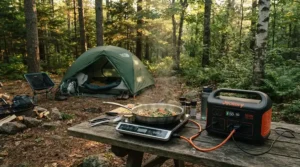
Camp Cooking Gear That Pairs Well With a Pellet Grill
A pellet grill is only part of the camp cooking gear puzzle. A few smart extras turn a good cookout into a great one.
- Leave-in thermometer: Essential for knowing when food is done. It prevents guesswork and overcooking.
- Heat-resistant gloves: Tabletop grills sit close to your hands.
- Cast iron pan or griddle: Adds sear power to grills with weaker high-heat performance.
- Grill cover: Protects the controller from rain and road dust.
- Dedicated pellet storage bin: Pellets absorb moisture, so keep them dry and sealed.
- Folding table: Many portable grills need a sturdy, heat-safe surface. Don’t use a flimsy picnic table.
Features that matter: battery compatibility, hopper size, and a reliable controller. Features that don’t: giant touchscreens and gimmicky lighting that add cost without improving cooking.
Common Mistakes When Buying a Portable Pellet Grill
I see the same traps over and over in buyer conversations and review threads.
Buying without a power plan. The grill arrives, the campsite has no outlet, and the trip is a bust. Decide on power first.
Using your car’s starter battery. It’s tempting and risky. A dedicated battery protects your ability to drive home.
Ignoring weight. Sixty pounds feels fine in a showroom and brutal in a gravel lot.
Chasing cooking area alone. More surface often means more weight and pellets.
Skipping the warranty. A rattled hopper or cracked controller is common on portable gear. Warranty length matters.
Expecting a sear like propane. Pellet grills smoke beautifully but rarely char like a flame grill.
Long-Term Cost and Maintenance
The sticker price is only the start. Here’s how total cost of ownership breaks down.
| Cost Item | Typical Range | Notes |
|---|---|---|
| Grill | $250–$650 | Varies by tier |
| Inverter | $60–$70 | 400-watt class |
| Deep-cycle battery | Varies | Plan for a dedicated unit |
| Pellets (per bag) | Varies | Brand and flavor dependent |
| Cover and accessories | Modest | Protects your investment |
Analysis: a $300 grill that needs a battery kit and accessories can end up near a $450 all-in-one purchase. So a model with native 12V, like the Green Mountain Grills Trek Prime 2.0, can narrow the gap by eliminating the inverter. Maintenance is simple: empty ash after every few cooks, wipe grease, and store pellets dry. A well-kept portable pellet grill can easily last several seasons, and a strong warranty like the one on the Pit Boss 150 reduces replacement risk.
Safety, Fire Rules, and Food Temperatures
Fun fact that isn’t fun: grilling fires are common. NFPA grilling safety guidance stresses never leaving a grill unattended, keeping children and pets at least three feet away, and keeping the grill clean of grease. Tabletop pellet grills are typically knocked over less than free-standing units, but a crowded parking lot is still risky.
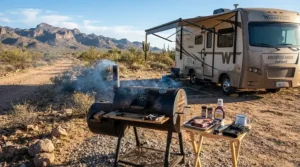
At campsites, check local fire restrictions. Some parks ban open flames during dry spells, and pellet grills can fall under those rules. Call the ranger station before you pack.
On the food side, the thermometer is your friend. The USDA’s safe minimum internal temperature chart lists 165°F for all poultry, 160°F for ground meats, and 145°F for steaks, chops, and roasts with a three-minute rest. Smoking at low temps takes hours, so keep perishable items on ice until they hit the grate.

Frequently Asked Questions
❓ Can you run a pellet grill off a car battery?
❓ How long will a 12V battery run a portable pellet smoker?
❓ Are portable pellet grills good for tailgating?
❓ What's the lightest portable pellet grill?
❓ Do portable pellet grills need electricity?
Conclusion
A portable pellet grill for camping and tailgating won’t replace your backyard rig, and it doesn’t need to. Its job is to bring real wood-fired flavor to places that used to mean hot dogs on a stick. If you keep one thing from this guide, make it this: choose your power plan first, then the grill.
Here’s the short version. Pick the Pit Boss 150 or Cuisinart CPG-256 for budget-friendly entry. Choose the Z Grills Cruiser 200A Pro if you camp without outlets and want documented battery guidance. Go with the Traeger Ranger for the griddle and polish, or the Traeger Tailgater 20 for crowds. Take the Camp Chef Pursuit 20 if searing matters, and the Green Mountain Grills Trek Prime 2.0 if 12V independence is the priority.
Whatever you choose, pair it with a deep-cycle battery, a decent thermometer, and a windbreak, and you’ll cook like a pro with a lot less stress.
Recommended for You
- Premium Pellet Grill For Serious Barbecue Enthusiasts: 7 Best (2026)
- Mid Range Pellet Grill For Backyard Cooks: 7 Best Picks 2026
- Entry Level Pellet Grill: 7 Best Picks That Won’t Disappoint (2026)
Disclaimer: This article contains affiliate links. As an Amazon Associate, I earn from qualifying purchases. If you purchase products through these links, we may earn a small commission at no additional cost to you.
✨ Found this helpful? Share it with your friends! 💬🤗
