
In This Article
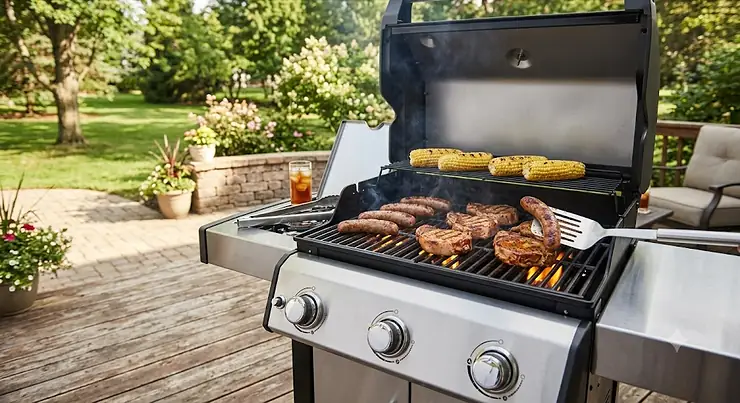
Here’s a confession every backyard cook eventually makes: the grill you can afford and the grill you actually want rarely feel like the same appliance. Somewhere between the $150 impulse-buy at a big-box store and the $1,200 stainless steel monument your neighbor rolled into his driveway, there’s a sweet spot — and for most families, that sweet spot is a 3 burner grill under $400. It’s enough burners to build real heat zones (searing on one side, gently finishing chicken thighs on the other) without paying for cabinetry you’ll never use.
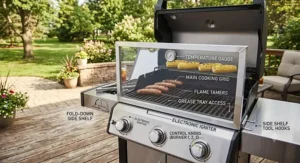
What is a 3 burner grill under $400? It’s a propane or natural-gas grill with three independently controlled main burners, typically producing 24,000 to 48,000 total BTUs, priced below $400 before tax — a category that spans compact cast-aluminum builds to full-width steel-cart models with side burners and warming racks.
This guide skips the marketing copy. We dug into real product listings, manufacturer specs, and aggregated owner feedback across seven models — from a scrappy $180 Nexgrill to a Monument Mesa creeping right up against the $400 ceiling — so you can figure out which one earns a spot on your patio. We’ll also walk through affordable 3 burner gas grill shopping traps, what “durable steel construction” actually means once you’ve owned the thing for three summers, and why BTU output per dollar is a far better shopping metric than BTU count alone. For a broader look at how backyard grilling has evolved as a category, the history and mechanics of the modern gas grill are worth a skim if you’re curious where all this hardware came from.
Let’s get into it.
Quick Comparison Table
| Grill | Total BTU | Primary Cooking Area | Build Material | Best For |
|---|---|---|---|---|
| Nexgrill 3-Burner (720-1094B) | 30,000 | 430 sq in | Cast iron grates, steel body | Tightest budget |
| Kenmore 3-Burner | 30,000 | 381 sq in | Alloy steel, powder coat | Compact storage |
| Char-Broil Performance 300 | ~30,600 | 450 sq in | Steel, TRU-Infrared | Family-size, no-flare cooking |
| Royal Gourmet GG3001S | 25,500 | ~350 sq in | Stainless steel cabinet | Storage + clean looks |
| Char-Griller E3001 Grillin’ Pro | 40,800 (+12,000 side) | 438 sq in | Tubular steel, cast iron | Best BTU-per-dollar |
| Broil King Gem 310 | 24,000 | 294 sq in | Cast aluminum cookbox | Long-term durability |
| Monument Grills Mesa 305/325 | 48,000 | ~400-405 sq in | Steel/stainless, cast iron | Feature-rich premium pick |
Look at the spread here for a second. The Char-Griller nearly doubles the Broil King’s BTU output while costing less, but that raw number doesn’t mean it cooks “better” — it means it burns more fuel to hit temperature faster, which matters if you’re impatient on a Tuesday but costs you more in propane over a season. Meanwhile the Broil King’s cast-aluminum cookbox trades some cooking area for something the others can’t claim: it physically can’t rust through, ever, which is the difference between owning a grill for five years and owning one for fifteen. The Monument Mesa splits the difference — biggest BTU number on the list, generous cooking area, and a glass lid nobody else at this price offers.
💬 Just one click — help others make better buying decisions too!😊
Top 7 3 Burner Grills Under $400: Expert Analysis
1. Nexgrill 3-Burner Liquid Propane Gas Grill in Black — cheapest true entry point
At well under $200, this is the least you can spend and still walk away with a legitimate 3 burner grill under $400, not a toy. The three burners combine for 30,000 BTUs across 430 square inches of primary cooking space, which is genuinely generous for the price tier. Porcelain-enameled cast iron grates retain heat well enough to leave real sear marks, something a lot of sub-$200 grills fake with stamped steel instead.
Here’s what the spec sheet won’t spell out: cast iron grates need a light oil wipe after cleaning or they’ll develop surface rust within a season, especially if you’re near the coast. Based on the spec comparison with pricier models here, what you’re sacrificing isn’t cooking performance so much as long-term hardware — the steel firebox and cart aren’t rated to survive a decade of weather the way a cabinet-style or cast-aluminum grill would. Reviewers consistently note that assembly takes under an hour and the grill lights reliably, with the main complaint being that the temperature gauge runs optimistic by 25-50°F.
This is the right call for a first-time grill owner, a renter who might move next year, or anyone who wants to test whether they’ll actually use a grill before investing more. Buyers on a tight budget who still want three independent heat zones consistently rate this as their top affordable 3 burner gas grill pick.
Pros:
- ✅ Lowest price point of any real 3-burner on this list
- ✅ 430 sq in primary area is large for the cost
- ✅ Cast iron grates outperform stamped steel in searing
Cons:
- ❌ Steel cart and firebox are the first parts to show rust
- ❌ Built-in thermometer reads noticeably hot
Price sits well under $200, and for that money, the value case is hard to argue with — check current price before buying, since Nexgrill runs frequent retailer-specific promotions.
2. Kenmore 3-Burner Grill — most foldable for tight patios
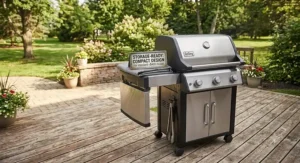
The Kenmore’s standout trick is mechanical, not thermal: fully extended it’s 51 inches wide, but the foldable side tables collapse it down to 32.5 inches for storage. If you’re working with a narrow balcony or a shed that barely fits a bike, that’s the difference between owning this grill and not owning a grill at all.
Total cooking space reaches 512 square inches once you count the 131-square-inch warming rack, with 381 square inches doing the actual grilling work off three 10,000-BTU burners for 30,000 BTUs total. Four caster wheels, two of them locking, make it easy to shove out of the way after dinner. Reviewers consistently flag the one-button ignition as reliable, and the built-in lid thermometer as accurate — a step up from cheaper competitors.
What most buyers overlook about this model is the frame material: it’s alloy steel with powder coating, not stainless, which means the coating can chip on impact and expose bare metal to rust. If you’re rolling it in and out of storage often, that risk goes up. This is a strong reliable 3 burner grill cheap pick specifically for renters, condo owners, and anyone whose outdoor space shrinks to almost nothing between cookouts.
Pros:
- ✅ Collapses from 51 inches to 32.5 inches for storage
- ✅ 512 sq in total cooking space is above average for its class
- ✅ Reliable one-button ignition per owner reports
Cons:
- ❌ Powder-coated alloy steel chips and rusts if scratched
- ❌ Smaller warming rack than some rivals
Typically priced in the $220-$260 range, it undercuts most 3-burner competitors while offering more total cooking surface.
3. Char-Broil Performance 300 — best for zero-flare family cookouts
Char-Broil’s TRU-Infrared system is the reason this grill earns its spot: instead of an open flame directly under your food, an infrared emitter plate diffuses the heat, which dramatically cuts flare-ups from dripping fat. Reviewers consistently note that burgers and chicken thighs come out juicier here than on comparable open-flame grills, because less moisture gets scorched off by sudden flame spikes.
With 450 square inches of cooking space split across three burners, it’s built to feed a full table without crowding the grate — genuinely one of the larger primary areas in this price bracket. Based on the spec comparison, the tradeoff for infrared technology is cleaning: the emitter plate needs periodic scraping or grease buildup can eventually affect heat distribution, something a plain grate design doesn’t require.
This is the pick for parents hosting weekend cookouts who are tired of babysitting flare-ups while flipping burgers one-handed. It’s less suited to searing enthusiasts chasing steakhouse crust, since infrared systems tend to cook more evenly than aggressively hot.
Pros:
- ✅ TRU-Infrared system meaningfully reduces flare-ups
- ✅ 450 sq in cooking area, among the largest here
- ✅ Even heat distribution across the whole grate
Cons:
- ❌ Emitter plate requires more deliberate cleaning routine
- ❌ Less suited to aggressive high-heat searing
Generally found in the $250-$300 range, making it a strong best value 3 burner grill contender for households that grill often.
4. Royal Gourmet GG3001S Cabinet Style — best for a clean, contained setup
The cabinet-style design is the whole pitch here: instead of an open cart with a propane tank strapped to a wire shelf, the GG3001S hides the tank behind real doors, which looks tidier and keeps rain and dust off the regulator. Three burners combine for 25,500 BTUs, on the modest end of this list, but the stainless steel finish and double-layer lid punch above the grill’s price class visually.
Based on the spec comparison, that enclosed cabinet is also a practical win for anyone in a rainy climate — a fully exposed tank corrodes its fittings faster than one tucked behind a door. Aggregated owner feedback frequently mentions easy electronic ignition startup and praises the two side tables with integrated hooks, though a handful of reviewers note the interior cabinet space isn’t large enough for bulky tool sets.
Best suited to buyers who care about how the grill looks parked against the house, not just how it cooks — a common priority for smaller patios where the grill is basically part of the outdoor furniture.
Pros:
- ✅ Enclosed cabinet protects propane tank from weather
- ✅ Stainless steel finish looks premium for the price
- ✅ Double-layer lid retains heat well
Cons:
- ❌ 25,500 BTU is on the lower end of this group
- ❌ Cabinet interior is tight for larger tool storage
Sits in the $300-$330 range typically, positioning it as a mid-tier, style-forward reliable 3 burner grill cheap enough to still leave room in the budget for a cover and tools.
5. Char-Griller E3001 Grillin’ Pro — best BTU output per dollar
If raw heat-per-cost is your metric, this is the grill that wins the math. Three stainless steel burner tubes push a combined 40,800 BTUs — nearly double some competitors here — plus a 12,000-BTU side burner for sauces or sides, all while staying comfortably under $400. That’s a genuinely strong BTU output per dollar ratio in this category, and it shows in how fast the grill recovers heat after you drop a stack of cold burgers on it.
630 square inches of total cooking area (438 primary, 192 warming) means you’re rarely fighting for grate space. Reviewers consistently report the dual smokestacks and porcelain-coated cast iron grates deliver even heat with good sear marks, though a recurring complaint across multiple owners is that the cooking chamber can start rusting from the inside within three to five years — a known weak point for barrel-style steel construction exposed to grease and moisture on the interior.
What the spec sheet won’t tell you: that BTU advantage burns propane faster too, so if you’re grilling several times a week, factor slightly higher fuel costs into the “budget” part of budget outdoor cooking. This is the pick for anyone hosting bigger groups regularly and prioritizing raw cooking capacity over ten-year longevity.
Pros:
- ✅ 40,800 BTU plus a 12,000 BTU side burner
- ✅ 630 sq in total cooking area, largest here
- ✅ Fast heat recovery for high-volume grilling
Cons:
- ❌ Interior chamber prone to rust within 3-5 years
- ❌ Higher BTU output means higher propane consumption
Frequently listed in the $280-$320 range — check current price, since this model sees more retailer discounting than most on this list.
6. Broil King Gem 310 — best for long-term durability in a small footprint
This is the grill built like it’s supposed to outlive its owner’s patience for grilling altogether. The Therma-Cast aluminum cookbox is genuinely rust-proof — not rust-resistant, rust-proof — because aluminum doesn’t corrode the way steel does, and it’s backed by warranty terms (10 years on the cookbox) that other budget grills simply don’t offer. Three stainless burners produce 24,000 BTUs, modest on paper, but testers have measured burnoff temperatures above 750°F in that compact 294-square-inch primary chamber.
Here’s what most buyers overlook about compact high-heat designs like this: less cooking area concentrated with the same burner count means hotter, more consistent zones — great for searing, less ideal if you’re trying to cook for a dozen people at once. Reviewers consistently praise the drop-down resin side shelves for tight-space living, and note the grill assembles in under 30 minutes.
Ideal for apartment or townhouse dwellers who want one of the most durable steel construction alternatives (aluminum, technically, but the same “built to last” philosophy) in a footprint that fits a small deck, and who value repair-free ownership over sheer cooking volume.
Pros:
- ✅ Rust-proof cast aluminum cookbox
- ✅ Reaches searing temps above 750°F reliably
- ✅ 10-year cookbox warranty, longest on this list
Cons:
- ❌ Smallest primary cooking area of the seven
- ❌ Struggles to hold consistent heat in strong wind
Typically priced from $350 up toward the $400 ceiling, which reflects its build quality more than its size — a fair trade if longevity outranks square inches on your priority list.
7. Monument Grills Mesa 305 / Mesa 325 — best all-around premium pick
The Mesa series is the closest thing on this list to a grill you’d expect at a higher price point. Three burners plus a side burner combine for 48,000 BTUs — the highest total here — inside 570 square inches of total cooking space (roughly 400-405 primary, 165-170 warming). The ClearView glass lid is the feature nobody else offers at this price: you can watch your food without lifting the lid and dumping heat every time you check on it.
Based on the spec comparison, that sear-focused burner setup reportedly reaches 650°F in about 15 minutes, putting it in the same performance conversation as grills costing considerably more. Aggregated review sentiment is unusually strong for a budget-tier grill — owners repeatedly mention fast, even heating and describe the glass lid and porcelain-enameled cast iron grates as feeling like a genuine upgrade over their prior grill, whatever brand that happened to be. A minority of reviews mention a bent part on arrival, though most report Monument’s customer service resolved it quickly with replacement parts.
This is the pick for anyone who’s decided a 3 burner grill under $400 is their ceiling, but refuses to feel like they’re settling. It’s the best value 3 burner grill on this list if you’re weighing features per dollar rather than raw price.
Pros:
- ✅ 48,000 total BTU, most powerful grill here
- ✅ ClearView glass lid unique at this price
- ✅ Sears to 650°F in roughly 15 minutes
Cons:
- ❌ Sits near the very top of the $400 budget
- ❌ Occasional reports of shipping damage to minor parts
Generally priced from the mid-$300s up toward $400, making it the splurge pick within an already tight budget — check current price and availability, as this model moves in and out of stock seasonally.
Practical Usage Guide: Setup, First 30 Days, and Maintenance
Getting a new 3 burner grill under $400 running well starts before you even light it. First, do a burn-off: turn all burners to high with the lid closed for 10-15 minutes before cooking anything, which clears manufacturing residue and factory oils off the grates. Skipping this step is the single most common reason first cookouts taste faintly metallic or chemical.
During the first 30 days, season cast iron grates by lightly oiling them after each cleaning while they’re still warm — this builds a protective layer that resists rust, which matters most on the budget models here that use painted steel rather than stainless. Check the propane hose connection with a soapy-water test before every use in the first month; a bubble forming at any fitting means a leak, and you should shut the tank off immediately rather than trying to grill through it.
A common first-month mistake is over-tightening the regulator connection, which can actually damage the seal. Hand-tight plus a quarter turn with a wrench is standard. For ongoing maintenance, scrape grates after every use while they’re still hot, empty the grease tray every two to three cookouts (grease fires are a leading cause of grill-related property damage), and do a deeper burner-tube inspection each spring — spiders love building nests inside burner tubes over winter, which can block gas flow and cause uneven flames. Budget outdoor cooking only stays budget-friendly if you maintain the hardware; neglect turns a $250 grill into a $250 grill you replace in eighteen months instead of five years.
Real-World Scenarios: Matching Grills to Grillers
The apartment dweller with a 6×8 balcony. Someone in this situation needs a grill that folds down small and won’t rust from being wedged against a railing in the rain. The Kenmore’s collapsible side tables and the Broil King Gem 310’s rust-proof cookbox both fit this profile better than anything with an exposed steel cart.
The family of five hosting weekly summer cookouts. Here, cooking area and burner recovery speed matter more than compactness. The Char-Griller E3001’s 630 square inches and 40,800 BTUs handle volume well, and the Char-Broil Performance 300’s flare-reducing infrared system keeps the process low-stress when you’re flipping food for a full table.
The first-time grill owner testing the waters. Someone unsure whether grilling will become a real hobby shouldn’t drop $380 on the Monument Mesa. The Nexgrill at well under $200 lets them learn the basics — how to manage heat zones, when to close the lid, how often to clean grates — without much financial risk if the hobby doesn’t stick.
Buyer’s Decision Framework: A Quick Priority Checklist
If you’re still torn, run through this in order:
- If your absolute ceiling is under $200, choose the Nexgrill, because nothing else on this list hits that price with real cast iron grates.
- If you need the grill to fold down for storage, choose the Kenmore, because its collapsing side tables solve a problem raw BTU numbers can’t.
- If flare-ups and uneven cooking are your biggest past frustration, choose the Char-Broil Performance 300 for its infrared system.
- If you host large groups often and want maximum heat recovery, choose the Char-Griller E3001 for its BTU output per dollar.
- If you want the grill to survive a decade of weather with minimal fuss, choose the Broil King Gem 310 for its rust-proof cast aluminum body.
- If your budget stretches close to $400 and you want the most feature-rich option, choose the Monument Mesa for its ClearView lid and top-tier BTU output.
How to Choose a 3 Burner Grill Under $400
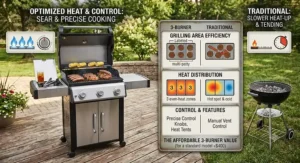
Picking the right grill in this category comes down to a handful of decisions, each with real tradeoffs:
- Decide your cooking volume first. If you’re regularly feeding six or more people, prioritize total square inches over price — a smaller grill just means longer cook times in batches.
- Weigh BTU count against fuel efficiency. Higher BTUs mean faster heat, but also faster propane consumption; match this to how often you’ll actually grill.
- Check the build material honestly. Painted steel is the cheapest but the first to rust; stainless steel resists corrosion better; cast aluminum, as seen on the Broil King, essentially eliminates the rust question entirely.
- Look at warranty length as a durability proxy. Manufacturers who back their cookbox for 8-10 years are signaling confidence that shorter warranties don’t.
- Consider your storage space before cooking area. A grill that doesn’t fit your patio doesn’t matter how many square inches it offers.
- Factor in accessories you’ll actually use. A side burner or warming rack only adds value if you’ll use it; otherwise it’s paying for unused steel.
- Read aggregated review themes, not star averages. A 4.3-star grill with consistent complaints about one specific part (like a chamber that rusts) tells you more than the number itself.
Common Mistakes When Buying an Affordable 3 Burner Gas Grill
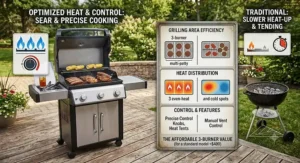
The most common misstep is fixating on total BTU count as a stand-in for quality. A grill with 48,000 BTUs isn’t automatically “better” than one with 30,000 — it just burns hotter and through more propane, which can actually work against you if you’re mostly cooking chicken and vegetables that don’t need blast-furnace heat.
A second frequent mistake: ignoring build material until after the first season of rust. Buyers chasing the absolute lowest price often land on painted steel carts and fireboxes, not realizing that coastal humidity or sprinkler overspray will start pitting the paint within a year. A reliable 3 burner grill cheap enough to fit your budget should still list its firebox material clearly — if a listing is vague about it, that’s usually not a good sign.
Third, people underestimate assembly time and skip reading the manual, which leads to gas leaks from improperly seated fittings — a genuinely dangerous shortcut. And fourth, plenty of shoppers forget to check the primary cooking area versus total cooking area distinction; a “600 square inch” grill might only offer 400 square inches of actual grilling surface, with the rest being a warming rack you’ll rarely use for direct heat.
3 Burner Grill vs 2 Burner and 4 Burner Models
A 2-burner grill, like the well-regarded Weber Spirit line, typically offers less total heat and fewer zones, but at a lower price and smaller footprint — ideal for couples or small households who rarely cook more than a few items simultaneously. The tradeoff is real: with only two burners, you can’t easily maintain a hot searing zone and a cooler holding zone at the same time without crowding.
A 4-burner grill solves that limitation and then some, typically adding 150-200 more square inches of cooking area along with a dedicated side burner as standard rather than optional. But four burners almost always pushes the price past the $400 ceiling this guide is built around, and for a household of two to four people, that extra capacity often goes unused.
Three burners sit in the genuine middle: enough independent zones to sear steak on one side while keeping corn warm on the other, without the price jump or footprint of a full four-burner unit. For most households — not commercial caterers, not solo apartment dwellers — three burners is the configuration that gets used to its full potential most consistently.
What to Expect: Real-World Performance From a Budget 3 Burner Propane Grill
On paper, BTU numbers suggest these grills should all perform similarly within their tier. In practice, heat distribution matters more than raw output. Grills with flame tamers or infrared emitter plates (like the Char-Broil) tend to cook more evenly edge-to-edge, while barrel-style designs with dual smokestacks (like the Char-Griller) can run slightly hotter in the center than at the edges — something worth knowing before you load a full grate of burgers expecting identical doneness.
Expect a genuine 8-12 minute preheat window across this whole category, regardless of BTU rating, since that number is influenced as much by lid design and insulation as by burner output. Expect ignition systems to occasionally need a second attempt in windy conditions — this is universal across budget gas grills, not a defect specific to any one brand. And expect the first cookout’s smoke to smell slightly different than subsequent ones, a normal byproduct of burning off factory coatings during that initial burn-in.
Where these grills separate from pricier competitors isn’t day-one performance — it’s how consistent that performance remains after eighteen months of actual use, which is where build material and maintenance habits start to show.
Long-Term Cost & Maintenance: Total Cost of Ownership
The sticker price is only part of the real cost. A 20-pound propane tank typically lasts 18-20 hours of grilling time on a mid-range 30,000 BTU grill, so a family grilling twice a week should budget for a refill roughly every six to eight weeks during peak season — a recurring cost that’s identical whether you spent $180 or $390 on the grill itself.
Replacement parts are where the real gap opens up. Grills with painted steel fireboxes, like the budget picks here, often need heat plate or burner tube replacements within three to five years as rust sets in — parts that typically run $20-$40 each but add up alongside the labor of your own time doing the swap. The Broil King Gem 310’s cast aluminum cookbox essentially removes that cost from the equation for a decade or more, which is exactly what that longer warranty is signaling. Reviewers consistently frame this tradeoff the same way: pay a bit more upfront for aluminum or heavier stainless, or accept a shorter lifespan and budget for parts replacement as a routine cost of choosing steel.
Cover purchases (typically $25-$40) extend any of these grills’ lifespans meaningfully and are, dollar for dollar, one of the best value additions you can make regardless of which model you choose.
BTU Output Per Dollar: Features That Actually Matter (And Those That Don’t)
BTU output per dollar is a genuinely useful shopping metric, but only when you interpret it correctly. Dividing total BTUs by price tells you how much raw heat capacity you’re buying, and on that math, the Char-Griller E3001 and Monument Mesa lead this list. What that ratio doesn’t capture is heat efficiency — how much of that BTU output actually reaches your food versus escaping around a poorly sealed lid or through thin, uninsulated steel walls. The technical definition of a BTU is simply a unit of heat energy, not a measure of cooking quality, which is exactly why two grills with identical BTU ratings can feel completely different to cook on.
Features that actually matter: porcelain-enameled grates (better heat retention and easier cleanup than bare steel), a lid that closes with a tight seal (retains heat, meaning your BTUs go further), and durable steel construction or aluminum in the firebox specifically, since that’s the part most exposed to sustained heat and moisture over years of use.
Features that matter far less than marketing suggests: built-in bottle openers, side hooks, and cosmetic LED knob lighting. They’re pleasant, but they add zero cooking performance and shouldn’t sway a decision between two otherwise similar grills.
Safety, Regulations & Compliance for Propane Grills
Every grill on this list is built to meet ANSI Z21.58 / CSA 1.6, the North American safety standard governing outdoor cooking gas appliances, which covers everything from burner performance to leak-prevention hardware. The U.S. Consumer Product Safety Commission’s overview of LP-gas appliance standards is a useful reference if you want to understand what that certification actually requires manufacturers to test for.
In practice, a few habits matter more than any spec sheet. Always check hose and regulator connections with a soapy water solution before the season’s first use — bubbles mean a leak, and the grill shouldn’t be lit until it’s fixed. Keep the grill at least three feet from siding, railings, and overhanging branches, since a large share of residential grill fires start from radiant heat igniting nearby combustibles rather than the grill itself malfunctioning. The National Fire Protection Association’s grilling safety guidance covers this and several other practical precautions in more depth, and it’s worth a few minutes even for experienced grillers, since fire departments consistently report the same preventable mistakes each summer.
Never store a spare propane tank near or under the grill, and never bring any gas grill indoors or into an enclosed porch, both of which risk carbon monoxide buildup and fire hazard regardless of how well-built the grill itself is.
✨ Don’t Miss These Exclusive Deals!
🔍 Take your backyard cookouts to the next level with these carefully selected grills. Click on any highlighted pick to check current pricing and availability. These tools will help you create authentic backyard barbecue memories your family will love!
FAQ
❓ What's the difference between a 3 burner grill and a 4 burner grill?
❓ How many people can a 3 burner grill under $400 realistically feed?
❓ Is a cast aluminum grill body actually better than stainless steel?
❓ How long does a 20-pound propane tank last on a 3 burner grill?
❓ Are budget 3 burner grills safe to use long-term?
Conclusion
A 3 burner grill under $400 isn’t a compromise so much as a genuinely smart landing spot in the market — enough burners for real cooking flexibility, without paying for cabinet space or capacity most households won’t use. Whether that means the no-frills Nexgrill for someone still deciding if grilling is their thing, the rust-proof Broil King Gem 310 for a small patio built to last a decade, or the feature-loaded Monument Mesa for buyers willing to stretch close to the ceiling, the right pick genuinely comes down to how you cook, how often, and how much storage and durability matter versus raw heat output.
The throughline across every product here: durable steel construction (or aluminum, where available) and honest BTU-per-dollar math matter more than flashy extras. Check current prices before buying, since this category sees frequent seasonal discounting, and remember that a grill cover and a few minutes of hose-checking each spring will do more for long-term value than almost any single spec on the page.
✨ Ready to fire up your next cookout? Compare these seven picks one more time, pick the one that matches your household size and patio space, and get grilling this weekend.
Recommended for You
- 3 Burner Gas Grill for Family: 7 Best Picks for 2026
- 3 Burner Gas Grill: 7 Best Picks Worth Buying in 2026
- 2 Burner Gas Grill for Couple: 7 Best Picks for 2026
Disclaimer: This article contains affiliate links. As an Amazon Associate, I earn from qualifying purchases. If you purchase products through these links, we may earn a small commission at no additional cost to you.
✨ Found this helpful? Share it with your friends! 💬🤗
