
In This Article
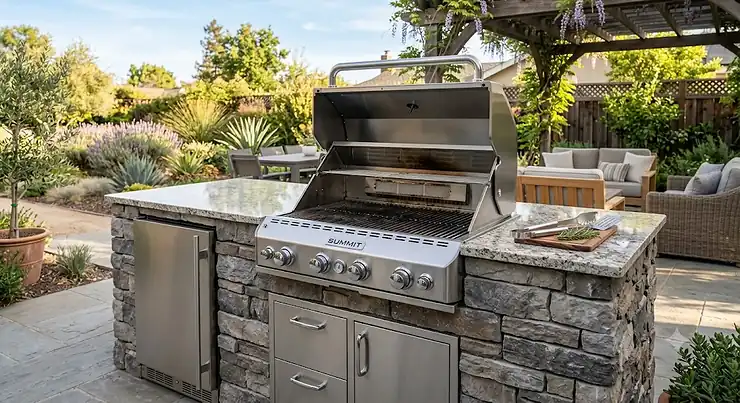
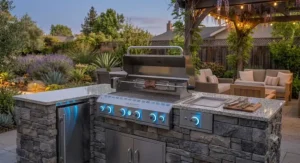
So you’ve decided your patio needs an upgrade, and somewhere between browsing pool decks on Pinterest and actually measuring your counter cutout, you landed on the phrase built-in grill insert. Good instinct. A built-in grill insert — sometimes called a drop-in grill head or island grill head — is the powerhouse that turns a stack of stone or a steel-framed island into an actual outdoor kitchen. Unlike a cart grill you wheel out of the garage, this thing gets bolted, dropped, and plumbed into a permanent cutout, and it’s not going anywhere for the next fifteen-plus years. That permanence is exactly why picking the right one matters more than picking the right toaster.
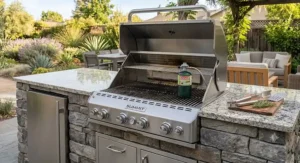
Here’s a quick working definition before we go further: a built-in grill insert is a grill head, minus the cart or legs, engineered to drop into a pre-cut opening in a masonry, steel-framed, or concrete outdoor kitchen island, connecting directly to a natural gas line or propane tank. Unlike freestanding grills, it has no wheels, no side panels, and usually no storage cabinet of its own — the island handles all of that.
We spent real hours digging through manufacturer spec sheets, owner reviews, and industry buying guides so you don’t have to cross-reference six browser tabs at 11 p.m. What follows is a genuinely researched breakdown of seven real, currently available models spanning entry-level workhorses to splurge-worthy luxury units, backed by actual BTU numbers, cooking surface dimensions, and aggregated reviewer sentiment — not marketing copy dressed up as advice. Whether you’re outfitting a compact patio island or building a full outdoor kitchen from scratch, you’ll walk away knowing exactly which built-in grill insert fits your space, your budget, and how often you actually plan to cook outside.
One more thing before the list: prices below are ranges, not exact figures, because retail pricing on grill heads shifts constantly with promotions, freight surcharges, and seasonal demand. Always check current price at checkout rather than trusting a number you read in an article.
Quick Comparison Table
Before we get into the deep dives, here’s the condensed version for anyone in a hurry.
| Grill | Price Range | Total BTU | Cooking Area | Best For |
|---|---|---|---|---|
| Bull Outlaw 30-Inch Drop-In | $1,300–$1,600 | 60,000 | ~575–810 sq in | Budget-conscious first-time builders |
| Coyote C-Series 28-Inch | $1,300–$1,600 | 40,000 | ~497–640 sq in | Small or narrow islands |
| Blaze Prelude LBM 32-Inch | $1,700–$1,950 | 56,000–66,000 | ~715–738 sq in | Commercial-style looks on a budget |
| Lion L75000 32-Inch | $2,100–$2,450 | 60,000–75,000 | ~830 sq in | Best accessory-bundled value |
| Napoleon Prestige PRO 825 | $4,000–$5,600 | 106,000–123,000 | ~1,245 sq in | Dual-zone infrared searing |
| DCS Series 9 36-Inch | $5,200–$6,700 | 75,000–89,000 | ~1,164 sq in | Ceramic-radiant precision cooking |
| Fire Magic Echelon Diamond E1060i | $9,500–$11,800 | 112,000–137,000 | ~1,056–1,440 sq in | USA-made luxury centerpiece |
Looking at the spread above, the jump in BTU and cooking surface between the entry-level Coyote C-Series 28-Inch and the flagship Fire Magic Echelon Diamond E1060i is almost fourfold, but that gap isn’t purely about raw power — it reflects burner metallurgy, hood insulation, and ignition redundancy that only show up after years of weekly use. Notice, too, that total BTU output doesn’t track price in a straight line; the Lion L75000 actually rivals some pricier grills on paper while undercutting them by thousands of dollars, which tells you specs alone are a poor shortcut for value.
💬 Just one click — help others make better buying decisions too!😊
Top 7 Built-In Grill Inserts: Expert Analysis
We picked these seven because they cover every realistic budget tier and use case we could find real, verifiable specs and review data for — no filler picks, no products that only exist as stock photos.
1. Bull Outlaw 30-Inch Drop-In — best value for raw grilling power
The Bull Outlaw 30-Inch Drop-In earns its budget-hero reputation by refusing to overcomplicate things: four burners, 60,000 combined BTUs, no infrared sear zone, no smart app. Built from 14-gauge 304 stainless steel, this grill puts out 60,000 BTUs across four welded stainless burners, delivering a cooking surface in the 575 to 810 square inch range depending on which retailer’s spec sheet you’re reading, plus a 176 to 210 square inch warming rack. In practice, that BTU-per-dollar ratio means you’re not paying a premium for features you’ll rarely touch — you’re paying for heat, and lots of it. Grillers who want to sear a dozen burgers for a backyard party without babysitting three temperature zones tend to gravitate here; it’s the pickup-truck of built-in grill insert options, dependable rather than flashy.
Owner reviews aggregated across retail sites consistently praise the dual-piece hood design for holding heat evenly and note the stainless build resists discoloration better than cheaper 430-grade competitors in the same price bracket. A recurring theme in customer feedback is appreciation for the straightforward, no-frills control layout, which several reviewers say makes the grill easy to hand off to a less experienced family member at a cookout.
Pros:
- ✅ Exceptional BTU output for the price bracket
- ✅ Heavy 14-gauge 304 stainless steel resists rust
- ✅ Simple controls that don’t require a manual
Cons:
- ❌ No infrared sear zone or heat separators
- ❌ Available cooking-area figures vary by retailer listing
Expect to pay in the $1,300 to $1,600 range depending on natural gas versus propane configuration and current promotions — at that price, it’s hard to beat the value if you don’t need dual-zone cooking.
2. Coyote C-Series 28-Inch — best compact grill head for a small outdoor island
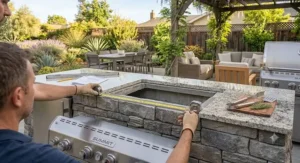
If your island cutout is tight, the Coyote C-Series 28-Inch deserves a serious look. This 28-inch built-in gas grill features 18-gauge 304 grade stainless steel construction with a double-walled canopy, powered by two cast stainless Infinity burners delivering up to 40,000 BTUs across a cooking area that retailers list anywhere from 497 to 640 square inches depending on measurement method. What that means day to day: the smaller footprint doesn’t sacrifice sear quality, since the cast Infinity burners run hotter per-burner than many tube-burner competitors at the same total BTU rating, and heat control grids spread that output evenly rather than leaving cold spots at the edges.
This is the grill head for outdoor island projects where square footage is the enemy — think condo patios, narrow side-yard kitchens, or a secondary grill station next to a primary smoker. Reviewers frequently mention the halogen interior lighting as genuinely useful rather than gimmicky, since it lets you monitor doneness after dark without a headlamp. A smaller subset of owners have flagged burner longevity concerns after several seasons of heavy use, which is worth factoring in if you grill nightly rather than on weekends.
Pros:
- ✅ Compact 28-inch footprint fits tight cutouts
- ✅ Cast stainless Infinity burners sear efficiently
- ✅ Halogen interior lighting for night grilling
Cons:
- ❌ Lower total BTU than most 30-inch-plus rivals
- ❌ Some owners report burner wear after years of daily use
Price typically lands between $1,300 and $1,600, with natural gas and propane versions priced close together — always confirm current price since Coyote runs frequent seasonal promotions.
3. Blaze Prelude LBM 32-Inch — best all-rounder for first-time outdoor kitchen builders
The Blaze Prelude LBM 32-Inch is arguably the most-recommended entry point into commercial-style grilling, and the spec sheet explains why. Four commercial-grade 304 stainless steel tube burners deliver 14,000 BTUs each for 56,000 BTUs total, paired with 8mm stainless cooking rods across roughly 715 to 738 square inches of grilling surface. Some listings add an optional 10,000 BTU infrared rear rotisserie burner, pushing total grill output toward 66,000 BTUs. Here’s what the spec sheet won’t spell out: those thick 8mm rods hold heat longer between flips than the thinner 6mm rods found on cheaper grills, which is the difference between a proper steakhouse crosshatch and faint gray lines.
Heat zone separators divide the cooking surface into independent temperature zones, so you can sear a ribeye on one side while keeping vegetables on gentle indirect heat on the other — a genuinely useful feature for anyone cooking for a mixed group of steak lovers and vegetarians. Reviewers across multiple retail platforms consistently highlight the lifetime residential warranty as a standout, along with praise for the push-and-turn flame-thrower ignition rarely misfiring even after a season of neglect between grilling weekends.
Pros:
- ✅ Heat zone separators enable true multi-temperature cooking
- ✅ Thick 8mm rods deliver steakhouse-quality sear marks
- ✅ Backed by an industry-leading lifetime warranty
Cons:
- ❌ No infrared sear burner included on base configuration
- ❌ Slightly narrower cooking area than some 32-inch rivals
Typical pricing runs $1,700 to $1,950, occasionally dipping lower during seasonal sales — this is one of the more frequent targets for manufacturer promotions, so timing your purchase can meaningfully change the number.
4. Lion L75000 32-Inch — best stainless value with a genuinely useful accessory bundle
The Lion L75000 32-Inch consistently shows up on “best value” shortlists, and the reasoning holds up under scrutiny. Four cast stainless steel burners deliver 60,000 BTUs of primary cooking power, backed by a 15,000 BTU infrared rotisserie burner, all wrapped in 16-gauge, double-layer 304 stainless steel with a seamless welded head. Total cooking space lands around 830 square inches when you combine the roughly 647 square inch main grate with the secondary warming area. What sets this model apart from budget competitors at a similar price isn’t just the metal gauge — it’s the bundled accessory package, which several retailers include at no extra charge and typically covers a rotisserie kit, grill cover, smoker box, and griddle insert worth several hundred dollars on their own.
Based on the spec comparison against the Bull Outlaw and Blaze Prelude LBM, the L75000 sits in an interesting middle ground: heavier-gauge steel than either, plus a rotisserie burner neither includes standard, for roughly $400 to $700 more. Aggregated owner reviews are largely positive on build quality and heat output even after years of coastal salt-air exposure, though a recurring complaint involves ignition reliability degrading over time and reports of uneven heat distribution across the cooking surface — worth noting if consistent edge-to-edge searing is a priority for you.
Pros:
- ✅ Bundled accessory package adds real dollar value
- ✅ Heavy 16-gauge double-layer 304 stainless construction
- ✅ Infrared rotisserie burner included standard
Cons:
- ❌ Some owners report ignition reliability issues over years of use
- ❌ Heat distribution described as uneven by a subset of reviewers
Expect a price range of roughly $2,100 to $2,450, which still undercuts several rivals offering less total cooking area for more money.
5. Napoleon Prestige PRO 825 — best dual-zone infrared searing setup
Step up into genuinely premium territory with the Napoleon Prestige PRO 825, a twin-head design that pairs a conventional tube-burner grill with a dedicated infrared sear station. One side runs four stainless tube burners at up to 48,000 BTUs, while the other houses two ceramic infrared burners producing 24,000 BTUs plus an 8,000 BTU warming tube between them; add the 18,000 BTU rear infrared rotisserie burner and total output climbs toward 106,000 to 123,000 BTUs depending on configuration. Cooking area totals roughly 1,245 square inches across the main and warming surfaces — genuinely large enough to feed a full backyard party without staging food in batches.
What most buyers overlook about this model is that the infrared side isn’t just for looks — ceramic infrared burners reach searing temperatures in under two minutes, which means you can finish a reverse-seared steak that was slow-roasted on the conventional side without ever losing the grill to preheat time. The integrated wood chip smoker tray adds real versatility too, letting you add smoke flavor without buying a separate smoker unit. Reviewers highlight the WAVE cooking grid pattern for consistently attractive sear lines and note the LED-lit control knobs as a genuinely useful safety feature after dark, since they glow to indicate an active burner.
Pros:
- ✅ Dedicated infrared sear station reaches high heat fast
- ✅ Integrated smoker tray adds real versatility
- ✅ Massive 1,245 square inch total cooking area
Cons:
- ❌ Significant price jump over mid-range competitors
- ❌ Twin-head design requires a wider island cutout
Pricing generally falls between $4,000 and $5,600 depending on fuel type and rear-burner configuration — a meaningful investment, but one that replaces what would otherwise be two separate appliances.
6. DCS Series 9 36-Inch — best ceramic-radiant heat control for precision cooking
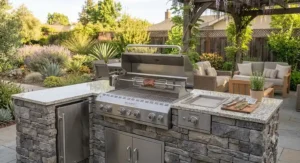
The DCS Series 9 36-Inch takes a different technical approach than everything else on this list. Three U-shaped stainless burners deliver 25,000 BTUs each for 75,000 BTUs total, but the standout feature is Ceramic Radiant Technology — a layer of ceramic rods sitting between the burners and the cooking grate that evens out heat across the entire surface rather than concentrating it directly above each burner. Total grill output including the optional infrared rotisserie burner reaches roughly 89,000 BTUs, spread across a double-sided cast stainless grate offering around 630 square inches of primary cooking space plus 534 square inches of secondary warming and broiling area.
Here’s what that ceramic layer means in practice: the spec sheet won’t tell you this, but user reports and professional reviews suggest it dramatically reduces the classic built-in grill insert problem of hot spots directly over burner tubes, letting you sear evenly across the full grate rather than only in narrow stripes. The reversible double-sided grates add genuine flexibility — flip to the curved side for delicate fish and vegetables, flip back to the W-shaped side for aggressive sear marks on steak. Reviewers consistently mention the patented grease management system as noticeably reducing flare-ups compared to standard flavorizer-bar designs.
Pros:
- ✅ Ceramic Radiant Technology eliminates hot-spot searing
- ✅ Reversible double-sided grates add real versatility
- ✅ Grease management system cuts down on flare-ups
Cons:
- ❌ Among the pricier options outside the true luxury tier
- ❌ Larger cutout footprint than mid-range 30-inch grills
Budget $5,200 to $6,700 for this one, with rotisserie and infrared upgrades pushing toward the top of that range.
7. Fire Magic Echelon Diamond E1060i — best luxury splurge, built in the USA
If money genuinely isn’t the constraint, the Fire Magic Echelon Diamond E1060i is where the built-in grill insert category tops out. This 48-inch grill packs cast stainless steel burners rated at 31,000 BTUs each — four of them, for roughly 112,000 to 115,000 BTUs of primary output — plus dual Quantum infrared backburners contributing another 22,000 BTUs for rotisserie cooking, pushing combined output well past 130,000 BTUs on some configurations. The primary cooking surface measures 48 by 22 inches (1,056 square inches), with an additional 384 square inch warming rack bringing total usable cooking real estate to roughly 1,440 square inches.
Based on the spec comparison against every other grill on this list, what justifies the price gap isn’t just raw BTU count — it’s the manufacturing pedigree. Fire Magic has built grills in the USA for over 85 years, and the Echelon Diamond line reflects that with trapezoidal Diamond Sear cooking grids designed to optimize heat transfer, a hot-surface ignition system that reviewers describe as dramatically more reliable than spark-ignition rivals, and a 15-year warranty that signals genuine confidence in long-term durability. The optional Magic View glass window lets you monitor food without losing heat by lifting the hood, a small feature that repeat buyers consistently cite as unexpectedly valuable for slow cooks and rotisserie sessions.
Pros:
- ✅ Industry-leading 15-year warranty on a USA-made grill
- ✅ Massive combined cooking and warming surface
- ✅ Hot-surface ignition rated more reliable than spark systems
Cons:
- ❌ Price puts it well out of reach for most first-time buyers
- ❌ 48-inch footprint demands a genuinely large island
Expect to pay $9,500 to $11,800 depending on burner configuration and the Magic View Window option — this is the grill head you buy once and never think about upgrading again.
Practical Installation Guide: Getting Your Built-In Grill Insert Set Up Right
Buying the grill is honestly the easy part. Getting a built-in grill insert installed correctly determines whether it lasts fifteen years or gives you problems by year three, so treat this stage with real care. Start by confirming your island cutout dimensions against the manufacturer’s exact spec sheet — not the general product description, the actual cutout diagram — because even a half-inch discrepancy can mean re-cutting stone or steel framing after the fact.
Next, get your gas line sized correctly before the grill arrives. Natural gas installations typically need a dedicated line run from your home’s meter, sized to handle the grill’s full BTU draw without pressure drop, which is a job for a licensed plumber rather than a DIY afternoon. Propane setups are simpler but still require a regulator rated for your total BTU output; undersizing the regulator is a common first-30-days mistake that shows up as weak, sputtering flames under high demand.
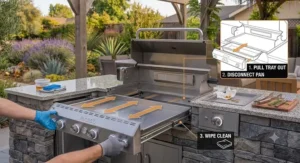
Once the grill is dropped in and connected, run a soap-and-water leak test on every fitting before your first cook — bubbles mean a leak, full stop. For the first few uses, expect slightly uneven heat as the grates season and burner ports clear of manufacturing residue; most manufacturers recommend a 15 to 20 minute high-heat burn-off before cooking anything. A maintenance schedule worth adopting: wipe down grates after every use while they’re still warm, deep-clean the burner tubes and drip tray every four to six weeks during grilling season, and inspect gas connections for wear at least twice a year.
Real-World Scenarios: Which Built-In Grill Insert Fits Your Life
Specs only tell half the story, so let’s match a few realistic buyer profiles to the products above. If you’re a young family in a starter home hosting maybe two backyard barbecues a month on a tight renovation budget, the Bull Outlaw 30-Inch Drop-In or Coyote C-Series 28-Inch make the most financial sense — both deliver genuinely reliable heat without stretching a first-time outdoor kitchen budget thin.
If you’re renovating a mid-size suburban patio and entertain regularly enough that a single-zone grill feels limiting, the Blaze Prelude LBM 32-Inch or Lion L75000 32-Inch hit a sweet spot: enough BTU headroom for larger groups, heat zone flexibility, and accessory bundles that reduce the total cost of building out a fuller outdoor kitchen. A couple in this position who host monthly dinner parties with eight to twelve guests will likely find the extra 15,000 BTU rotisserie burner on the Lion genuinely gets used, not just admired.
If you’re building a serious outdoor kitchen as the centerpiece of your home’s entertaining space — the kind with a pizza oven, beverage fridge, and full bar already planned — the Napoleon Prestige PRO 825, DCS Series 9 36-Inch, or Fire Magic Echelon Diamond E1060i justify their price through the sheer volume and versatility they add. A household hosting large gatherings weekly, or a homeowner planning to stay in the house for a decade or more and wants a grill that ages gracefully, is exactly the buyer these premium units are engineered for.
✨ Don’t Miss These Exclusive Deals!
🔍 Take your outdoor kitchen build to the next level with these carefully selected grill inserts. Click on any highlighted model to check current pricing and availability. These grills will help you create the backyard cookouts your family and friends will actually talk about
How to Choose a Built-In Grill Insert
What is a built-in grill insert, in the most practical sense? It’s the appliance that determines nearly everything else about your outdoor kitchen build, from the size of your cutout to your gas line requirements, so getting the selection criteria right up front saves real money later. Here’s the process worth following, step by step:
- Measure your available cutout space first, including clearance behind and beside the grill for hood swing and ventilation — never buy the grill before confirming it physically fits.
- Decide between natural gas and propane based on whether you already have a gas line to the patio; retrofitting a line later is far more expensive than running it during initial construction.
- Set a realistic total BTU target based on party size — as a rough baseline, 400 to 500 BTUs per person you regularly cook for keeps searing power comfortable without overbuying.
- Prioritize stainless steel grade over flashy features; a 304-grade grill from a budget brand will outlast a feature-loaded 430-grade grill from a flashier one.
- Factor in secondary features like infrared sear zones or rotisserie burners only after core heat and build quality are locked in, since these add cost fast.
- Check warranty length and what it actually covers — burners, body, and grates often carry different coverage periods within the same warranty.
- Read aggregated owner reviews specifically for ignition reliability and heat evenness, since these two issues show up disproportionately in long-term complaints across every price tier.
| Feature | Value | Analysis |
|---|---|---|
| Fuel Type | Natural Gas / Propane | Natural gas costs less per BTU long-term but requires a dedicated line |
| Steel Grade | 304 vs 430 stainless | 304 resists corrosion significantly better in outdoor exposure |
| BTU Range | 40,000–137,000 | Higher isn’t automatically better — match to typical party size |
| Best For | Varies by model | See individual product breakdowns above |
The table above underscores a point worth repeating: fuel type and steel grade often matter more for long-term satisfaction than raw BTU count, since a poorly ventilated high-BTU grill can actually cook less consistently than a well-designed lower-output model. If you’re deciding between natural gas and propane and haven’t run a gas line yet, that decision alone should come before you even shortlist specific grill heads.
Drop-In Grill Insert Reviews: What Owners Actually Report Across Brands
Reading manufacturer marketing only gets you halfway to an informed decision, so let’s talk about what aggregated drop-in grill insert reviews consistently reveal once the honeymoon period wears off. Across the budget and mid-range tiers, reviewers report solid overall satisfaction with build quality but flag two recurring pain points: ignition systems that grow less reliable after two to three seasons of exposure, and heat distribution that can skew uneven near the edges of wider cooking surfaces. Reviewers consistently note that push-and-turn flame-thrower ignition systems tend to outlast simple spark-button designs, which is worth checking on the spec sheet before you buy.
On the premium end, real customer feedback shifts toward praising features like ceramic radiant heat, infrared sear zones, and hot-surface ignition for solving exactly those budget-tier complaints — which tracks with the price difference, since manufacturers are literally engineering around the most common failure points. A common complaint in user reviews across nearly every brand and price point, though, involves the initial burn-in period: expect somewhat inconsistent heat for the first several cooks as burner ports clear and grates season, regardless of how much you spent.
Grill Head BTU Rating Explained: What the Numbers Actually Mean
Grill head BTU rating gets treated as the single most important spec by casual shoppers, and while it matters, it’s frequently misunderstood. A BTU, or British Thermal Unit, measures the amount of heat energy a burner can theoretically produce per hour — it does not directly measure how hot your food gets, how evenly it cooks, or how efficiently that heat actually reaches the grate. Two grills rated at the same total BTU can perform very differently depending on burner design, grate material, and hood insulation.
What matters more in practice is BTU-per-square-inch of cooking surface, since that ratio tells you how concentrated the heat actually is. A grill rated at 60,000 BTUs across 500 square inches will generally feel hotter and sear faster than a 60,000 BTU grill spread across 900 square inches, even though the total number on the box is identical. As a rough shopping benchmark, most quality built-in grill insert models land somewhere between 80 and 120 BTUs per square inch; anything meaningfully below that range may struggle to sear steaks properly on a cold or windy day.
Built-In Grill Head Natural Gas vs Propane: Which Fuel Wins?
The built-in grill head natural gas versus propane debate comes down to trade-offs rather than a clear winner. Natural gas connects to your home’s existing gas line, meaning you never run out mid-cookout and never haul a tank to the hardware store for a refill — genuinely convenient once it’s installed. However, running a dedicated gas line to your patio is a real upfront cost, often several hundred to over a thousand dollars depending on distance from your meter and local labor rates.
Propane, by contrast, requires no gas line installation at all — just a standard tank connection — which makes it the faster and cheaper option for a straightforward build. The trade-off is ongoing tank refills and, per BTU, propane typically costs somewhat more than natural gas over the life of the grill, so heavy year-round grillers often find natural gas pays for its installation cost within a few years. If you’re gutting an outdoor kitchen from scratch and don’t yet have a gas line, the Department of Energy’s overview of residential natural gas is a useful starting point for understanding installation and supply basics before committing either way.
Top Rated Grill Insert Stainless Steel: 304 vs 430 and Why It Matters
When shoppers search for a top rated grill insert stainless steel option, they’re usually asking the right question without realizing it — the steel grade matters more than almost any other spec on the sheet, because it directly determines how long your investment survives outdoor exposure. Most quality built-in grill inserts, including every model reviewed above, use 304-grade stainless steel, which contains roughly 18% chromium and 8% nickel, giving it strong resistance to rust and pitting even with regular exposure to rain, humidity, and grease. Budget grills sometimes substitute 430-grade stainless, which looks similar out of the box but lacks the nickel content that gives 304 its long-term corrosion resistance, meaning it can develop surface rust and discoloration noticeably faster, especially near coastal areas with salt air. For a deeper technical breakdown of how different stainless alloys resist corrosion, Wikipedia’s overview of 316L stainless steel is a solid reference, since it explains the alloying principles that also apply to comparing 304 against lower grades.
Gauge thickness matters alongside grade — a thinner 18-gauge 304 sheet will dent and warp under heat cycling faster than a heavier 14-gauge sheet of the same grade, which is part of why the Bull Outlaw’s 14-gauge construction punches above its price point.
Common Mistakes When Buying a Grill Head for an Outdoor Island
Even careful shoppers stumble on a few predictable pitfalls when selecting a grill head for outdoor island installation. The single most common mistake is buying the grill before finalizing island dimensions, which locks you into a cutout size that may not actually fit your preferred model — measure the island first, or at minimum, choose your grill and design the island cutout around its exact spec sheet.
A second frequent error is underestimating gas line or regulator sizing, which shows up later as weak flame output under high demand, especially frustrating when you’re mid-sear for a dinner party. Third, buyers often skip reading warranty fine print, only to discover burners are covered for a fraction of the time the grill body is warrantied, leaving them exposed to a costly replacement part years before expected. Finally, many first-time buyers chase the highest BTU number available without matching it to realistic cooking needs, ending up with a grill that’s overkill for their household size and, in some cases, actually harder to control at low, indirect-heat settings.
Island Grill Head Replacement: When and How to Swap Your Insert
Eventually, even a well-maintained grill reaches the end of its useful life, and island grill head replacement becomes the more sensible move than continuing to nurse an aging unit. Warning signs worth watching for include persistent uneven heat that cleaning and burner replacement don’t fix, visible rust penetrating past the surface into the steel structure itself, and ignition systems that fail more often than they succeed despite fresh batteries or igniter replacement.
The good news is that most built-in grill insert models are designed with standardized cutout dimensions within a given size class, meaning a 30-inch replacement grill will often drop into an existing 30-inch cutout with minimal modification. Before ordering a replacement, measure your existing cutout precisely and cross-reference it against the new model’s spec sheet, paying close attention to depth as well as width, since depth mismatches are the most common reason a replacement doesn’t fit cleanly. If your gas connections are more than a decade old, this is also a smart moment to have a professional inspect and potentially replace aging fittings rather than reusing them with a brand-new grill head.
Modular Outdoor Kitchen Planning: Building Around Your Grill Insert
If you’re approaching this as part of a larger modular outdoor kitchen build, the grill insert should genuinely be the first component you finalize, not an afterthought squeezed into leftover space. Modular outdoor kitchen systems are built from prefabricated cabinet modules — grill module, sink module, storage module, refrigeration module — that snap together into a custom layout without full masonry construction, which makes them significantly faster and often cheaper to install than a fully built stone island.
Once your grill insert is selected, its exact cutout width dictates which modular grill cabinet you order, and that module’s width then anchors the rest of your layout. A practical rule of thumb: leave at least 12 to 24 inches of counter space on at least one side of the grill module for landing hot food and prep work, and never place a refrigeration module directly adjacent to the grill without an insulating buffer module between them, since sustained heat exposure can shorten a compact fridge’s lifespan. Proper ventilation matters just as much in modular builds as in poured-concrete islands — BBQGuys’ outdoor kitchen ventilation buying guide breaks down vent panel placement by fuel type in more detail than we have room for here.
Long-Term Cost & Maintenance
Sticker price is only the opening bid in the total cost of owning a built-in grill insert. Annual maintenance costs are relatively modest if you stay on top of them — a cleaning kit, occasional grate replacement, and periodic gas fitting inspection typically run under $150 a year for most homeowners. Where costs escalate is neglect: allowing grease to build up in burner tubes can lead to clogged ports and uneven flame, sometimes requiring a $200 to $400 professional cleaning or burner replacement that routine upkeep would have avoided entirely.
Fuel costs favor natural gas over the long haul for frequent grillers, often saving $50 to $150 annually compared to propane tank refills depending on regional pricing and usage frequency, though that advantage only materializes after covering the upfront line installation cost. Cost-per-use is worth calculating honestly: a $10,000 luxury grill used weekly for fifteen years amortizes to roughly $13 per cook, while the same grill used twice a year balloons past $130 per cook — a useful gut check before chasing the flagship model out of aspiration rather than actual grilling frequency.
Safety, Ventilation & Regulations for Built-In Grill Inserts
Safety isn’t optional with any gas-fired built-in grill insert, and getting ventilation wrong is genuinely dangerous rather than a minor inconvenience. Propane is heavier than air and pools at the bottom of an enclosed island if it leaks, while natural gas is lighter and rises, meaning vent panel placement differs depending on which fuel you’re running — get this backwards and you’re creating a real explosion risk rather than a hypothetical one. The U.S. Consumer Product Safety Commission’s grill safety guidance outlines the core precautions every gas grill owner should follow, including regularly inspecting hoses for cracking and checking connections for leaks with a simple soap-and-water test.
Beyond ventilation, local and national building codes govern clearances to combustible materials, minimum gas pipe exposure at connection points, and, in many jurisdictions, permitting requirements for new gas line runs. The International Code Council’s guidance on outdoor kitchen code requirements is a genuinely useful resource for understanding what inspectors actually check before signing off on a build. Always follow the specific clearance and ventilation instructions in your grill’s installation manual over any general guideline, since manufacturer specifications are typically the strictest — and most legally binding — requirement in the mix.
Frequently Asked Questions
❓ How much does a built-in grill insert cost on average?
❓ Can I convert a natural gas grill head to propane?
❓ What size built-in grill insert do I need for a family of four?
❓ How long does a built-in grill insert typically last?
❓ Do built-in grill inserts need a professional installer?
Conclusion
Choosing the right built-in grill insert really comes down to matching honest specs to how you actually plan to use your outdoor kitchen, not chasing the biggest BTU number on the shelf. The Bull Outlaw 30-Inch Drop-In and Coyote C-Series 28-Inch deliver genuine value for budget-conscious first builds, the Blaze Prelude LBM 32-Inch and Lion L75000 32-Inch hit a smart middle ground for regular entertainers, and the Napoleon Prestige PRO 825, DCS Series 9 36-Inch, and Fire Magic Echelon Diamond E1060i justify their price tags for households ready to make outdoor cooking a serious part of daily life.
Whichever model you land on, don’t skip the unglamorous parts — accurate cutout measurements, correctly sized gas lines, and proper ventilation matter just as much as the burner count on the spec sheet. Get those fundamentals right, and any grill on this list should serve your family well for well over a decade of backyard cookouts.
Recommended for You
- Built-In Grill for Outdoor Kitchen: 7 Best Picks for 2026
- Best Built-In Gas Grill 2026: 7 Top Picks
- 7 Best Portable Gas Grills for Beach Trips in 2026
Disclaimer: This article contains affiliate links. As an Amazon Associate, I earn from qualifying purchases. If you purchase products through these links, we may earn a small commission at no additional cost to you.
✨ Found this helpful? Share it with your friends! 💬🤗
