
In This Article
Somewhere around the third time you’ve had to abandon a half-cooked rack of ribs to sprint to the hardware store for a propane tank, the question starts nagging at you: is there a better way to do this? That’s the exact fork in the road anyone comparing a propane vs natural gas grill eventually reaches, and it’s rarely as simple as “one is just better.” Propane gives you a grill that goes anywhere your patio does — no plumbing, no permits, just a tank and a dream. Natural gas ties you to a fixed line that never runs dry mid-cookout, at the cost of a one-time install bill and zero portability. Neither is wrong. They’re built for different backyards, different budgets, and honestly, different personalities of griller.

We spent our research digging into real product specs, aggregated owner feedback, and current installation-cost data so you’re not just guessing based on a salesperson’s pitch. Below you’ll find seven real grills spanning budget to premium, four comparison tables you can actually use to make a decision, and a full breakdown of BTU output, conversion costs, and the hidden line items nobody mentions until you’re halfway through a Saturday project. According to the U.S. Energy Information Administration, heat content is measured in British thermal units, and that single unit of measurement is going to explain almost everything else in this article — so keep it in your back pocket as you read on.
Quick Comparison Table
| Factor | Propane | Natural Gas |
|---|---|---|
| Upfront cost | Lower (grill only) | Higher (grill + line install) |
| Portability | Excellent — move it anywhere | None — fixed to gas line |
| Fuel cost per cookout | Higher per BTU | Lower per BTU |
| Refueling | Tank swaps/refills required | Unlimited, never runs out |
| BTU per cubic foot | ~2,500 | ~1,030 |
| Best For | Renters, first homes, tailgating | Permanent outdoor kitchens |
Look at this table long enough and the pattern becomes obvious: propane wins on flexibility and low commitment, while natural gas wins on convenience once it’s installed. The BTU gap looks dramatic, but as we’ll cover later, manufacturers compensate with larger orifices on natural gas models, so real-world cooking heat ends up closer than the raw numbers suggest. If you’re renting, moving within five years, or don’t already have a gas line near your patio, propane is the pragmatic default — natural gas only pulls ahead once the infrastructure is already sunk into your property.
💬 Already leaning one way? Compare the exact models below before you commit to a tank size or a trench in your lawn.
What Is a Propane vs Natural Gas Grill?
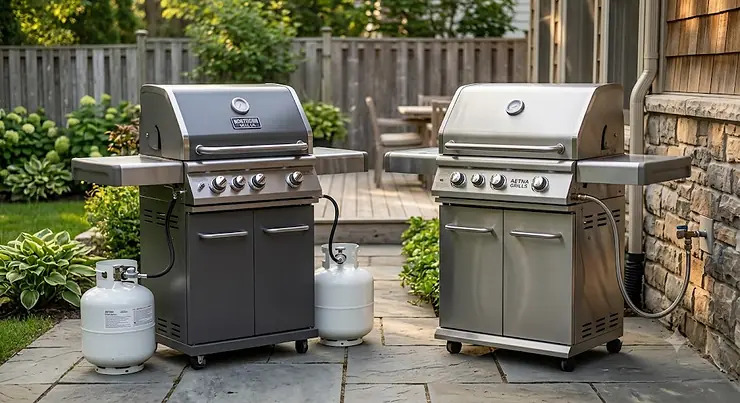
A propane grill runs on liquid propane (LP) stored in a portable, refillable tank, while a natural gas grill connects permanently to your home’s utility gas line and never needs refueling. Both burn gas through the same basic burner design, but the orifice sizes, regulators, and hose fittings are fuel-specific and generally not interchangeable without a certified conversion kit.
That distinction matters more than it sounds like it should. A grill built for propane and one built for natural gas can look identical on a showroom floor — same knobs, same stainless lid, same price tag on the sticker — but underneath, the plumbing is tuned for a completely different fuel density. Swap fuels without converting the orifices and you’ll either starve the burner of gas (weak, sputtering flames on natural gas) or flood it (dangerous over-fueling if you force propane through a natural-gas-sized orifice). That’s precisely why the manufacturer conversion kit exists as its own product category, and why we cover it in detail further down.
Top 7 Propane and Natural Gas Grills: Expert Analysis
We picked these seven specifically because they span budget to premium, several of them ship in both fuel configurations, and a few even the enthusiast crowd tends to overlook.
1. Nexgrill 4-Burner Gas Grill with Side Burner — cheapest true entry point
The standout here is simple: full four-burner functionality plus a dedicated side burner for sauces, all for a price that usually undercuts single-burner “premium” models by half. Its four stainless burners combine for roughly 36,000 BTUs across around 600 square inches of primary cooking space, which is respectable output for weeknight burgers and the occasional backyard crowd. The porcelain-coated cast-iron grates hold heat evenly enough that you won’t get the cold spots that plague cheaper grates stamped from thin steel.
Based on the spec sheet, this is the grill for someone who wants a genuinely functional four-burner setup without financing a patio purchase. Reviewers consistently report that assembly takes longer than the box suggests — budget a full two hours with a second set of hands — but that the ignition system and heat retention outperform the price point once it’s together. A recurring complaint in user reviews is that the exterior cart hardware shows wear faster than the cooking components do, which tracks with a grill engineered to prioritize function over finish.
Pros:
- ✅ Four burners plus side burner at a budget price point
- ✅ Roughly 600 square inches handles family-sized cookouts
- ✅ Porcelain-coated cast-iron grates distribute heat evenly
Cons:
- ❌ Cart hardware shows wear faster than main components
- ❌ Assembly instructions are thinner than the parts list suggests
Expect to pay in the $250-$350 range depending on retailer promotions; for a first grill or a rental-property patio, the value case here is hard to beat.
2. Char-Broil Performance Series 4-Burner — easiest natural gas conversion
What most buyers overlook about this model is that it’s one of the more straightforward propane grills to convert to natural gas later, since Char-Broil’s orifice spacing is common enough that aftermarket conversion kits are cheap and widely stocked. At around 36,000 BTUs across four burners with a built-in temperature gauge on the lid, it delivers accurate heat feedback that budget grills often skip entirely.
The porcelain-coated grates and firebox resist the rust that plagues bare-steel competitors in this price tier, which matters if your patio sees real weather. Reviewers consistently note that the integrated lid thermometer runs a touch warm compared to grate-level temperature, so experienced owners recommend cross-checking with an instant-read thermometer for the first few cooks until you learn the offset. Common feedback also praises the swing-away warming rack, though a few owners mention the side shelves feel flimsy under heavier prep tasks.
Pros:
- ✅ Common orifice pattern makes natural gas conversion simple
- ✅ Built-in lid thermometer gives real temperature feedback
- ✅ Porcelain-coated firebox resists rust in humid climates
Cons:
- ❌ Lid thermometer reads warmer than actual grate temperature
- ❌ Side shelves feel flimsy under heavier prep loads
Price typically falls in the $300-$400 range, with a separate natural gas conversion kit adding roughly $40-$80 if you go that route later.
3. Weber Spirit II E-310 — best factory-built dual-fuel option
The Weber Spirit II E-310 is one of the few mid-range grills you can order factory-built for either propane or natural gas, which removes the conversion-kit guesswork entirely. Its GS4 grilling system delivers roughly 30,000 BTUs across three burners, and Weber’s angled Flavorizer bars catch drippings to create smoke flavor while reducing flare-ups — a detail that shows up in real cooking, not just marketing copy.
On paper, this means you’re paying a premium over the Nexgrill and Char-Broil models specifically for engineering consistency: porcelain-enameled cast-iron cooking grates, a stainless steel burner tube system rated for extended service life, and a compact footprint that suits smaller patios. Aggregated owner sentiment is notably positive on longevity, with many reviewers reporting a decade or more of reliable service, though a recurring theme is that the “II” electronic ignition system occasionally needs a manual light with a match on humid days.
Pros:
- ✅ Available factory-built in propane or natural gas versions
- ✅ Flavorizer bars reduce flare-ups and add authentic smoke flavor
- ✅ Long owner-reported lifespan on burner tubes and grates
Cons:
- ❌ Electronic ignition occasionally fails in humid conditions
- ❌ Smaller cooking area than similarly priced competitors
Expect a price in the $550-$650 range for either fuel version — a rare case where you’re not paying extra to skip the conversion-kit step.
4. Monument Grills Mesa II — fastest heat-up in its class
The Advanced Broil Zone on the Monument Grills Mesa II genuinely rivals sear stations found on grills costing twice as much, and independent testing clocked it reaching 500°F in under five minutes — quicker than most indoor ovens. That kind of recovery speed matters more than it sounds like it should when you’re searing multiple steaks back-to-back for a dinner party.
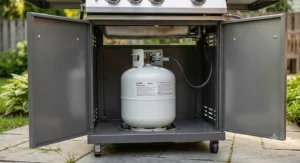
Its 304 stainless burners are built to resist the corrosion that eventually eats through lower-grade steel, and the enameled cast-iron grates spread heat evenly enough to avoid the classic “hot middle, cold edges” problem common in budget four-burners. Reviewers consistently praise the enclosed cabinet for keeping the propane tank shielded from weather, and foldable side shelves make it workable on tighter patios. A common thread in feedback is that the printed assembly instructions lag behind the actual hardware, so first-time builders lean on video guides instead.
Pros:
- ✅ Reaches 500°F in under five minutes for fast searing
- ✅ 304 stainless burners resist long-term corrosion
- ✅ Enclosed cabinet protects the tank and looks premium
Cons:
- ❌ Printed assembly instructions are thinner than the hardware needs
- ❌ Newer brand means a smaller long-term track record
Price generally lands in the $450-$550 range, making it one of the better value-to-performance ratios in the mid-tier.
5. Cuisinart 3-in-1 Stainless 5-Burner Grill — most versatile cooking surface
The Cuisinart 3-in-1 Stainless 5-Burner Grill stands out for combining a traditional grate section with a griddle zone and a dedicated sear burner, effectively replacing three separate outdoor appliances with one footprint. Five burners deliver a combined BTU output well above the four-burner competitors here, translating into faster preheat times across a genuinely large total cooking surface.
What most buyers overlook about combo grills is that griddle and grate zones heat at slightly different rates, so this model rewards a little practice zoning your food — pancakes on the griddle side while steaks finish on the grate side, timed so everything lands on the table together. Based on the spec comparison, this is the pick for anyone who cooks a wide variety of foods rather than steaks and burgers exclusively; aggregated reviews highlight the griddle’s usefulness for breakfast cookouts, while some owners note the flat-top surface needs more frequent seasoning maintenance than a standard grate.
Pros:
- ✅ Combines grill, griddle, and sear burner in one unit
- ✅ Five burners provide strong total BTU output
- ✅ Griddle zone opens up breakfast and stir-fry style cooking
Cons:
- ❌ Griddle surface requires more frequent seasoning upkeep
- ❌ Larger footprint demands more patio space than single-purpose grills
Typical pricing sits in the $600-$700 range, which is reasonable considering it functionally replaces two additional appliances.
6. Weber Genesis E-325s — best overall for serious grillers
The Weber Genesis E-325s earns its reputation through PureBlu burners rated at roughly 39,000 BTUs across three primary burners plus a dedicated sear station, backed by a 12-year warranty that signals genuine confidence in the build. It’s also one of the cleanest conversion candidates on this list — Weber sells a dedicated, pre-drilled natural gas conversion kit specific to this model, avoiding the universal-kit guesswork that causes problems on off-brand grills.
Here’s what the spec sheet won’t tell you, but owners consistently report: the iGrill-compatible temperature probes turn multi-zone cooking (searing a steak while slow-roasting a chicken) into something approachable rather than a juggling act. Reviewers overwhelmingly praise even heat distribution and the durability of the stainless cook box, though a recurring critique is that the total package price puts it out of reach for casual weekend grillers who don’t cook outdoors several times a week.
Pros:
- ✅ 12-year warranty reflects genuine build-quality confidence
- ✅ Dedicated pre-drilled conversion kit simplifies switching fuels
- ✅ iGrill probe compatibility supports true multi-zone cooking
Cons:
- ❌ Premium price puts it out of reach for occasional grillers
- ❌ Conversion kit is an added cost if you switch fuels later
Price generally runs in the $1,000-$1,300 range depending on configuration, with the natural gas conversion kit adding roughly $100-$150 if purchased separately.
7. Napoleon Prestige 500 — best lifetime-warranty value
The Napoleon Prestige 500 backs nearly every component with a lifetime warranty, an unusually aggressive guarantee that few competitors in this price bracket are willing to match. Its rear infrared burner is purpose-built for rotisserie cooking, giving it a genuine edge for anyone who wants restaurant-style rotisserie chicken without buying separate equipment.
On paper, the standout value angle is that Napoleon offers this grill natural-gas-ready straight from the factory for only a modest premium over the standard propane version — a detail that undercuts the usual assumption that natural gas always costs meaningfully more upfront. Aggregated owner feedback frequently highlights the even heat distribution from the stainless burners and praises Napoleon’s customer support for parts and troubleshooting, while some reviewers note the assembly process, while thorough, takes longer than competing premium models due to the number of included accessories.
Pros:
- ✅ Lifetime warranty covers most components, not just burners
- ✅ Natural-gas-ready factory configuration for a small premium
- ✅ Rear infrared burner enables true rotisserie cooking
Cons:
- ❌ Longer assembly time than comparable premium competitors
- ❌ Rotisserie kit accessories add to overall footprint
Expect a price range around $1,000-$1,200, positioning it as a direct rival to the Weber Genesis E-325s with a different feature emphasis.
Top 7 Products Comparison
| Product | Burners | BTU (approx.) | Fuel Options | Best For |
|---|---|---|---|---|
| Nexgrill 4-Burner | 4 + side | ~36,000 | Propane | Tightest budgets |
| Char-Broil Performance | 4 | ~36,000 | Propane (easy NG convert) | First-time conversion |
| Weber Spirit II E-310 | 3 | ~30,000 | Propane or factory NG | No-hassle dual fuel |
| Monument Grills Mesa II | 4 + sear | Varies by zone | Propane | Fast searing on a budget |
| Cuisinart 3-in-1 | 5 | High combined | Propane | Variety cooking |
| Weber Genesis E-325s | 3 + sear | ~39,000 | Propane w/ NG kit | Serious weekly grillers |
| Napoleon Prestige 500 | 4 + infrared rear | High combined | Propane or factory NG | Rotisserie + lifetime warranty |
Scanning this table, the clearest split is between grills that ship ready for either fuel out of the box — the Weber Spirit II E-310 and Napoleon Prestige 500 — versus grills that require an aftermarket conversion kit to switch, like the Weber Genesis E-325s. If avoiding a conversion project entirely matters to you, that factory-built distinction should weigh more heavily than raw BTU numbers. Budget shoppers will notice the Nexgrill and Char-Broil models cluster around similar BTU output despite the price gap, meaning you’re mostly paying for build materials and conversion-friendliness rather than raw cooking power.
💬 Just one click — help others make better buying decisions too! 😊
Propane Grill vs Natural Gas Grill Comparison
Put side by side, the propane grill vs natural gas grill comparison really comes down to a trade between upfront simplicity and long-term convenience, and the “winner” genuinely depends on how long you plan to stay in your current home. Propane wins the portability argument outright — toss it in a truck bed for a tailgate, roll it to a new deck layout on a whim, or take it with you when you move. Natural gas wins the “I never think about fuel again” argument, since a properly installed line means you’ll never again discover an empty tank thirty seconds after you’ve oiled the grates.
Where it gets more nuanced is cost over time. Propane runs roughly $28-$32 per million BTUs consumed, while natural gas typically lands around $15-$25 per million BTUs in most U.S. markets — meaning natural gas usually costs less per cookout once the line is installed, but that installation cost has to be earned back through years of grilling before it pays for itself. For someone who grills twice a month, that payback period can stretch well past a decade; for someone who grills three or four nights a week, it can shrink to just a couple of years. Reviewers and industry sources alike tend to agree that the decision should be driven by grilling frequency and how long you’ll stay in the home, not by which fuel sounds more “modern.”
Should I Buy Propane or Natural Gas Grill? How to Choose
If you’re wondering whether you should buy a propane or natural gas grill, run through this sequence before you commit:
- Check whether a gas line already exists near your patio. If your home has an existing outdoor gas connection (common near fire pits or outdoor kitchens), natural gas becomes far cheaper to set up than starting from scratch.
- Estimate your grilling frequency. Grilling more than twice a week tips the math toward natural gas, since fuel savings accumulate faster and offset the install cost sooner.
- Factor in how long you’ll stay in the home. Renters or anyone planning to move within a few years should lean propane — you can’t take a gas line with you, but a propane grill goes wherever you go.
- Price the installation realistically. Budget $600-$1,300 for a new line if none exists, and add permit fees where required by your municipality.
- Decide if portability matters for your lifestyle. Tailgaters, campers, and anyone who entertains at rental properties or a second home should prioritize propane regardless of the other factors.
- Consider resale and home value. A permanently plumbed outdoor kitchen with natural gas can be a selling point for a forever home, while propane keeps things flexible for a starter property.
- Match the grill, not just the fuel. Once you’ve picked a fuel, choose from the models above that ship ready for it, rather than buying first and converting later.
BTU Heat Output Comparison: Propane vs Natural Gas
| Fuel | BTU per Cubic Foot | Notes |
|---|---|---|
| Propane | ~2,500-2,516 | Higher energy density, smaller orifices |
| Natural Gas | ~1,030-1,037 | Lower density, larger orifices compensate |
| Practical Cooking Heat | Roughly equal | Manufacturers size orifices per fuel |
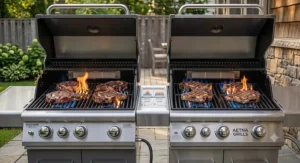
The raw numbers make propane look like the clear heat-output winner, and per cubic foot, it genuinely is — natural gas delivers less than half the energy density. But grill engineers aren’t working with amateur math: natural gas models ship with larger burner orifices specifically to push more volume through and compensate for the lower density, so a properly designed 30,000-BTU natural gas burner and a properly designed 30,000-BTU propane burner will sear a steak with essentially the same intensity. The only place the BTU gap actually bites you is in an improperly converted grill, where mismatched orifices leave the burner underfed and struggling to hit searing temperatures.
Gas Line Installation Cost: What to Budget
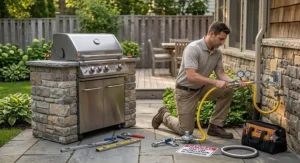
Installing a dedicated natural gas line for an outdoor grill typically costs between $600 and $1,300 on average, with most homeowners landing closer to $700 once permits and minor site prep are included. Per linear foot, expect roughly $20-$25 for flexible tubing routed under a deck or across a yard, with underground trenching adding cost if your local code requires burial depths of 18-24 inches.
Several variables swing that number meaningfully. A short run from an existing outdoor kitchen gas stub might cost as little as $200-$300, while a long trenched run from a home’s main supply to a detached patio can push toward $1,500-$2,000 once excavation and landscaping repair are factored in. Permit and inspection fees typically add another $50-$200 on top, and it’s worth budgeting for a licensed plumber or gas fitter rather than attempting the work yourself — most municipalities require professional installation and a pressure test before signing off on the line.
Fuel Portability: Which Wins When You’re On the Move
Propane’s biggest structural advantage is that the fuel source travels with the grill, full stop. A 20-pound tank swap takes under five minutes at nearly any grocery store, hardware store, or gas station, and portable 1-pound canisters make tabletop and camping grills genuinely mobile in a way natural gas simply cannot replicate. If your grilling life includes tailgates, campsites, a vacation property, or a rental where you can’t modify the gas infrastructure, this isn’t a close comparison — propane is the only realistic option.
Natural gas, by design, sacrifices all of that mobility in exchange for permanence. Once the line is installed, the grill effectively becomes a fixed appliance, similar to a built-in oven — you’re not moving it to a different corner of the patio without another plumbing project, let alone taking it to a new address. That’s a fair trade for someone building a permanent outdoor kitchen in a forever home, but it’s worth being honest with yourself about how often your grilling actually happens somewhere other than your own backyard before ruling propane out.
✨ Don’t Miss These Exclusive Deals!
🔍 Take your backyard grilling to the next level with these carefully selected models above. Click on any highlighted product to check current pricing and availability before you decide on a fuel type. The right grill will help you create the kind of effortless cookouts your family actually looks forward to!
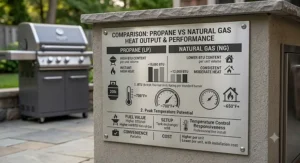 fPropane Gas Grills
How to Convert a Propane Grill to Natural Gas: Practical Usage Guide
Converting an existing propane grill to natural gas is a realistic weekend project on models with manufacturer-supported kits, but it is not universal, and attempting it on an unsupported model is a genuine safety risk rather than a shortcut. Start by confirming your exact model number and manufacture year — as multiple grill parts suppliers note, Weber alone has used several different orifice sizes across its product history, and a “universal” kit claiming compatibility with a broad range of models should be treated with real skepticism.
Once you’ve sourced the correct kit, the swap generally involves replacing the burner orifices with ones drilled to natural gas specifications, installing the included natural gas hose and low-pressure regulator, and connecting to your home’s gas line via a quick-disconnect fitting. Budget 30-60 minutes for the physical work if you’re reasonably handy, plus time to test every connection with a soapy water solution and watch for bubbles indicating a leak before you ever light the burners. A common first-30-days mistake is skipping the air-shutter adjustment on the burner tubes after conversion — natural gas burns differently enough that flame color and height need to be rechecked and tuned, not just left as they were on propane. If in doubt, or if your model has no manufacturer-endorsed kit, hiring a certified gas technician for the conversion is worth the added cost given what’s at stake.
Real-World Scenarios: Matching the Fuel to Your Life
Consider Maria, a college student renting a duplex with a small concrete patio. She grills maybe twice a month, has no gas line access, and will likely move within two years. For her, a budget propane model like the Nexgrill 4-Burner makes obvious sense — low cost, zero installation commitment, and it packs into a moving truck without a second thought.
Now consider the Hendersons, a family of five who bought their forever home last year and grill four or five nights a week from spring through fall. They already have a gas line stub near their patio from a previous fire pit installation. For them, the math on a factory natural gas model like the Weber Spirit II E-310 or Napoleon Prestige 500 pays off within a couple of grilling seasons, and they’ll never again face the indignity of running out of propane mid-cookout with guests already seated.
Finally, picture Devon, a weekend tailgate regular who also entertains often at home. He wants the sear performance of a serious grill for his backyard but needs something that can occasionally travel. A model like the Weber Genesis E-325s on propane, paired with a spare tank kept on hand, gives him premium performance at home while staying flexible enough for the occasional road trip — the natural gas conversion kit stays in the box unless his living situation changes.
Propane Grill Pros and Cons
Weighing propane grill pros and cons honestly means separating genuine advantages from the marketing gloss both fuel camps tend to lean on.
Pros:
- ✅ Fully portable — no installation, no permits, no waiting
- ✅ Wide availability of tanks and refill stations nationwide
- ✅ Typically lower upfront grill cost than natural gas equivalents
Cons:
- ❌ Higher cost per BTU consumed over the long run
- ❌ Risk of running out mid-cookout without a backup tank
The portability argument alone makes propane the practical default for most first-time grill buyers, renters, and anyone whose living situation isn’t fully settled. Where it loses ground is in the ongoing cost math — if you grill often enough and stay in one place long enough, those marginally higher per-BTU fuel costs add up in a way that eventually favors switching to natural gas.
Common Mistakes When Buying a Propane or Natural Gas Grill
The most frequent mistake we see is buyers assuming any propane grill can be converted to natural gas with a “universal” kit — as grill parts specialists repeatedly warn, orifice sizing, thread type, and even metric-versus-standard threading vary by brand and model year, and a mismatched kit is a genuine safety hazard, not just an inconvenience. A close second is underestimating installation costs for natural gas, since many buyers price only the grill and forget the $600-$1,300 line installation until it’s time to actually schedule the work.
Buyers also commonly overlook BTU-per-square-inch efficiency, chasing the highest total BTU number on the box without checking how that heat is distributed across the actual cooking surface — a grill with fewer BTUs but tighter, more even distribution can outcook a higher-BTU model with hot spots and cold corners. Finally, plenty of shoppers skip checking warranty coverage on burners and cook boxes specifically, since these are the components most exposed to heat-cycling stress and the most expensive to replace out of pocket.
Safety, Regulations, and Compliance Guide
Both fuels carry real fire risk when handled carelessly, which is exactly why the U.S. Consumer Product Safety Commission publishes annual grilling safety guidance covering hose inspection, tank storage, and ignition procedures. For propane specifically, always store tanks upright and outdoors, never in a garage or trunk, and check hose connections with a soapy water solution before every season’s first use — a bubbling leak is your early warning sign, not something to shrug off. Propane tanks manufactured or refilled today are required to include an overfill prevention device, identifiable by a three-pronged valve handle, and older five-pronged tanks should be swapped out at your next refill.
For natural gas installations, most municipalities require a licensed plumber or gas fitter to perform the work and a pressure test before final sign-off, and permit fees in the $50-$200 range are standard rather than optional red tape to skip. Regardless of fuel, always ignite your grill with the lid open — gas that accumulates under a closed lid before ignition can combust with far more force than an open-lid flare-up, and always shut off the fuel source first when you’re finished, letting residual gas in the line burn off before closing the burner controls.
Frequently Asked Questions
❓ Is propane or natural gas better for a grill?
❓ Can I convert my propane grill to natural gas myself?
❓ How much does it cost to run a natural gas line to a grill?
❓ Do natural gas grills cook as hot as propane grills?
❓ Which fuel is cheaper to operate long-term?
Conclusion
There’s no universal winner in the propane vs natural gas grill debate, and honestly, anyone promising you one is oversimplifying a decision that hinges entirely on your specific situation. Propane remains the right call for renters, frequent movers, tailgaters, and anyone who values the freedom to grill wherever the mood strikes without a plumbing project attached. Natural gas earns its keep for homeowners settled into a forever house who grill often enough that the installation cost pays for itself in lower fuel bills and the simple relief of never running dry mid-cookout.
Whichever direction you land, match the grill to the fuel rather than forcing a conversion after the fact — models like the Weber Spirit II E-310 and Napoleon Prestige 500 remove the guesswork entirely by shipping factory-ready for either option, while models like the Weber Genesis E-325s reward grillers willing to invest in a proper conversion kit down the line. Whatever you choose, the seven grills above cover budget, mid-range, and premium tiers well enough that the fuel decision — not the grill itself — should be the last thing standing between you and your next cookout.
Recommended for You
- 7 Best Propane Grills for the Money in 2026
- Best Propane Grill 2026: 7 Top-Rated Picks Reviewed
- 7 Best Premium Gas Grill Picks of 2026 (Tested Specs, Real Prices)
Disclaimer: This article contains affiliate links. As an Amazon Associate, I earn from qualifying purchases. If you purchase products through these links, we may earn a small commission at no additional cost to you.
✨ Found this helpful? Share it with your friends! 💬🤗
