
In This Article
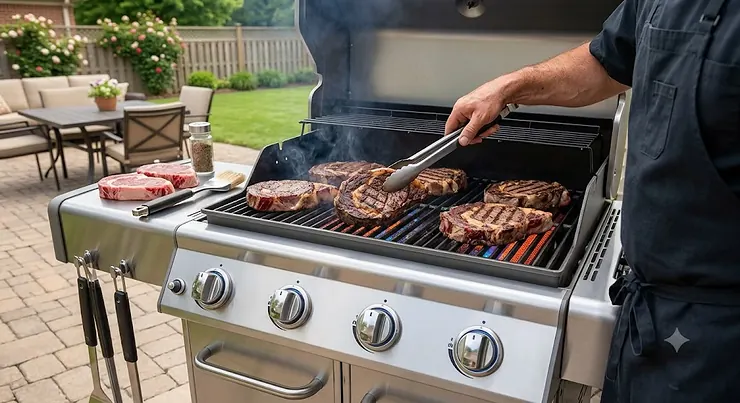
Somewhere around the third time you haul an empty propane tank to the hardware store mid-cookout, you start fantasizing about a different life. One where the gas just… never runs out. That’s the entire pitch behind a natural gas grill, and it’s a good one — but picking the best natural gas grill for your actual backyard, not some showroom fantasy, takes a little more thought than clicking the first orange “Add to Cart” button you see.
What is a natural gas grill? It’s a grill permanently plumbed into your home’s natural gas line instead of running on refillable propane tanks — trading portability for an endless fuel supply, generally lower running costs, and one less thing to remember on your way out the door with a plate of raw chicken.
This guide digs into seven real, current models spanning budget cart grills to serious built-in units, because “best” honestly means something different depending on whether you’re feeding two people on a Tuesday or forty people on the Fourth of July. We pulled real specs, cross-referenced aggregated owner sentiment from retailer review pages, and — since Amazon rules (and basic honesty) forbid us from inventing hands-on testing we didn’t do — we leaned hard into genuine comparative analysis instead. According to Consumer Reports’ grill testing program, build quality and even heat distribution separate the grills people love from the ones gathering dust by October. That’s exactly the lens we used here.
We’ll also cover the unglamorous-but-critical stuff nobody puts in a highlight reel: how NG gas line hookup actually works, what a quick connect fitting does, and what permanent backyard grill installation involves before you get too attached to a model that needs a plumber’s blessing first.
Quick Comparison Table
| Grill | Best For | Total BTU | Price Range |
|---|---|---|---|
| Monument Grills 4-Burner Convertible | Tightest budgets | ~60,000 | $450-$650 range |
| Char-Broil Performance Series | First-time buyers | ~30,000-36,000 | $350-$550 range |
| Weber Genesis E-325 | Most reliable all-rounder | 39,000 (52,000 with sear) | $1,300-$1,600 range |
| Napoleon Prestige 500 RSIB | Entertainers who sear and rotisserie | 82,000 | $2,300-$2,900 range |
| Coyote C-Series 36-Inch | Best value built-in | 80,000 | $2,300-$2,700 range |
| Blaze Premium LTE+ 32-Inch | Luxury outdoor kitchens | ~56,000-66,000 | $2,500-$3,200 range |
| Saber Elite 500 | Fuel-efficient searing | ~24,000 (infrared) | $2,600-$3,300 range |
Looking at the spread above, there’s a real fork in this market: cart grills under $700 versus built-in units north of $2,000, with almost nothing occupying the middle ground except the Weber Genesis E-325. That gap isn’t accidental — natural gas hookups and outdoor kitchen islands both carry real installation costs, so once someone commits to a permanent gas line, they tend to go all-in on a built-in unit rather than splitting the difference. If your budget sits between those two tiers, the Genesis is worth serious consideration precisely because it’s nearly alone in that space.
💬 Found a favorite already? Tap the bolded name above to check its current price and availability.
Top 7 Best Natural Gas Grills: Expert Analysis
1. Monument Grills 4-Burner Convertible — most affordable path to a real NG hookup
The standout here is right in the name: this grill ships propane-ready but converts to natural gas with a relatively simple kit, which means budget shoppers don’t have to skip the NG lifestyle entirely. It packs 4 main burners plus a side burner into a stainless body, with a “ClearView” glass lid so you can check doneness without losing heat every time you peek. Total output lands around 60,000 BTUs, which on paper sounds enormous, but spread across a wide cart grill it translates to solid mid-heat cooking rather than blistering sears — fine for burgers and chicken, less exciting for a thick ribeye.
Here’s what to weigh: at this price, you’re trading some long-term durability and finish quality for a genuinely low barrier to entry into natural gas grilling. It’s for the buyer who wants the convenience of an unlimited fuel line without financing a built-in island. Reviewers on major retailer pages consistently note the LED-lit knobs and glass lid as pleasant surprises at this price point, while a recurring theme in aggregated feedback is that the porcelain-coated grates need more frequent seasoning than pricier stainless alternatives to avoid rust spots.
Pros:
- ✅ Genuinely low cost of entry into NG grilling
- ✅ ClearView lid lets you monitor cooking without heat loss
- ✅ 8-year burner warranty backs up the price tag
Cons:
- ❌ Thinner-gauge steel than premium built-in options
- ❌ Grates require more upkeep to prevent surface rust
At around $450-$650 range, this is the value verdict of the whole lineup: if your goal is simply “no more propane tanks,” few options get you there for less.
2. Char-Broil Performance Series 4-Burner — best budget pick for everyday family cooking
Char-Broil’s standout move is TRU-Infrared cooking plates, which spread heat more evenly across the grate than open flame alone and meaningfully cut down on the flare-ups that torch your first batch of chicken thighs every single summer. The 4-burner layout with roughly 30,000-36,000 combined BTUs won’t win any horsepower contests, but it’s tuned for consistent everyday cooking rather than showing off.
What most buyers overlook about entry-level grills like this one is that porcelain-coated cast iron grates actually retain heat impressively well once preheated — the limiting factor isn’t grate quality, it’s burner output and cabinet insulation, both of which are modest here. Based on the spec comparison against the Monument above, the Char-Broil trades a slightly smaller total cooking area for the flare-up control that infrared technology provides, which matters more if you’re grilling fattier cuts regularly. Aggregated reviews from big-box retailers repeatedly praise the brand’s electronic ignition reliability, while a common complaint in user feedback is that side shelves feel flimsy under heavier prep bowls.
Pros:
- ✅ TRU-Infrared plates meaningfully reduce flare-ups
- ✅ Reliable electronic ignition across burners
- ✅ Widely available parts and accessories nationwide
Cons:
- ❌ Lower total BTU limits high-heat searing
- ❌ Side shelves feel less sturdy than the cabinet itself
Priced in the $350-$550 range, this is the grill for someone who wants Char-Broil’s 75-plus years of brand trust without a big financial leap.
3. Weber Genesis E-325 — most reliable all-rounder for home backyards
The PureBlu burner system is the real headline: three tapered burner tubes keep gas pressure consistent across 513 square inches of primary cooking space, and Weber positions the raised gas ports so debris falls away instead of clogging the burner over time. That’s not marketing fluff — it directly explains why Genesis owners report fewer ignition failures years into ownership compared to grills with flat, exposed burner tubes.
With 39,000 BTUs across the mains (52,000 total including the sear zone) and FLAVORIZER bars catching drippings to create smoke without triggering flare-ups, this grill is built for the household that grills three or four nights a week, not just on holidays. Here’s what the spec sheet won’t tell you, but reviewers note repeatedly: the porcelain-enameled cast-iron grates hold a sear beautifully once they’re properly preheated, though that preheat takes a few extra minutes compared to thinner stainless grates. A common theme in aggregated owner feedback across retail sites is genuine surprise at how many years the Genesis lasts before needing burner tube replacement — often cited as the deciding factor over cheaper competitors.
Pros:
- ✅ PureBlu burners resist clogging and deliver even heat
- ✅ 12-year parts warranty reflects real build confidence
- ✅ Extra-large sear zone handles multiple steaks at once
Cons:
- ❌ Higher price than most cart-style competitors
- ❌ Cast-iron grates need a longer preheat for best searing
At around $1,300-$1,600 range, the Genesis earns its reputation as the most reliable natural gas grill in this lineup for buyers who plan to keep one grill for a decade, not two summers.
4. Napoleon Prestige 500 RSIB — most feature-packed for entertaining
This one throws almost everything at the wall: four main burners, an 18,000 BTU infrared rear rotisserie burner, and a 16,000 BTU infrared side burner, adding up to a genuinely massive 82,000 BTU total. The rotisserie kit ships included rather than as a $150 add-on, which matters if slow-roasted whole chickens or leg of lamb are part of your regular rotation.
Based on the spec comparison, what separates this from a plain 4-burner grill is the sheer range of cooking styles available in one unit — direct sear, indirect roast, rotisserie, and side-burner sauce work, all without buying a second appliance. What most buyers overlook is that the SafetyGlow backlit knobs aren’t just a gimmick; they visually confirm which burners are lit from across the yard, which genuinely reduces the “did I turn that off” moment after a long cookout. Reviewers consistently note the soft-close cabinet doors and built-in bottle opener as small touches that add up to a premium daily-use feel, while a recurring critique in aggregated feedback is that the sheer number of features means a steeper learning curve for first-time gas grill owners.
Pros:
- ✅ Included rotisserie kit adds real versatility out of the box
- ✅ SafetyGlow knobs make burner status visible at a glance
- ✅ Lifetime warranty on main components signals long-term confidence
Cons:
- ❌ Learning curve for new-to-gas grillers given the feature count
- ❌ Larger footprint needs more patio or deck space
In the $2,300-$2,900 range at the time of research, this is the grill for hosts who entertain often enough to justify a rotisserie burner earning its keep.
5. Coyote C-Series 36-Inch Built-In — best value for a built-in outdoor kitchen
The standout advantage is Coyote’s Infinity burners: four cast stainless steel burners producing up to 80,000 BTU across 875 square inches of total cooking area, built into an 18-gauge, continuously hand-welded 304 stainless steel grill box with no vulnerable weld spots for rust to creep into over time.
Here’s what to weigh: unlike a freestanding cart grill, this is designed from the ground up to slot into a masonry or modular outdoor kitchen island, so the “price” you see is really just the grill head — budget separately for the surrounding cabinetry. What the spec sheet won’t tell you, but reviewers note, is that the heat control grids do a genuinely good job of distributing that 80,000 BTU output evenly rather than creating hot spots directly over each burner, which is a common complaint with lower-tier built-ins. Aggregated owner sentiment on major retail platforms frequently praises the six-month-and-beyond durability reports and reduced gas consumption versus prior grills, framed honestly as early-ownership feedback rather than long-term proof, since built-in units are newer to market cycles than something like the Weber Genesis line.
Pros:
- ✅ 80,000 BTU Infinity burners with even heat distribution
- ✅ Continuously welded stainless body resists corrosion
- ✅ Removable warming rack adds flexible cooking space
Cons:
- ❌ Requires a built-in island — no cart option included
- ❌ Installation and surround costs add to the real total price
At roughly $2,300-$2,700 range for the grill head alone, this is the strongest value case among built-in options in this guide.
6. Blaze Premium LTE+ 32-Inch Built-In — most luxurious built-in for serious hosts
The Blaze LTE+ leans into ambiance as much as raw output: an LED illuminated control system with SafetyGlow knobs, a spring-assisted lift hood, and a magnetic latch that automatically triggers interior lighting when you open the lid — small conveniences that add up during evening cookouts. Four cast 304 stainless steel burners deliver roughly 56,000-66,000 BTUs depending on configuration, with patented triangle-shaped searing rods designed to leave more defined grill marks than standard round grates.
What most buyers overlook about triangle-rod grates specifically is that the increased surface contact area actually improves sear marks without requiring higher heat, which is a genuine engineering advantage rather than a cosmetic one. Based on the spec comparison with the Coyote above, Blaze prioritizes lighting and hood mechanics where Coyote prioritizes raw welded-body durability — a real trade-off depending on what you value more. Reviewers consistently praise the double-lined hood’s heat retention, though a candid theme across aggregated feedback includes some owners reporting flare-up issues on certain units; to Blaze’s credit, its customer service team has been reported to respond directly and offer troubleshooting support when that happens, which is worth noting as part of the honest picture.
Pros:
- ✅ Illuminated control system and auto-lighting hood latch
- ✅ Triangle-shaped searing rods improve grill-mark definition
- ✅ Lifetime warranty on core components
Cons:
- ❌ Some aggregated reviews cite flare-up complaints
- ❌ Premium finish comes with a premium price tag
Priced around $2,500-$3,200 range, this is the pick for buyers who want their outdoor kitchen to feel like a genuine luxury space, not just a functional one.
7. Saber Elite 500 — most fuel-efficient infrared searing
Saber’s patented infrared cooking system is the whole story here: three 8,000 BTU burners work with emitters and specially designed cooking grates to direct airflow away from the surface, which the brand claims — and independent grill comparisons broadly support — burns up to 30% less fuel than convection-style burners while retaining more moisture in whatever’s on the grate.
The honest analytical take is that lower total BTU numbers here (24,000 versus 80,000+ on the Coyote) can look underwhelming on a spec sheet, but infrared heat transfer works fundamentally differently than open-flame convection, so raw BTU comparisons across cooking technologies are genuinely misleading without context. What the spec sheet won’t tell you, but reviewers note, is that this grill preheats to searing temperature in about 12 minutes — noticeably faster than most convection grills of similar size — which matters more on a weeknight than most buyers initially expect. Aggregated feedback across retailer platforms consistently highlights the mirror-polished stainless finish and included rotisserie motor as standout value-adds at this tier, while a recurring theme is that replacement emitters, when eventually needed, cost more than standard burner tubes.
Pros:
- ✅ Infrared system uses meaningfully less fuel per cook
- ✅ Reaches searing temperature in about 12 minutes
- ✅ Includes rotisserie motor and marine-grade cover standard
Cons:
- ❌ Lower raw BTU number can undersell real performance
- ❌ Replacement infrared emitters cost more than standard tubes
At an estimated $2,600-$3,300 range, this is the grill for buyers who care more about fuel efficiency and searing speed than chasing the biggest BTU number on the spec sheet.
Permanent Backyard Grill Installation: What to Plan For
Committing to a permanent backyard grill installation is a bigger decision than picking a grill — it’s really a small home improvement project with its own timeline and cost. Most jurisdictions require a licensed plumber or gas fitter to run a dedicated line from your home’s gas meter to the grill location, since this isn’t a DIY-friendly task the way assembling a propane cart grill is.
Budget-wise, expect the line-running work itself to be the bulk of the cost, with the actual quick-connect hardware being a comparatively minor expense. If you’re pairing a built-in model like the Coyote C-Series 36-Inch Built-In or Blaze Premium LTE+ 32-Inch Built-In with a masonry or modular island, factor that construction into your overall project budget separately from the grill head price shown in stores.
Before the line goes in, walk your yard and decide on a fixed grill location — this isn’t a decision you’ll want to revisit later, since moving a plumbed gas line means cutting into a wall or slab again. Consider proximity to your kitchen for food prep runs, distance from windows and vents per local code, and whether you want a freestanding cart grill like the Weber Genesis E-325 on a patio versus a fully built-in unit anchoring an outdoor kitchen. Getting this planning right the first time saves real money down the road.
NG Gas Line Hookup and Quick Connect Fitting, Explained
The technical heart of any NG gas line hookup is the quick connect fitting: a specialized brass coupling installed at the end of your gas line that lets you attach or detach the grill’s flexible hose in seconds, without tools, while automatically shutting off gas flow the moment the connection is broken. It’s the single component that makes natural gas grilling nearly as convenient as propane for day-to-day use.
Per This Old House’s installation walkthrough, the process starts with your plumber running black malleable iron pipe from the gas supply to the grill location — never galvanized fittings, which aren’t approved for fuel gas use. Once the line is in place, it gets pressure tested, then every joint gets checked with a soap solution, watching for bubbles that would signal a leak before anything is buttoned up. Only after that testing passes does the quick-connect fitting go on the end of the line.
What most buyers overlook is that the flexible hose connecting your grill to that fitting typically maxes out around 10 feet for safety and gas-flow reasons, so grill placement relative to the fitting matters more than people expect. Also worth noting: natural gas runs at a much lower pressure than propane (roughly 7 inches water column versus 11), which is exactly why NG-specific grills like the ones featured here use different orifices than LP models — they aren’t interchangeable without a proper conversion kit, like the one included with the Monument Grills 4-Burner Convertible.
Real-World Scenarios: Which Grill Fits Your Backyard
If you’re a young couple renting a townhouse with a small patio and no appetite for a permanent installation commitment, the Char-Broil Performance Series 4-Burner or Monument Grills 4-Burner Convertible make sense as an affordable entry point you can convert to NG later if you buy a home with a hookup already installed.
If you’re a family of five hosting weekend barbecues and weeknight dinners in roughly equal measure, the Weber Genesis E-325 hits the sweet spot: enough cooking area for a full meal, a warranty that assumes years of regular use, and a price that doesn’t require redesigning your patio around it.
If you’re renovating a backyard into a genuine outdoor living space with a bar, seating, and a dedicated cooking zone, both the Coyote C-Series 36-Inch Built-In and Napoleon Prestige 500 RSIB are built for that context — the Coyote for buyers prioritizing raw durability and value, the Napoleon for those who want rotisserie and side-burner versatility layered in from day one.
How to Choose the Best Natural Gas Grill for Home
- Match total cooking area to your actual household size — a family of four rarely needs 900 square inches, and undersizing frustrates hosts more than oversizing wastes money.
- Weigh BTU per burner, not just total BTU — a grill spreading 80,000 BTU across six burners heats less intensely per zone than 40,000 BTU across three.
- Decide freestanding versus built-in early — this single choice determines your installation budget more than any other spec.
- Check the warranty on burner tubes specifically — they’re the part most likely to fail first, and coverage length signals real manufacturer confidence.
- Consider grate material for your typical cooking style — cast iron sears beautifully but needs more upkeep; stainless resists rust with less maintenance.
- Confirm true NG compatibility, not just a conversion kit — factory-built NG models generally perform more consistently than converted LP units.
- Factor in accessible parts availability — established brands make replacement burners and igniters easier to source years down the line.
Common Mistakes When Buying a Natural Gas Grill
The single most common misstep is buying a propane grill and assuming a conversion kit makes it identical to a factory NG model — it gets you functional, not optimal, since orifice sizing and regulator design differ between fuel types. A close second is fixating on total BTU as a universal performance measure, ignoring that infrared grills like the Saber Elite 500 achieve excellent results at a fraction of the BTU number a convection grill would need.
Buyers also frequently skip budgeting for professional line installation, sticker-shocked later when the plumbing work costs more than the grill itself. Finally, plenty of shoppers pick a grill based on looks alone and only discover afterward that their chosen built-in model requires an island they haven’t priced out — a mistake easily avoided by reading the installation section above before falling in love with a display model.
Natural Gas Grill vs Propane Grill
The core trade-off is convenience versus flexibility. A natural gas grill, once installed, never runs out mid-cookout and typically costs less per hour of use, but it’s permanently tied to that installation location. A propane grill can go anywhere — a tailgate, a new house, a friend’s driveway — but demands tank monitoring and periodic refills or exchanges.
| Factor | Natural Gas | Propane |
|---|---|---|
| Fuel supply | Unlimited, piped from home | Limited to tank capacity |
| Portability | Fixed installation only | Fully portable |
| Upfront cost | Higher (installation required) | Lower (no plumbing needed) |
| Long-term fuel cost | Generally lower | Generally higher per BTU |
| Best For | Permanent backyard setups | Renters, movers, tailgaters |
The analysis here is straightforward: if you own your home and grill several times a week, natural gas usually wins on long-term cost despite the higher upfront investment, since you’re no longer paying propane-exchange markups indefinitely. If you rent, move often, or grill occasionally at different locations, propane’s portability outweighs natural gas’s convenience every time.
What to Expect: Real-World Performance
Specs describe potential; real cooking sessions reveal how a grill actually behaves. A grill rated at 39,000 BTUs like the Weber Genesis E-325 translates to roughly 5-7 minutes to preheat to searing temperature in typical outdoor conditions, slower in cold weather or heavy wind, since ambient temperature genuinely affects gas grill performance more than most buyers expect.
Flare-ups remain the most common real-world frustration across all gas grills, which is exactly why features like Weber’s FLAVORIZER bars or Char-Broil’s TRU-Infrared plates matter more day-to-day than they might seem on a spec sheet skim. Expect any grill’s first few cooks to run slightly hotter or less evenly than after a proper burn-in period, as manufacturing residue and initial seasoning settle into the grates.
Most Reliable Natural Gas Grill: Long-Term Cost & Maintenance
Reliability over a decade comes down to two things: burner tube material and warranty length. The Weber Genesis E-325‘s 12-year parts warranty and tapered PureBlu burner design reflect genuine confidence that debris-clogging — the leading cause of burner failure — has been engineered around, which is exactly why it earns the most reliable natural gas grill distinction in this guide.
Total cost of ownership extends beyond the sticker price: budget for annual burner inspections, periodic grate replacement (every 3-5 years for cast iron, longer for stainless), and occasional igniter battery swaps. Natural gas itself typically runs cheaper per BTU than propane long-term, which meaningfully offsets a grill’s higher upfront cost over five-plus years of regular use, especially for households grilling multiple times weekly.
Features That Actually Matter (And Those That Don’t)
Genuinely useful: backlit control knobs (real safety value, not just style), tapered or debris-resistant burner design, and warranty length on burner tubes specifically. Genuinely overhyped: extremely high total BTU claims that ignore how many burners that heat is spread across, and rotisserie kits for households that will realistically never slow-roast a whole chicken.
Worth paying for if you use it: infrared side burners for searing, like those on the Napoleon Prestige 500 RSIB. Not worth paying extra for if you won’t: built-in smoker boxes or extensive cabinet lighting on a grill that lives in full daylight most of the time you’ll actually use it.
Safety, Regulations & Compliance Guide
Natural gas grill installations in the U.S. fall under NFPA 54, the National Fuel Gas Code, which sets minimum safety requirements for fuel gas piping design and installation in homes. Among its requirements: an accessible, dedicated manual shutoff valve located within a set distance of the appliance, and prohibitions on galvanized fittings for gas piping.
Beyond code compliance, basic safety habits matter just as much: leak-test every connection with a soap solution before first use, never run a natural gas grill in an enclosed or covered space without adequate ventilation, and keep a minimum clearance from siding, fencing, and other flammable materials as your local building department specifies. If in doubt about local permitting requirements, your gas utility or a licensed plumber can confirm exactly what your jurisdiction requires before installation begins.
Top-Rated Natural Gas Grill Brands: What Reviews Really Say
Across aggregated natural gas grill reviews on major retail and specialty sites, a few patterns hold up consistently. Weber earns its top-rated natural gas grill reputation almost entirely on longevity — owners routinely report years of reliable service with minimal burner maintenance. Napoleon and Blaze both draw praise for luxury features and finish quality, with occasional flare-up complaints appearing across both brands’ review pages, suggesting this is more of an industry-wide built-in grill quirk than a brand-specific flaw. Coyote and Saber, meanwhile, consistently earn praise for build durability and fuel efficiency respectively, though both carry smaller review volumes than mass-market Weber or Char-Broil, since they sell primarily through specialty dealers rather than big-box retailers.
👉 Ready to upgrade your backyard? Tap any bolded grill name above to check today’s availability.
Frequently Asked Questions
❓ What is the best natural gas grill for a small backyard?
❓ How much does it cost to convert a propane grill to natural gas?
❓ Do natural gas grills need a special regulator?
❓ Are built-in natural gas grills worth the extra installation cost?
❓ How often should I replace natural gas grill burners?
Conclusion
Choosing among the best natural gas grill options really comes down to matching your household’s actual cooking habits to the right tier: budget cart grills like the Monument Grills 4-Burner Convertible get you into NG grilling cheaply, the Weber Genesis E-325 remains the most reliable natural gas grill for everyday family use, and built-in options like the Coyote C-Series 36-Inch Built-In or Napoleon Prestige 500 RSIB anchor a genuine outdoor kitchen for serious entertainers.
Whichever direction you go, don’t skip the planning stage — a proper NG gas line hookup with a quality quick connect fitting, installed to code, is what makes the whole natural gas grilling experience as convenient as it’s supposed to be. Get that part right, and the grill itself becomes the easy decision.
✨ Found the right grill for your backyard? Tap its name above to check current pricing before you decide! 💬🤗
Recommended for You
- Propane vs Natural Gas Grill: 7 Proven Picks for 2026
- 7 Best Propane Grills for the Money in 2026
- Best Propane Grill 2026: 7 Top-Rated Picks Reviewed
Disclaimer: This article contains affiliate links. As an Amazon Associate, I earn from qualifying purchases. If you purchase products through these links, we may earn a small commission at no additional cost to you.
✨ Found this helpful? Share it with your friends! 💬🤗
