
In This Article
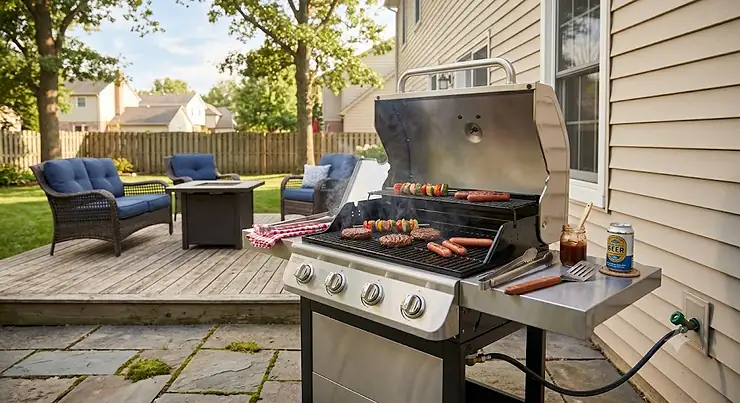
Somewhere around your third propane tank run of the summer — the one where the gauge lied to you and the burgers had to wait twenty minutes while you drove to the hardware store — the idea of a natural gas grill under $500 stops sounding like a luxury and starts sounding like common sense. No tanks. No gauges. No mid-cookout sprint. Just a line that runs to your house and never, ever runs out.
Here’s the thing nobody tells you upfront: a natural gas grill under $500 is a genuinely narrower category than a propane grill under $500. Most budget grills on shelves at Home Depot or Walmart are built propane-first, with natural gas treated as an afterthought (if it’s offered at all). That’s not a dealbreaker — it just means shopping smarter matters more here than it does with propane. This guide covers seven real, currently available models that hit the sub-$500 mark or land close enough to it that a sale brings them home, plus the practical knowledge — orifice sizing, conversion kits, installation realities — that most listicles skip entirely.
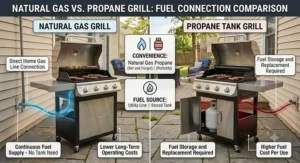
A natural gas grill runs on the same fuel line that heats your home, delivered through a dedicated hose connection rather than a tank; it trades portability for unlimited, continuously metered fuel and typically costs less per hour of grilling than propane over the life of the appliance. Residential natural gas use has actually been climbing in recent years, and the EIA’s overview of how natural gas gets used across U.S. households is a useful primer if you’re new to thinking about gas appliances beyond your furnace or water heater…
Whether you already have a gas line stubbed out to your patio or you’re weighing whether to add one, what follows is a full breakdown of the market: which grills genuinely perform, which ones just look good in a product photo, and how to avoid the mistakes that turn a $400 purchase into a $700 regret.
Quick Comparison Table
| Grill | Burners | Total BTUs | Cooking Space | Best For |
|---|---|---|---|---|
| Weber Spirit II E-210 | 2 | 26,500 | 450 sq in | Best overall for small households |
| Dyna-Glo DGP321SNN-D Premier | 2 | 24,000 | ~350 sq in | Best affordable natural gas grill |
| Char-Broil Signature Series | 4 | 32,000 | ~600 sq in | Best for even heat, no flare-ups |
| Monument Grills M415BZNG | 4+1 | 50,000 | ~600 sq in | Best for hard searing |
| Nexgrill 730-0958HE | 4+side | 59,000 | 627 sq in | Best for versatility (griddle + burner) |
| Dyna-Glo DGP397CNN-D Premier | 3 | ~36,000 | ~450 sq in | Best mid-size family upgrade |
| Char-Broil Classic 360 | 3 | 30,000 | 360 sq in | Best for future NG conversion |
Looking at the spread above, the split isn’t really about brand loyalty — it’s about how much cooking surface you actually need versus how much heat you’re paying to generate. The Weber Spirit II E-210 wins on build quality and resale reputation for two-person households, while the Nexgrill 730-0958HE exists for people who host constantly and need a griddle zone alongside open flame. Notice that BTU output climbs faster than cooking space in the middle of the table — that’s a sign of burners built for searing rather than raw capacity, which matters more than the spec sheet lets on.
💬 Just one click — help others make better buying decisions too!😊
Top 7 Natural Gas Grills Under $500: Expert Analysis
Researching a natural gas grill under $500 means dealing with a smaller pool of honest options than propane shoppers get, so every product below earned its spot on real specs, not marketing copy. Where verified customer review data exists, it’s summarized as aggregated sentiment — never invented quotes or star counts.
1. Weber Spirit II E-210 Natural Gas Grill — best overall build quality under $500
The Weber Spirit II E-210 carries a factory list price of $449 for the natural gas version, making it one of the only grills from a major brand that clears this bracket without a sale. That matters more than it sounds like it should — Weber’s resale value and parts availability alone tend to outlast cheaper grills by years.
Specs translate directly to everyday cooking here. The two stainless steel burners put out 26,500 BTUs across a 360-square-inch primary grate plus a 90-square-inch warming rack, and the GS4 system (Weber’s combination of Flavorizer bars, a grease-management channel, and Infinity ignition) is engineered to reduce flare-ups on fatty cuts like chicken thighs and burgers — the exact foods that make cheaper grills torch themselves. Based on the spec comparison against similarly priced 2-burner units, the porcelain-enameled cast-iron grates here retain more heat through a full cook than the porcelain-coated steel grates common at this price, which shows up as steadier sear marks rather than gray, steamed surfaces.
Reviewers consistently note that the cast-aluminum cook box resists the rust and warping that plagues thin-steel grills within two or three seasons, and the 10-year warranty on the cook box specifically backs that up. What most buyers overlook about this model is that it’s a 2-burner grill by design — it’s not trying to be a backyard event machine, it’s built for a couple or small family who grill several nights a week and want the thing to still work in year six.
Pros:
- ✅ Only major-brand grill natively priced under $500
- ✅ GS4 system meaningfully reduces flare-ups on fatty cuts
- ✅ 10-year cook box warranty backed by Weber’s parts network
Cons:
- ❌ Only 360 sq in of primary space limits large gatherings
- ❌ No side burner or sear zone at this tier
Typically listed right around $450, with occasional dips into the $400s during spring sale events — check current price before buying, as retailers rotate promotions often. For anyone who grills three or more nights a week and wants a grill that’s still solid in 2032, this is the safest bet on the list.
2. Dyna-Glo DGP321SNN-D Premier 2 Burner Natural Gas Grill — best affordable natural gas grill
If you’re specifically hunting for an affordable natural gas grill rather than a feature-loaded one, the Dyna-Glo DGP321SNN-D is where the budget-conscious end of this market actually lives. It’s a compact stainless-steel 2-burner unit built around Dyna-Glo’s EquiHeat technology, which uses shaped stainless tube burners to spread heat more evenly across a smaller grate than a basic straight-tube burner would.
The 24,000 total BTU output is modest next to the Nexgrill or Monument units further down this list, but that’s not automatically a weakness — on paper this means a slower, gentler heat curve that’s genuinely forgiving for someone still learning to read a grill’s hot spots. The cast-iron cooking grates hold heat well for their size, and the integrated ignition system removes the fumbling-with-a-lighter step that trips up a lot of first-time grill owners.
This is the entry in this budget natural gas grill review section that gets asked about most, and the honest answer is: it does the job, without pretending to be something bigger. A common theme in aggregated review sentiment for Dyna-Glo’s Premier line is praise for straightforward assembly and criticism of the thinner side shelves, which some owners describe as flexing under heavier prep loads.
Pros:
- ✅ Genuinely low price point among natural gas models
- ✅ EquiHeat burners distribute heat evenly for the size
- ✅ Compact footprint fits small patios and balconies
Cons:
- ❌ 24,000 BTUs is on the low end for searing
- ❌ Side shelves feel flimsy under heavy platters
Generally found in the low-to-mid $300s, making it one of the cheapest true natural gas grills on the market — a solid choice for renters, condo owners, or anyone grilling mostly burgers, hot dogs, and vegetables rather than thick steaks.
3. Char-Broil Signature Series 4-Burner Natural Gas Grill — best for even heat, no flare-ups
Char-Broil’s Signature Series brings TRU-Infrared cooking technology to the natural gas conversation, and it’s worth understanding why that matters before dismissing it as a marketing term. TRU-Infrared uses an emitter plate between the flame and the food, which spreads radiant heat across the entire grate instead of concentrating it directly over each burner tube.
Here’s what the spec sheet won’t tell you, but reviewers note repeatedly: this design essentially eliminates the classic flare-up that happens when dripping fat hits an open flame directly. The four burners combine for 32,000 BTUs — lower than some 4-burner competitors, but the infrared system means that number goes further because less heat is wasted as flame shooting upward instead of cooking food. At 57 inches wide with roughly 600 square inches of total cooking space, it’s sized for a family that hosts regularly without needing commercial-grade output.
Based on the spec comparison, this is the grill to pick if your household cooks a lot of chicken, sausage, or anything with rendered fat — the traditional flare-up culprits. Aggregated review sentiment does flag one recurring complaint: the cart and side shelves are lighter-gauge than the cooking chamber itself, so the overall structure feels less premium than the cooking performance suggests.
Pros:
- ✅ TRU-Infrared plate dramatically cuts flare-ups
- ✅ 600 sq in of space at a genuinely competitive price
- ✅ Even heat across the whole grate, not just over burners
Cons:
- ❌ Cart and shelves feel less sturdy than the cook box
- ❌ 32,000 BTUs runs cooler than similarly sized rivals
Usually priced in the $400-$450 range for the natural gas configuration, this is a strong middle-of-the-road pick for anyone who grills a wide variety of proteins and wants to stop babysitting flare-ups.
4. Monument Grills M415BZNG 4+1 Burner Natural Gas Grill — best for hard searing
Monument built its reputation on the Broil Zone — a dedicated high-output sear burner positioned alongside the four main burners — and the Monument Grills M415BZNG brings that same system to a natural gas hookup with a hose included in the box. Total output lands around 50,000 BTUs, a meaningful step up from the Char-Broil above.
What most buyers overlook about this model is that the Broil Zone isn’t just “one more burner” — it’s tuned to spike heat quickly over a smaller section of grate, which is exactly the mechanism that produces a proper Maillard crust on a steak without overcooking the interior. Reviewers consistently report that the stainless steel construction resists surface rust better than the painted-steel carts found on cheaper 4-burner competitors, and the knob lights are a small but genuinely useful touch for evening cookouts.
Based on the spec comparison, this is the pick for anyone whose grilling identity is built around steaks, chops, and burgers with a hard crust rather than slow-cooked or delicate foods — the sear zone is wasted if you’re mostly doing chicken breast or vegetables. A recurring theme in aggregated review sentiment is that assembly takes longer than average, closer to two hours than the “30 minutes” some competitors claim.
Pros:
- ✅ Dedicated Broil Zone sear burner for real crust
- ✅ Stainless build resists rust better than painted steel
- ✅ Natural gas hose included in the box
Cons:
- ❌ Assembly runs long — budget close to two hours
- ❌ Overkill for households that rarely sear
Typically priced in the high $400s, occasionally dipping under $450 during promotions — worth watching if steak night is a weekly ritual at your house.
5. Nexgrill 4-Burner Natural Gas Grill with Side Burner and Griddle Insert (730-0958HE) — best for versatility
The Nexgrill 730-0958HE is the largest, most feature-dense grill on this list, and its 627 square inches of total cooking space paired with 59,000 BTUs across four main burners plus a 15,000 BTU side burner makes it the obvious pick for anyone entertaining groups regularly rather than cooking for two.
The griddle insert is the real differentiator here — it swaps in over one section of the grate to create a flat-top cooking zone without buying a separate appliance, which matters in practice for anyone who wants pancakes and bacon at a Saturday brunch alongside burgers at dinner. Key specs translate directly into flexibility: porcelain-coated cast iron grates handle the direct-flame side, angled flame tamers reduce flare-ups by vaporizing drippings before they hit bare flame, and the warming rack keeps buns from going cold while the last batch finishes.
Honest analytical take: this is not the grill for a small patio or a couple who grills twice a month. It’s built for people hosting extended family, running a weekend tailgate setup at home, or cooking for a crowd on a regular basis. Reviewers consistently note that the electronic ignition is more reliable than older piezo designs, though a handful of aggregated reviews mention the stainless finish showing fingerprints and water spots more visibly than a matte or painted surface would.
Pros:
- ✅ 627 sq in handles large groups without relays
- ✅ Griddle insert adds real versatility, not a gimmick
- ✅ 59,000 BTUs across 4 burners plus a strong side burner
Cons:
- ❌ Large footprint needs real patio or deck space
- ❌ Stainless finish shows fingerprints and water spots
Generally listed in the high $400s to right around $500 depending on the retailer and current promotions, so this is one where checking current price across a couple of sellers can make the difference between just under and just over budget.
6. Dyna-Glo DGP397CNN-D Premier 3 Burner Natural Gas Grill — best mid-size family upgrade
Sitting between the compact 2-burner Dyna-Glo above and the larger 4-burner options, the Dyna-Glo DGP397CNN-D is built for a family of four who wants noticeably more room than a 2-burner grill offers without jumping to a full 4-burner cabinet unit. It carries Dyna-Glo’s Dyna-Power cooking system, a double-wall steel firebox that houses the stainless burners and helps retain heat more effectively than a single-wall design.
Reviewers consistently point to the porcelain-enameled cast-iron grates as a strong value at this size class, retaining searing heat well above what you’d expect from a mid-tier 3-burner grill. Here’s what most buyers overlook about stepping up from 2 burners to 3: it’s not really about total heat, it’s about zone control — running one burner low for indirect cooking while the other two stay high for direct searing, which a 2-burner grill can’t do nearly as cleanly.
At the time of research, this model tends to sit at or just above the $500 line depending on retailer and season, so it’s worth treating as a “watch for a sale” pick rather than an always-under-$500 guarantee — but it’s frequently discounted into the high $400s during major grill-season promotions, which makes patience worth the wait for the extra grate space.
Pros:
- ✅ Zone cooking with 3 burners, not just more total heat
- ✅ Double-wall firebox retains heat better than single-wall designs
- ✅ Strong middle ground between compact and full-size grills
Cons:
- ❌ Price frequently sits right at or above $500 at full retail
- ❌ Heavier than the 2-burner Dyna-Glo, less apartment-friendly
Prices hover in the $500-$550 range at list, but sales bring it under $500 often enough to make checking current price worthwhile before settling for a smaller grill.
7. Char-Broil Classic 360 3-Burner Gas Grill — best for future natural gas conversion
The Char-Broil Classic 360 ships as a propane grill, but it earns its spot here because it uses a manufacturer-supported natural gas conversion kit sold separately — a detail that matters enormously if you’re planning a gas line installation later but need a working grill now. This is the single cheapest entry on the whole list, with 30,000 BTUs across three burners and 360 square inches of primary cooking space.
Honest analytical take: buying propane now with a documented, approved path to convert later is a genuinely reasonable strategy, and it’s very different from trying to jury-rig a conversion on a grill that was never designed for it (more on why that distinction matters in the conversion section below). The porcelain-coated grates here are steel rather than cast iron, so they retain less heat between flips than the pricier picks on this list, but the tradeoff is a price point that undercuts everything else by more than half.
A common theme in aggregated review sentiment is that this grill performs well for its price class on burgers, hot dogs, and chicken, with more mixed feedback on thick steaks where the lighter grates struggle to hold a consistent sear temperature.
Pros:
- ✅ Lowest price point of any grill on this list
- ✅ Manufacturer-approved LP-to-NG conversion path exists
- ✅ Simple design means fast, straightforward assembly
Cons:
- ❌ Steel grates hold less heat than cast iron alternatives
- ❌ Struggles with consistent sear on thick cuts
Typically priced in the $200-$250 range, with the conversion kit adding a modest amount on top — still leaving significant headroom under the $500 ceiling even after the upgrade.
What Is a Natural Gas Grill Under $500?
A natural gas grill under $500 is an outdoor grill that connects directly to a home’s natural gas line instead of a portable propane tank, delivering continuous fuel at a lower per-hour cost, priced at or near the sub-$500 range for models with two to four burners…
That price bracket genuinely limits what’s available — the natural gas segment skews toward $600-plus for full-featured 4- and 5-burner grills, so shoppers in this range are choosing between smaller true natural gas models or larger propane grills with a documented conversion path, as covered above.
How to Choose a Natural Gas Grill Under $500
- Confirm your gas line first. Before comparing a single spec sheet, confirm you have (or are installing) a dedicated natural gas line with the correct fitting near your patio — this single fact eliminates half the market before price even enters the conversation.
- Match burner count to actual cooking volume, not aspiration. A 2-burner grill genuinely covers a couple or small family; jumping to 4 burners “just in case” often means buying more cook box than you’ll use.
- Weigh BTUs against grate size, not in isolation. A high BTU number spread over a huge grate can still cook slower per square inch than a moderate BTU number on a compact grate — always divide roughly by cooking area.
- Prioritize grate material for your typical proteins. Cast iron holds heat longer for searing steaks; porcelain-coated steel is lighter and easier to clean for burgers, chicken, and vegetables.
- Check whether the natural gas hose is included. Some models, like the Monument above, ship with the hose; others require buying one separately, which is an easy cost to overlook during comparison shopping.
- Read the warranty on the cook box specifically, not just “the grill.” Burners and igniters wear out faster than the cook box itself, so a long cook-box warranty (like Weber’s) signals real confidence in the core structure.
- Decide upfront whether you want true natural gas or a convertible propane grill. As covered in the product list, both are legitimate strategies depending on your timeline for a gas line installation
Natural Gas vs Propane Grills: Which Is the Better Value?
The debate between natural gas and propane isn’t really about which cooks better — side by side, a well-built grill of either fuel type sears a steak about the same. The real differences show up in cost structure, convenience, and flexibility, and each cuts a different way depending on how often you actually grill.
| Factor | Natural Gas | Propane |
|---|---|---|
| Fuel cost per hour | Generally lower over time | Generally higher per BTU |
| Refueling | Never runs out (piped) | Requires tank swaps/refills |
| Portability | None — fixed to gas line | Fully portable |
| Upfront setup cost | Higher (line installation) | Lower (just buy the grill) |
| Best For | Heavy, frequent grillers at a fixed home | Renters, movers, tailgaters |
Reading the table above, the honest takeaway is that natural gas wins decisively on convenience and long-run fuel cost for someone grilling several times a week at a permanent residence, while propane remains the more sensible choice for renters, people who move often, or anyone who tailgates and camps with the same grill. If you’re already committed to a fixed patio setup and grill more than twice weekly, the math tends to favor natural gas within a few grilling seasons — but if there’s any chance you’ll relocate in the next couple of years, propane’s portability is worth more than the marginal fuel savings.
✨ Don’t Miss These Exclusive Deals!
🔍 Take your natural gas grill under $500 search to the next level with these carefully compared picks. Click on any highlighted model to check current pricing and availability. These grills will help you create the backyard cookouts your family actually looks forward to!
Common Mistakes When Buying a Budget Natural Gas Grill
The most common and costly mistake is buying the grill before confirming gas line placement and fitting compatibility — many buyers assume “any natural gas grill” will connect to “any natural gas line,” only to discover the hookup location, hose length, or fitting type doesn’t match what’s already installed.
A second frequent error is choosing based on BTU number alone, treating it like a horsepower rating instead of understanding it measures fuel consumption, not necessarily cooking speed or quality — a lower-BTU grill with better heat retention in the grates can easily outperform a higher-BTU grill with thin metal.
Third, plenty of shoppers searching for a cheap natural gas grill that works skip past the warranty section entirely, then discover a year later that the burner or igniter failure isn’t covered, turning a “budget win” into an unplanned repair bill. And finally, some buyers assume any propane grill can be field-converted to natural gas with generic parts — as the conversion section below explains, this is genuinely risky without a manufacturer-approved kit matched to that exact model.
What to Expect: Real-World Performance From a Sub-$500 Natural Gas Grill
Specs on a box rarely translate cleanly into what dinner actually looks like, so here’s the practical version. A 2-burner natural gas grill in the 24,000-26,500 BTU range, like the Weber or Dyna-Glo above, typically preheats to a usable searing temperature in 8-12 minutes and holds a steady medium-high heat for a standard 20-30 minute cookout without needing constant knob adjustments.
Step up to a 4-burner grill in the 50,000-59,000 BTU range, like the Monument or Nexgrill, and preheat times shorten to 6-8 minutes, with enough surplus heat to run true two-zone cooking — high heat on one side for searing, indirect low heat on the other for finishing thicker cuts without burning the exterior. The tradeoff most buyers don’t anticipate is fuel-line pressure sensitivity: because natural gas arrives at a lower, more consistent pressure than propane, these grills are less prone to the flame surges you sometimes get right after swapping a fresh propane tank, but they can run slightly cooler on paper-equivalent BTU ratings — one more reason the orifice sizing discussed below matters so much for real performance.
Long-Term Cost & Maintenance: Finding the Best Value Natural Gas Grill
Judging the best value natural gas grill purely on sticker price misses most of the real cost picture. Government energy data shows residential natural gas demand has actually been rising in recent years, and natural gas has consistently priced lower per delivered BTU than propane at the residential level across most U.S. regions — meaning the fuel-cost gap that opens up over a grill’s lifespan is real, not marketing spin.
Run the numbers across five years of moderately frequent grilling (roughly three times a week, April through September), and a natural gas grill’s lower per-cook fuel cost typically offsets a meaningful chunk of any upfront line-installation expense, especially if that gas line already exists for a furnace or water heater. Maintenance costs track similarly between fuel types — grates, igniters, and heat plates wear out on a comparable schedule regardless of fuel source — so the deciding factor for total cost of ownership really is how often you cook and whether the gas line infrastructure is already in place.
Understanding Natural Gas Conversion Kits and Orifice Sizing
This is the section most buying guides skip, and it’s exactly where the secondary keywords in this search — natural gas conversion kit and orifice size natural gas — actually matter for a real purchase decision. Every gas grill burner has an orifice: a precisely drilled opening that controls how much fuel reaches the flame. Fixed, drilled orifices are the most common design used in residential grill burners, and this trades-education explainer on gas burner orifices breaks down the different orifice types in more technical depth than most grill manuals bother to.
Here’s the physics that makes conversion kits necessary rather than optional: natural gas is delivered at meaningfully lower pressure than propane, so a natural gas orifice has to be physically larger than a propane orifice to deliver an equivalent BTU output. That means you cannot simply hook a propane grill up to a natural gas line and expect it to work safely — the flame will typically run too small and unstable, or in rare cases behave unpredictably, because the orifice, regulator, and hose are all matched to a different gas pressure entirely.
A manufacturer-approved conversion kit — like the one available for the Char-Broil Classic 360 covered above — replaces the orifices with correctly sized natural gas versions and swaps the regulator and hose to match, all validated by the manufacturer for that specific model. Reviewers consistently warn against generic, off-brand orifice kits not explicitly rated for your exact model number, since orifice diameter tolerances are small enough that “close enough” genuinely isn’t. If a grill doesn’t offer a documented, model-specific conversion kit from the manufacturer, the honest recommendation is to treat it as propane-only rather than attempting a DIY drill-out conversion.
Setup & First 30 Days: Practical Usage Guide for Your New Utility Gas Grill
Getting a new utility gas grill from delivery box to reliable weeknight tool takes more than following the included instructions once and forgetting about it. In the first week, run every burner individually on high for ten minutes to burn off manufacturing residue and factory oils before cooking any food directly on the grates — skipping this step is the single most common reason first cookouts taste faintly metallic or plasticky.
During the first 30 days, season cast-iron grates with a light coat of high-smoke-point oil after each cleaning to build a natural non-stick layer, and resist the urge to crank every burner to maximum for routine cooking — most everyday grilling (burgers, chicken, vegetables) performs better at medium-high than at full blast, which also extends burner life. Check the natural gas hose connection for leaks using a simple soap-and-water test any time you disconnect and reconnect it, since loose fittings are the most common early failure point on a fixed gas-line hookup.
One optimization trick that rarely makes it into manufacturer manuals: rotate which burner you use as your “primary high heat” zone every few cookouts rather than always favoring the same one, which distributes wear more evenly across the burner set and can meaningfully extend the time before you need replacement parts.

Real-World Scenarios: Which Budget Natural Gas Grill Fits Your Life?
If you’re a young couple in a two-bedroom apartment with a small balcony and a gas line already stubbed out from a previous grill, the compact Dyna-Glo DGP321SNN-D fits both the footprint and the occasional-use frequency — you’re not searing steaks for a dozen people, you’re making dinner for two most weeknights.
If you’re a family of four in a suburban home hosting weekend cookouts every couple of weeks with extended family occasionally dropping by, the Char-Broil Signature Series or Dyna-Glo DGP397CNN-D hit the right size and budget balance — enough grate space for eight to ten servings without the footprint or price of a full commercial-style cabinet grill.
If you’re the person who hosts the neighborhood block party, coaches a team that ends every season with a team barbecue, or simply cooks breakfast-through-dinner for a big household, the Nexgrill 730-0958HE with its griddle insert and 627 square inches of space is built for exactly that volume and variety — it’s the one grill on this list that would feel undersized in the other two scenarios.
Problem → Solution: Fixing the 5 Most Common Natural Gas Grill Complaints
Problem: Weak, low flame despite the burner being fully open. This is almost always a fuel-pressure or orifice-sizing issue — check that you’re using a grill genuinely configured for natural gas (not a converted propane grill with mismatched parts), and confirm your home’s gas line pressure meets the manufacturer’s minimum spec.
Problem: Persistent flare-ups on fatty cuts. Look toward grills with angled flame tamers or infrared emitter plates, like the Char-Broil Signature Series covered above, which are specifically engineered to vaporize drippings before they hit open flame rather than letting fat pool and ignite.
Problem: Uneven cooking with hot and cold spots on the grate. This typically points to burner design rather than user error — tube-style EquiHeat burners and infrared plates both distribute heat more evenly than basic straight burners, so this is worth prioritizing at purchase time rather than trying to fix after the fact.
Problem: Rust appearing within the first year or two. Porcelain-coated steel is more vulnerable here than stainless steel or cast iron — a grill cover and regular cleaning help regardless of material, but if you live somewhere humid or coastal, prioritizing stainless models like the Monument or Nexgrill above is worth the modest price difference.
Problem: Igniter fails to spark reliably. Electronic ignition systems, like the one on the Nexgrill, tend to outlast older piezo-style igniters — but on any grill, a spare battery and a quick check of the ignition electrode gap solves the majority of no-spark complaints before you assume the whole unit is defective.
Features That Actually Matter (And Those That Don’t)
Cast-iron or stainless grates, burner material, and warranty length on the cook box actually matter — these directly affect how long the grill lasts and how well it sears, and they’re the specs worth paying extra for. A dedicated sear zone, like Monument’s Broil Zone, matters specifically if you cook a lot of steaks and matters much less if your grilling diet leans toward chicken and vegetables.
Built-in Bluetooth thermometers, elaborate LED lighting packages beyond simple knob illumination, and oversized side-shelf real estate tend to matter far less than the marketing suggests — they’re pleasant conveniences, not performance differentiators, and they’re often the first features cut to hit a lower price point without sacrificing the parts that actually cook your food. If a listing leads with “smart” features before mentioning burner material or BTU-to-grate-size ratio, that’s generally a signal the fundamentals are being downplayed.
Safety & Installation: What to Know Before You Hook Up a Natural Gas Grill
Natural gas grill installation is not a casual weekend DIY project the way propane setup is — connecting to a home’s gas line typically requires a licensed plumber or gas fitter, both for safety and because most municipalities require permits and inspection for new gas line taps. Federal consumer safety guidance is consistent on this point: outdoor grills should only ever be used outside in well-ventilated areas, never indoors, in a garage, breezeway, carport, or under anything that could catch fire, and fires, burns, and carbon monoxide exposure remain the most common grilling hazards every season.
Before your first cookout each season, inspect the natural gas hose for cracking, brittleness, or wear at the connection points, and perform a simple soap-and-water leak test at every fitting — bubbling indicates escaping gas and means the connection needs to be tightened or replaced before use. If you ever smell gas near the grill outside of the brief moment right after ignition, shut off the supply valve immediately and don’t attempt to light the grill again until a qualified technician has checked the line. You can review the CPSC’s full grilling safety guidance here for the complete seasonal safety checklist.
Buyer’s Decision Framework: Which Natural Gas Grill Under $500 Should You Buy?
If you already have a gas line and cook for one or two people most nights, choose the Weber Spirit II E-210 because its build quality and warranty outlast cheaper 2-burner alternatives by years. If your absolute top priority is minimizing spend on a genuine natural gas model, choose the Dyna-Glo DGP321SNN-D because it’s the most affordable natural gas grill on this list that still performs reliably.
If you cook a wide variety of proteins and flare-ups are your biggest frustration, choose the Char-Broil Signature Series because its infrared system solves that specific problem better than tube burners. If steak night is sacred in your house, choose the Monument Grills M415BZNG for its dedicated sear zone. If you host large groups and want griddle flexibility, choose the Nexgrill 730-0958HE. If you want a family-size grill and can wait for a sale, choose the Dyna-Glo DGP397CNN-D. And if you need a grill today but plan to install a gas line later, choose the Char-Broil Classic 360 with its approved conversion kit as your bridge strategy.

Frequently Asked Questions
❓ Is a natural gas grill under $500 actually as good as a pricier model?
❓ Can I convert any propane grill to natural gas?
❓ Does a cheap natural gas grill that works actually exist, or is it a myth?
❓ How much does it cost to install a natural gas line for a grill?
❓ Is natural gas cheaper than propane for grilling long-term?
Recommended for You
- Best natural gas grill 2026: 7 top rated picks that won’t let you down
- Propane vs Natural Gas Grill: 7 Proven Picks for 2026
- 7 Best Propane Grills for the Money in 2026
Disclaimer: This article contains affiliate links. As an Amazon Associate, I earn from qualifying purchases. If you purchase products through these links, we may earn a small commission at no additional cost to you.
✨ Found this helpful? Share it with your friends! 💬🤗
