
In This Article
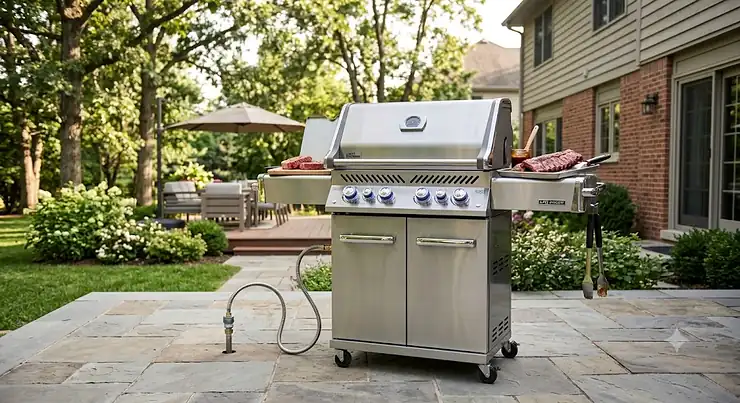
Running out of propane mid-cookout is one of those small disasters that somehow always happens right as the burgers hit the grates. That’s the exact moment most people start Googling convertible natural gas grill options at 6 p.m. on a Saturday, phone in one hand, tongs in the other. I get it — the appeal isn’t complicated. Hook your grill to the gas line already running to your house, and you never think about tank levels again.
But “convertible” is doing a lot of heavy lifting in that phrase, and it means different things depending on the grill. Some models ship dual-fuel ready with a swap kit sold separately. Others need a manufacturer-specific orifice kit ordered by serial number. A few simply aren’t safe to convert at all, no matter what a forum post tells you. This guide breaks down seven real, currently available grills that handle the propane-to-natural-gas switch well, what the conversion actually involves, and which option fits your backyard, your budget, and your patience for a Saturday afternoon project.
We’ll also dig into the mechanics — orifice sizing, manifold pressure, and why natural gas needs a completely different plumbing setup than propane despite looking almost identical on the outside. According to the U.S. Energy Information Administration, residential natural gas pricing varies enormously by state, which matters more than people expect when weighing the long-term math of switching fuels.
Quick Comparison Table
| Grill | Fuel Setup | Main Burner Output | Best For |
|---|---|---|---|
| Monument Grills Denali 605 | Dual-fuel, NG kit sold separately | 84,000 BTU | Families wanting smart-grill features on a budget |
| Napoleon Prestige 500 | Factory-built NG model | 48,000 BTU + infrared | Buyers who want a premium factory NG grill |
| Broil King Baron 440 Pro | Factory-built NG model | 40,000 BTU | Compact patios wanting durable mid-range build |
| Char-Broil Commercial Dual Fuel | Dual-fuel, NG kit required | 30,000–36,000 BTU | Budget-conscious first-time converters |
| Nexgrill Deluxe 7-Burner | Dual-fuel, NG kit sold separately | 6-burner + side burner array | Large families and frequent entertainers |
| Blackstone 36″ Griddle (Rangetop Combo) | Dual-fuel, NG kit sold separately | Up to 60,000 BTU combined | Griddle cooking and breakfast-to-dinner variety |
| Camp Chef Flat Top 600 | Convertible via pro install | 48,000 BTU | Hybrid grill-and-griddle cooking |
Looking at the table above, the split between factory-built natural gas models (Napoleon Prestige 500, Broil King Baron 440 Pro) and dual-fuel-convertible models (everything else) is the single biggest decision point in this whole category. Factory NG grills skip the conversion step entirely but lock you into that fuel type permanently, while dual-fuel models cost a little more upfront in kit money but give you the option to switch back if you move to a house without a gas line. Budget-focused shoppers converting an existing propane grill should look hardest at the Char-Broil and Nexgrill entries, since both have widely available, well-documented conversion kits.
💬 Just one click — help others make better buying decisions too!😊
Top 7 Convertible Natural Gas Grills: Expert Analysis
1. Monument Grills Denali 605 — smart-grill features at a dual-fuel price point
The standout here is that Bluetooth app control and an LED display show up on a grill priced well below where smart features usually start. The Denali 605 packs six main burners plus a side burner for 84,000 total BTUs across 895 square inches of cooking area, with 640 square inches as primary grilling space. Dual-fuel compatibility means the same cook box runs on propane out of the box, and switching to natural gas requires Monument’s own conversion kit (model 97352 or 98523, sold separately) rather than a universal third-party part.
Based on the spec comparison, that BTU count is genuinely high for this price tier — most direct competitors top out closer to 60,000 BTUs — but raw BTU output isn’t the same as even heat, and six burners crammed into a mid-size cook box can create hot spots if you’re not rotating food. Reviewers consistently report that assembly is fast and the Bluetooth range holds up to the advertised 65 feet, which matters if you’re monitoring a slow cook from inside the house. A recurring theme in aggregated feedback is praise for how easily the grill heats up and how evenly it cooks once dialed in, though a smaller subset of buyers note the conversion kit purchase feels like an unexpected add-on cost rather than an included accessory.
Pros:
- ✅ 84,000 BTUs is unusually high output for this price class
- ✅ Bluetooth app control with 65-foot range is rare below premium pricing
- ✅ Large 895 sq in cooking area fits big family cookouts
Cons:
- ❌ Natural gas conversion kit sold separately, adding to total cost
- ❌ Six burners can create uneven heat zones without rotation
The Monument Grills Denali 605 runs in the $700-$900 range for the grill alone, with the conversion kit adding roughly $40-$60. For the BTU output and smart features you’re getting, that’s a strong value proposition if you’re comfortable ordering the matching kit as a second step.
2. Napoleon Prestige 500 — infrared rear burner built specifically for natural gas
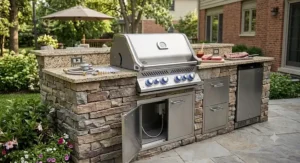
What stands out first is that this isn’t a converted grill at all — it’s a purpose-built natural gas model with its own SKU, which sidesteps every orifice-swap headache entirely. The Prestige 500 pairs four main burners with an infrared side burner (rated up to 1,800°F for searing) and an 18,000 BTU infrared rear burner built for rotisserie cooking, all wrapped in a full stainless steel cart with soft-close cabinet doors.
Here’s what to weigh: buying a dedicated NG model instead of a convertible propane grill means Napoleon’s engineers matched every orifice and regulator to natural gas from the factory, which is inherently safer than a field conversion — but it also means you can’t easily switch back to propane if you move somewhere without a gas hookup. What most buyers overlook about this model is the dual-level sear plates, which vaporize drippings before they hit the burner tubes, extending burner life significantly compared to grills using simple heat tents. Aggregated review sentiment is largely positive on cooking performance and the JETFIRE ignition system’s reliability, though a portion of buyers have flagged inconsistent quality control on shipped units, including occasional cosmetic shipping damage.
Pros:
- ✅ Purpose-built NG engineering eliminates conversion-kit guesswork
- ✅ Infrared side and rear burners add steakhouse-style searing and rotisserie use
- ✅ Full stainless cart with soft-close doors and interior storage lighting
Cons:
- ❌ Premium pricing compared to convertible dual-fuel alternatives
- ❌ No easy path back to propane if your gas line situation changes
Expect the Napoleon Prestige 500 to land in the $2,800-$3,400 range depending on the exact configuration. For buyers who know they’re staying on natural gas long-term, that premium buys genuine peace of mind over aftermarket conversion parts.
3. Broil King Baron 440 Pro — durable cast-aluminum cook box in a compact footprint
The short version: this is a factory NG grill built around a cast-aluminum cook box that resists the rust and warping that plague steel cook boxes over a decade of outdoor exposure. Four stainless steel Dual-Tube burners deliver a combined 40,000 BTUs across roughly 460 square inches of primary cooking space, with a 15,000 BTU side burner rounding out the package.
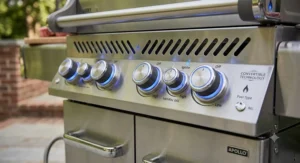
The spec sheet won’t tell you this, but user reports suggest the Flav-R-Wave cooking system (Broil King’s flame-tamer design) does a genuinely good job preventing flare-ups compared to bare heat plates, which matters if you’re cooking fattier cuts regularly. Based on the spec comparison, 40,000 BTUs across 460 square inches is a leaner power-to-space ratio than the Monument or Nexgrill entries here, meaning this grill runs a touch cooler at max output — better suited to steady, controlled cooking than blast-furnace searing. Reviewers consistently note the cast-aluminum construction feels noticeably more solid than comparably priced steel grills, and the illuminated control knobs are a small but appreciated detail for evening cookouts.
Pros:
- ✅ Cast-aluminum cook box resists long-term rust and warping
- ✅ Flav-R-Wave system meaningfully reduces flare-ups
- ✅ Compact footprint fits smaller patios without sacrificing cooking space
Cons:
- ❌ Lower BTU-per-square-inch ratio than higher-output competitors
- ❌ Side burner output is modest for serious sauce-making or side dishes
Pricing for the Broil King Baron 440 Pro typically falls in the $900-$1,100 range for the natural gas version. It’s a strong pick if long-term durability matters more to you than raw searing power.
4. Char-Broil Commercial Series Dual Fuel — the most widely documented conversion path on the market
The standout feature isn’t the grill itself so much as the ecosystem around it — Char-Broil’s Dual Fuel line has been around long enough that conversion kits, instructional manuals, and troubleshooting guides are everywhere, which meaningfully lowers the risk of getting stuck mid-project. Depending on the specific model year, these grills run four or five burners at roughly 30,000-36,000 combined BTUs, and any grill carrying the Dual Fuel logo is compatible with Char-Broil’s own conversion kits (part numbers vary by production year, from 2008-2019 models to 2020-and-newer models).
Reviewers consistently note the conversion kit instructions are clear enough for a confident DIYer to follow, provided the grill actually carries the Dual Fuel badge — Char-Broil is explicit that grills without that logo cannot be safely converted, no matter how similar they look. On paper this means slightly lower peak heat than some competitors here, but what most buyers overlook is that consistent, well-documented mid-range heat is often more useful for everyday grilling than an extra 20,000 BTUs you’ll rarely use. A recurring complaint in aggregated feedback involves sourcing the correct kit for older model years, since part numbers changed between the pre-2020 and 2020-plus generations.
Pros:
- ✅ Extensive documentation and widely available conversion kits
- ✅ Lower entry price than most other dual-fuel options here
- ✅ Straightforward DIY conversion process for confident owners
Cons:
- ❌ Lower peak BTU output than higher-end competitors
- ❌ Must match kit part number to exact model year and production era
The grill itself typically runs $500-$650, with the matching conversion kit priced around $60-$70. This is a sensible starting point if you already own an older Dual Fuel model or want the cheapest reliable entry into natural gas grilling.
5. Nexgrill Deluxe 7-Burner — the most cooking space per dollar in this lineup
What jumps out immediately is the sheer scale: six 304 stainless steel main burners plus a stainless side burner, all built for dual-fuel operation with Nexgrill’s own conversion kit sold separately. This is a grill designed around feeding a crowd rather than searing a single steak perfectly, and the 34-inch-wide cooking deck reflects that priority.
Based on the spec comparison, six main burners spread across a wide deck means more even heat distribution across a bigger surface than grills that pack similar BTU totals into a tighter footprint — you get more usable cooking zones rather than one concentrated hot spot. What the spec sheet won’t tell you is that angled, porcelain-coated flame tamers do double duty here, both distributing heat evenly and vaporizing drippings into smoke flavor, a detail that shows up more in day-to-day cooking than in the spec list. Aggregated review sentiment tends to praise the sheer amount of usable cooking real estate for the price, while a portion of buyers note the black nickel knob finish shows fingerprints and needs more frequent wiping than stainless alternatives.
Pros:
- ✅ Six main burners plus a side burner cover large cookouts easily
- ✅ Wide 34-inch deck gives multiple independent heat zones
- ✅ Strong value for the amount of cooking space delivered
Cons:
- ❌ Conversion kit is a separate purchase, adding setup steps
- ❌ Black nickel knob finish shows fingerprints more than stainless
The Nexgrill Deluxe 7-Burner typically sits in the $450-$550 range, making it one of the most cost-effective ways to get serious cooking capacity with a dual-fuel path built in.
6. Blackstone 36″ Griddle (Rangetop Combo) — the flat-top alternative for breakfast-to-dinner variety
The standout advantage is versatility that a traditional grate grill simply can’t match: a flat cooking surface that handles pancakes, smash burgers, stir-fry, and seafood without flare-ups or food falling through grates. The Rangetop Combo configuration adds burner elements alongside the griddle top, and Blackstone’s own conversion kit (model 5249) is purpose-built for this exact lineup, including the 28-inch and 36-inch griddle, Tailgater, and single-burner Rec Stove models.
Here’s what to weigh: griddle cooking fundamentally changes what “grilling” means day to day, trading the char and grill marks people associate with backyard cooking for even, consistent heat across a huge cooking surface — great for breakfast crowds and large groups, less ideal if you specifically want seared grill marks on a steak. Reviewers consistently note the conversion kit’s included orifices and 7mm wrench make the swap manageable for a confident DIYer, though Blackstone is explicit that the AirFryer Griddle Combo and Culinary Collection griddles are not compatible with this same kit — a distinction that trips up buyers browsing similar-looking product listings. A common theme in aggregated feedback is appreciation for how much food volume the surface handles at once, which suits tailgates and family gatherings especially well.
Pros:
- ✅ Flat cooking surface handles breakfast, lunch, and dinner without grates
- ✅ Purpose-matched conversion kit with clear compatibility documentation
- ✅ Huge surface area cooks for large groups efficiently
Cons:
- ❌ Not compatible with AirFryer Griddle Combo or Culinary Collection models
- ❌ Lacks traditional grill marks and char some cooks specifically want
The Blackstone 36″ Griddle (Rangetop Combo) typically runs $400-$500, with the natural gas conversion kit adding roughly $40-$60. It’s the strongest pick here if your household cooks more breakfast and stir-fry than steaks.
7. Camp Chef Flat Top 600 (FTG600 Series) — hybrid grill-and-griddle with professional NG conversion
The defining feature is flexibility: this unit ships as a flat-top griddle but converts to a traditional grate grill by swapping the cooking surface, giving you two cooking styles in one footprint. Four stainless steel burners generate 12,000 BTUs each for 48,000 BTUs total across a 604-square-inch, pre-seasoned cold-rolled steel surface, with two separate grease management systems depending on which surface configuration is in use.
On paper this means comparable total output to the Napoleon Prestige 500, but delivered across a flat cooking surface rather than open grates — a meaningfully different cooking experience for the same BTU number. What most buyers overlook is that Camp Chef explicitly requires natural gas conversion to be performed by a licensed professional rather than a DIY kit installation, which adds labor cost but also removes the risk of a mismatched orifice size. Reviewers consistently praise the pre-seasoned surface for skipping the lengthy break-in process other flat-tops require, and the folding legs and side shelves get frequent mentions as genuinely useful for storage and prep space, though some buyers note the splash guard needs regular cleaning to keep grease from building up at the edges.
Pros:
- ✅ Converts between flat-top griddle and open grill grates
- ✅ Pre-seasoned surface skips the standard griddle break-in process
- ✅ Dual grease management systems keep cleanup manageable
Cons:
- ❌ Natural gas conversion requires professional installation, adding cost
- ❌ Splash guard needs frequent cleaning to prevent grease buildup
The Camp Chef Flat Top 600 typically runs $500-$650 depending on configuration (with or without hood, with or without grill grates). Factor in professional conversion labor separately, since this isn’t a self-install kit like the others on this list.
What Is a Convertible Natural Gas Grill?
A convertible natural gas grill is a propane grill engineered with a dual-fuel valve system, letting owners swap in a natural gas conversion kit — new orifices, a matching regulator, and a hose — to run on piped household gas instead of refillable tanks. Not every propane grill qualifies; only models explicitly labeled dual-fuel or Dual Fuel ready are built with the correct manifold to make the switch safely.
The distinction matters because propane and natural gas burn at different pressures and require different orifice sizes to deliver the correct BTU output. A grill without dual-fuel engineering simply doesn’t have the physical hardware to accept a conversion kit, regardless of how similar the connection point looks.
Propane to Natural Gas Convertible Grill: How the Swap Actually Works
Converting a propane to natural gas convertible grill isn’t as simple as connecting a new hose. Natural gas flows at roughly 4-7 inches of water column pressure, dramatically lower than propane’s 11 inches, which means every burner orifice has to be replaced with a larger opening to deliver equivalent heat at that lower pressure. Skip this step, and you’ll get a starved, weak flame that can’t reach proper cooking temperatures — or worse, an unstable one.
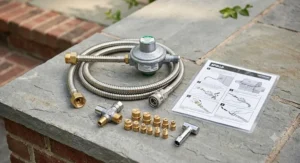
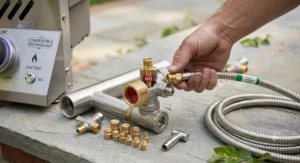
A full kit typically bundles a natural gas-specific regulator, a rated hose (usually 10 feet, sized for either 3/8-inch or 1/2-inch ID depending on the grill), a set of drilled brass orifices matched to your exact burner count, and sometimes a wrench or nut driver for installation. According to Angi’s grill conversion guide, most kits cost $50 to $100, and professional installation of the gas line itself can run from $140 to $430 depending on distance from an existing supply point. Budget two hours for a straightforward DIY swap if your grill’s serial number matches the kit exactly — mismatched orifice sizes are the single most common reason a conversion doesn’t work on the first try.
✨ Don’t Miss These Exclusive Deals!
🔍 Take your outdoor cooking setup to the next level with these carefully selected grills and conversion kits. Click on any highlighted item to check current pricing and availability. These tools will help you build authentic backyard cookouts your family will love!
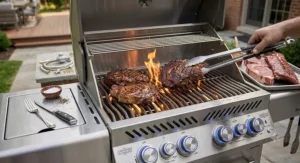
Dual Fuel Convertible Grill vs Single-Fuel Models
A dual fuel convertible grill and a single-fuel propane-only grill look nearly identical from the outside, but the internal valve and manifold engineering is where the real difference lives. Dual-fuel models are built with a manifold designed to accept both propane and natural gas orifice sizes — essentially future-proofing the grill for a fuel switch — while single-fuel grills are permanently locked to whatever gas type they shipped with.
| Feature | Dual-Fuel Convertible | Single-Fuel (Propane Only) |
|---|---|---|
| Fuel flexibility | Can run on either propane or NG | Propane only, no conversion path |
| Upfront cost | Slightly higher (grill + kit) | Lower initial purchase price |
| Long-term operating cost | Lower once converted to NG | Ongoing tank refill costs |
| Best For | Monument Denali 605, Nexgrill Deluxe 7-Burner | Renters or frequent movers |
Reviewers and industry sources consistently point to the same tradeoff: dual-fuel flexibility costs a little more at checkout but pays off within a season or two of natural gas use, since piped gas is typically cheaper per BTU than refilling propane tanks. Single-fuel propane grills remain the better fit for renters, RV owners, or anyone who moves often enough that a permanent gas line hookup doesn’t make sense.
How to Choose the Best Grill That Converts to Natural Gas
Finding the best grill that converts to natural gas comes down to matching a handful of practical factors to your actual backyard setup rather than chasing the highest BTU number on the box.
- Confirm dual-fuel compatibility first. Look for an explicit “Dual Fuel” or “NG convertible” badge on the model — grills without this hardware cannot be safely converted regardless of aftermarket kit claims.
- Check your gas line’s existing capacity. A shorter run from your home’s meter to the patio keeps installation costs down; anything over 50 feet often needs a licensed plumber regardless of grill model.
- Match burner count to household size. Four burners comfortably feed 4-6 people; six-plus burners make more sense for regular entertaining.
- Prioritize documented conversion kits over generic ones. Manufacturer-specific kits (like Char-Broil’s or Blackstone’s) reduce the risk of an orifice mismatch compared to universal third-party kits.
- Factor in cook-box material for your climate. Cast-aluminum resists corrosion better in coastal or humid regions; stainless steel handles temperature swings well in most other climates.
- Decide between factory NG and converted dual-fuel. Factory-built NG grills skip conversion risk entirely; dual-fuel models keep a path back to propane if your situation changes.
- Budget for professional installation separately. Even a well-reviewed kit may require a licensed technician depending on local code, adding $140-$430 to your total cost.
Natural Gas Conversion Kit for Grill: What’s Inside and What to Check
Every natural gas conversion kit for grill use follows roughly the same anatomy, but the details that actually matter get buried in bullet points most people skim past. The core components — regulator, hose, and orifices — need to match your specific burner count and grill model, not just the brand name on the box.
Features that actually matter:
- Orifice sizing matched to your exact serial number, not just the model family
- A regulator rated for low-pressure natural gas (typically 4-7 inches water column)
- Hose length adequate for your actual gas line distance without excessive coiling
Features that get marketing attention but matter less:
- Cosmetic hose color or fitting finish
- Bundled accessories like grill covers, which have zero bearing on conversion safety
- Marketing language like “universal fit,” which often means broad compatibility claims rather than exact orifice matching
What most buyers overlook is that a kit advertised as compatible with “most” grills of a brand doesn’t guarantee it fits every burner configuration within that lineup — always cross-reference your model’s exact serial number against the kit’s documented compatibility list before ordering.
Conversion Orifice Kit and Manifold Pressure Adjustment Explained
The conversion orifice kit is the single most safety-critical component in any propane-to-natural-gas swap, and manifold pressure adjustment is the step most DIYers skip at their own risk. Orifices control how much gas reaches each burner; because natural gas runs at lower pressure than propane, every orifice needs a larger opening to deliver equivalent BTU output — using a propane orifice with natural gas starves the flame, while using it in reverse floods the burner with more gas than the burner tube can safely handle.
| Fuel Type | Typical Pressure (Water Column) | Orifice Sizing |
|---|---|---|
| Propane (LP) | ~11 inches | Smaller orifice opening |
| Natural Gas (NG) | ~4-7 inches | Larger orifice opening |
This pressure gap explains why manifold pressure adjustment isn’t optional — the regulator included in a proper conversion kit is specifically calibrated to step natural gas down to the correct manifold pressure for that grill’s burner design. The CSA/ANSI Z21.58 standard governs outdoor cooking gas appliance safety in the U.S. and Canada, and manufacturers test conversion kits against these pressure and ventilation requirements before certifying them for sale. Skipping a proper pressure check after conversion — or assuming “close enough” on orifice size — is the single most common cause of underperforming or unsafe converted grills.
Real-World Scenarios: Who Should Convert
The frequent backyard host in a fixed home. If you grill three or more times a week and already have a home with an existing gas line, a dual-fuel grill like the Nexgrill Deluxe 7-Burner pays for its conversion kit within one season of skipped propane tank refills. The math favors natural gas heavily once usage climbs past occasional weekend cookouts.
The renter or frequent mover. Someone relocating every year or two is generally better off sticking with a single-fuel propane grill or a portable option, since installing a natural gas line isn’t something you take with you, and reconverting a grill back to propane before a move adds an extra project to an already busy transition.
The griddle-curious family. Households that cook a wider variety of foods — breakfast, stir-fry, quesadillas — alongside typical grilling get more daily value from something like the Blackstone 36″ Griddle than a traditional grate grill, since the flat surface handles a broader range of cooking styles without needing separate pans.
✨ Ready to Upgrade Your Backyard?
🔥 Compare these dual-fuel and factory NG grills side by side and pick the one that matches how you actually cook — not just how you cook on paper.
Common Mistakes When Converting a Propane Grill to Natural Gas
The most frequent misstep is ordering a generic conversion kit based on brand alone rather than the exact model and serial number, which leads to orifice mismatches that either starve or overpower the burners. A close second is skipping the post-conversion leak test — a simple soapy-water check on every fitting — which manufacturers explicitly require before first use.
Another recurring problem is underestimating gas line distance costs; buyers budget for the $50-$100 kit but forget that running new gas piping to the patio, especially over long distances, can add hundreds of dollars in professional installation. Finally, some owners attempt to convert a grill that was never built with dual-fuel hardware in the first place, discovering too late that the manifold simply isn’t designed to accept the swap, no matter which kit they bought.
Long-Term Cost & Maintenance: Dual Fuel Flexibility Payoff
Dual fuel flexibility is where the economics of convertible grills really separate from single-fuel propane models. A 20-pound propane tank typically runs $20-$25 per refill and lasts roughly 18-20 hours of grilling time at medium heat, while natural gas billed through your home meter costs a fraction of that per equivalent BTU in most U.S. states. Per the EIA’s residential natural gas pricing data, rates vary significantly by state and season, but the underlying math consistently favors natural gas for anyone grilling several times a week over a full season.
Maintenance costs also shift once you convert: no more transporting tanks to refill stations, no risk of running dry mid-cook, and no propane tank replacement every decade or so as tanks age out of certification. The tradeoff is a one-time conversion cost (kit plus potential installation labor) and the fact that a natural gas grill is no longer portable — it’s tethered to wherever your gas line ends. For households that grill frequently and aren’t planning to move, that tradeoff resolves in favor of conversion within one to two grilling seasons.
Safety, Codes & Professional Installation Requirements
Every conversion touches gas-carrying components, which means local code compliance isn’t optional even for a confident DIYer. Many manufacturers — including Nexgrill’s own installation manuals — explicitly state that conversion kit installation should be performed by a qualified gas technician, particularly for the final connection to a home’s gas supply line, which typically requires a licensed plumber regardless of grill brand.
Outdoor cooking appliances sold in the U.S. and Canada are tested against the CSA/ANSI Z21.58 standard for outdoor cooking gas appliances, covering everything from ventilation requirements to construction tolerances and wind-resistance testing. Always complete a soapy-water leak test on every fitting after conversion, verify your local gas company’s supported pressure matches your regulator’s rating, and never attempt a conversion on a grill that doesn’t explicitly carry dual-fuel certification from the manufacturer.
Buyer’s Decision Framework
If you already own a Dual Fuel-badged propane grill and just want the cheapest path to natural gas, choose a manufacturer-matched conversion kit like Char-Broil’s or Nexgrill’s, because these are pre-drilled to your exact burner configuration.
If you’re buying new and know you’ll stay on natural gas permanently, choose a factory-built NG model like the Napoleon Prestige 500 or Broil King Baron 440 Pro, because you skip conversion risk entirely and get orifices matched from the factory.
If your cooking style leans toward breakfast foods, stir-fry, or feeding large groups efficiently, choose a griddle-style option like the Blackstone 36″ Griddle or Camp Chef Flat Top 600, because the flat surface handles food variety better than open grates.
If budget and cooking capacity matter more than premium finishes, choose the Nexgrill Deluxe 7-Burner or Monument Denali 605, because both deliver strong BTU output and cooking space per dollar spent.
Frequently Asked Questions
❓ Can any propane grill be converted to natural gas?
❓ How much does it cost to convert a grill to natural gas?
❓ Is natural gas cheaper than propane for grilling?
❓ Do I need a professional to convert my grill to natural gas?
❓ What's the difference between a conversion kit and a factory natural gas grill?
Conclusion
Choosing the right convertible natural gas grill really comes down to one honest question: are you converting an existing dual-fuel grill, or buying new with natural gas already in mind? Budget-focused converters do well with the Char-Broil Commercial Dual Fuel or Nexgrill Deluxe 7-Burner, both backed by well-documented kits and forgiving price points. Buyers who want to skip conversion risk entirely and are certain they’re staying on natural gas long-term should look at factory-built options like the Napoleon Prestige 500 or Broil King Baron 440 Pro. And if your household cooks a wider variety of food than steaks and burgers, the Blackstone 36″ Griddle or Camp Chef Flat Top 600 bring flat-top versatility that traditional grates can’t match.
Whichever route you take, the fundamentals stay the same: match your kit to your exact model and serial number, respect the pressure difference between propane and natural gas, and never skip the post-install leak check. Get those three things right, and you’ll spend a lot more Saturdays actually grilling instead of running to the store for another tank.
✨ Found the Right Grill for Your Backyard?
🔥 Check current pricing on today’s picks and start planning your next cookout — your propane tank days are almost over!
Recommended for You
- Natural Gas Grill for Outdoor Kitchen: 7 Best Built-In Picks (2026)
- Natural gas grill under $500: 7 Picks That Actually Deliver (2026)
- Best natural gas grill 2026: 7 top rated picks that won’t let you down
Disclaimer: This article contains affiliate links. As an Amazon Associate, I earn from qualifying purchases. If you purchase products through these links, we may earn a small commission at no additional cost to you.
✨ Found this helpful? Share it with your friends! 💬🤗
