In This Article
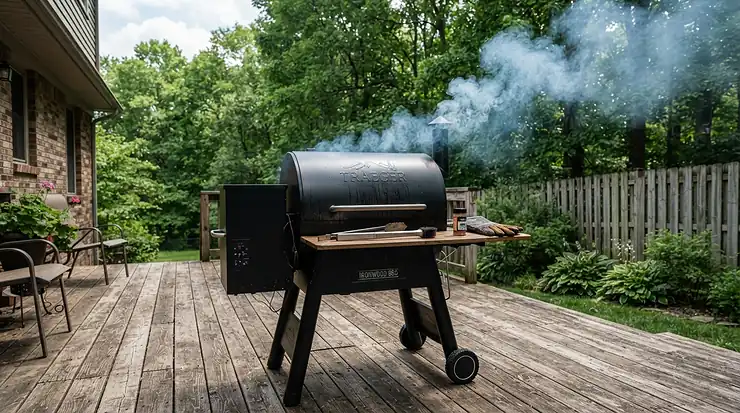
An entry level pellet grill is a wood-pellet-fueled cooker that automates smoking and grilling with a hopper, an auger feed system, and a digital temperature controller. It usually costs somewhere between the high-$300s and about $700. You choose a temperature, the grill meters out fuel, and you go enjoy your afternoon.
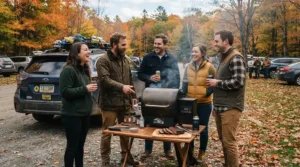
That convenience is the whole pitch. Think of a pellet grill as a charcoal smoker, a gas grill, and a kitchen oven that agreed to share one body. The tricky part is the shelf. Prices stretch from “sure, why not” to “is that a used car?”, and the spec sheets all sound identical. Shopping for your first entry level pellet grill shouldn’t require a degree in thermodynamics.
This guide covers seven real models, from a budget pellet grill for beginners to a stretch-budget searing machine. It also explains which entry level pellet grill features deserve your money. One honest note: I haven’t cooked on these grills, so you won’t find fake tasting notes here. What you will find is spec analysis, aggregated reviewer sentiment from published tests and owner feedback, and practical advice for choosing an affordable set and forget smoker you’ll actually enjoy using.
Quick Comparison: Entry Level Pellet Grill Picks at a Glance
| Grill | Cook Area | Hopper | Price Range | Best For |
|---|---|---|---|---|
| Z Grills 700D4E | 697 sq in | ~20 lb | Mid-$400s to low-$500s | Best all-round value |
| Pit Boss 850 DX | 840 sq in | 21 lb | Roughly $450-$650 (varies by retailer) | Most space plus a searing lever |
| Z Grills ZPG-450A2 | 459 sq in | 15 lb | Under $400 | Tightest budgets |
| Traeger Westwood | 653 sq in | 18 lb | Around $700 | Brand polish and app control |
| Recteq RT-B380 Bullseye | 380 sq in | 15 lb | Budget bracket, check current price | Small households who want to sear |
| Traeger Ranger | 176 sq in | 8 lb | Around $400-$450 | Tailgating and camping |
| Weber Searwood 600 | 648 sq in | 20 lb | Around $900-$1,000 | Stretch pick with true searing |
Looking at the table, the Z Grills 700D4E and Pit Boss 850 DX give the most cooking area per dollar, so they suit most families. The Z Grills ZPG-450A2 is the lowest-cost way into PID control, while the Traeger Ranger trades space for portability. The Weber Searwood 600 costs noticeably more, but it’s the only grill here that sears like a real grill.
💬 Just one click — help others make better buying decisions too!😊
Top 7 Entry Level Pellet Grills: Expert Analysis
Each pick below gets the same treatment. You’ll see what the specs mean in practice, who the grill suits, and what published reviews say. Prices are ranges only and move often, so check current listings.
1. Z Grills 700D4E — PID precision at a bargain price
Budget grills usually make you trade temperature accuracy for cook space. The Z Grills 700D4E mostly refuses that trade. You get 697 square inches (504 main rack plus 193 upper), a hopper of roughly 20 lb on most listings, a 180-450°F range, and two meat probes. That’s room for several rib racks plus a couple of chickens, with a probe pair to track a pork shoulder and a side dish without lifting the lid. The dual-wall insulated body helps the grill hold heat when wind or cool weather tries to steal it.
Based on the spec comparison, this is a strong budget pellet grill for beginners who plan to host. The 450°F ceiling is the catch. It bakes, roasts, and smokes beautifully, but steakhouse searing isn’t on the menu.
Reviewers consistently report that the PID controller settles in and holds within roughly 10-15°F once dialed in. Several outlets call that excellent at this price. A common comparison is that the app experience and cleanup polish trail premium brands. Older versions also lacked Wi-Fi, so confirm the listing matches what you want.
Pros:
- ✅ Tight temperature holding for the price
- ✅ Huge cook area per dollar spent
- ✅ Twist-open hopper cleanout for flavor swaps
Cons:
- ❌ 450°F ceiling limits real searing
- ❌ App polish trails the big brands
Expect the mid-$400s to low-$500s range (check current price). Verdict: the best overall value in this roundup.
2. Pit Boss 850 DX — most cook space plus a flame-broiler lever
Pit Boss built the Pit Boss 850 DX around a simple idea: more grill, more features, fewer dollars. It offers 840 square inches, a 21 lb hopper, a Wi-Fi and Bluetooth PID controller, and a 180-500°F range. A lever slides open a direct-flame zone for high-heat searing.
Here’s what that means in practice. A hands-on review from Smoked BBQ Source reports the 21 lb hopper carried an overnight-style chuck roast cook at around 200°F without a refill. The standout is probe-triggered Keep Warm. Once your meat hits its target, the grill drops to roughly 180°F, which is a real safety net for anyone who falls asleep during a long cook.
This grill suits beginners who want room to grow into brisket and big gatherings. One availability note: it’s a Lowe’s exclusive, so Amazon availability may vary. The Pit Boss Competition Series 850 is a near-identical spec sibling worth checking.
Reviewers praise the stable PID control. One recurring complaint is pellets “log jamming” in the hopper on long cooks, so stir them occasionally.
Pros:
- ✅ 840 sq in of cook space
- ✅ Probe-triggered Keep Warm protects overnight cooks
- ✅ Flame broiler lever adds direct-flame searing
Cons:
- ❌ Hopper log-jam reports on long cooks
- ❌ Heavy at roughly 164 lb
Expect roughly the $450-$650 range depending on retailer (check current price). Verdict: the biggest cooking area for the money.
3. Z Grills ZPG-450A2 — PID control for under $400
The Z Grills ZPG-450A2 proves a digital temperature controller no longer belongs only to expensive grills. Its 459 square inches suit a household of three to five. The 15 lb hopper, 180-450°F range, foldable front shelf, one meat probe, and included rain cover round out a package that’s friendly to patios.
On paper, 459 square inches sounds modest. In practice it holds multiple rib racks or a medium brisket flat. The foldable shelf is the unsung hero, because you need a place to set a hot pan when you open the lid.
This is the pick for first-timers who want to test whether pellet grilling fits their life before spending more. Reviewers consistently call it a budget champion. They also note limited searing power, thinner steel than premium brands, and struggles in very cold weather. The older 450A lacked the hopper cleanout the 450B added, so verify what your listing includes.
Pros:
- ✅ PID controller at an entry-level price
- ✅ Compact footprint for small patios
- ✅ Foldable shelf and rain cover included
Cons:
- ❌ Too small for big parties
- ❌ Thinner steel and weak cold-weather performance
Expect under $400 (check current price). Verdict: the lowest-risk way into pellet smoking.
4. Traeger Westwood — the friendliest Traeger entry ticket
The Traeger Westwood is Traeger’s most accessible grill. It offers 653 square inches across two tiers (428 plus 225), an 18 lb hopper, a 180-450°F range, and WiFIRE app control. A side shelf, a bottom shelf, and P.A.L. rail accessories are included. One wired probe ships in the box, and it’s also compatible with Traeger’s wireless probe.
Traeger kept the controller deliberately simple. Reviewers note the missing Super Smoke and Keep Warm modes, plus no pellet sensor, so you can’t get a low-fuel alert. In practice, you’ll eyeball the hopper before every long cook. Owners cite “hopper runs out faster than expected” as the classic surprise.
This grill suits buyers who value brand ecosystem, accessories, and an app that behaves. If you want maximum cook space per dollar, the Pit Boss and Z Grills options win. The Men’s Journal review recommends it for first-time pellet buyers moving from gas.
Pros:
- ✅ Polished Traeger app and WiFIRE connectivity
- ✅ Two-tier 653 sq in cook area
- ✅ Side and bottom shelves for prep room
Cons:
- ❌ No pellet sensor, so check fuel manually
- ❌ Fewer controller modes than pricier Traegers
Expect around $700 (check current price). Verdict: you’re paying for brand polish more than raw capability.
5. Recteq RT-B380 Bullseye — compact open-flame searing
The Recteq RT-B380 Bullseye looks like the odd one out, and that’s the point. Its 380 square inches fit three whole chickens, about 20 burgers, or two pork butts. A PID controller and an open-flame design exposing the grate to fire give it a range of roughly 200°F to nearly 750°F. A stainless dome and a weight of only about 55-70 lb (sources differ) make it easy to move.
What does open flame mean for you? It sears like a gas grill while still smoking like a pellet cooker. Smoked BBQ Source calls it a perfect weekday grill for feeding a family.
The trade-offs are real. The 15 lb hopper limits very long cooks, and the standard model lacks Wi-Fi. The Deluxe RT-B380X adds Wi-Fi, an 18 lb hopper, a front shelf, and a 1,000°F firepot.
Pros:
- ✅ Searing heat most pellet grills can’t match
- ✅ PID control with stainless construction
- ✅ Light and easy to reposition
Cons:
- ❌ Only 380 sq in of cook space
- ❌ Standard model has no Wi-Fi
Prices fall inside the budget bracket (check current price). Verdict: a great small-household pick for people who love steak as much as ribs.

6. Traeger Ranger — tailgate-ready portability
The Traeger Ranger turns pellet grilling into a carry-in-the-truck hobby. It has about 176 square inches of cooking space, an 8 lb hopper, a Digital Arc controller, a 450°F maximum, Keep Warm mode, a built-in meat probe, and a cast iron griddle.
Those 176 square inches fit a rack of ribs, six burgers, or ten hot dogs. The hopper is the number to respect. Guides note that at high heat an 8 lb load lasts only a few hours, so budget refills for longer cooks. At roughly 60 lb, “portable” means two-handed.
It’s the right pick for RV owners, tailgaters, and balcony cooks, assuming your lease and local fire rules allow pellet grills. Owner reviews are warm, but one called it a good workhorse that’s hard to clean.
Pros:
- ✅ Portable pellet grilling with real smoke flavor
- ✅ Cast iron griddle included
- ✅ Keep Warm mode and built-in probe
Cons:
- ❌ Small cook area and small hopper
- ❌ Heavy for a portable grill
Expect around $400-$450 (check current price). Verdict: wonderful on the road, a compromise at home.
7. Weber Searwood 600 — the stretch pick that actually sears
The Weber Searwood 600 costs roughly double the typical entry level grill, but it fixes pellet grilling’s biggest weakness: searing. It offers 648 square inches (420 main plus 228 upper), a 20 lb side-mounted hopper, a 180-600°F range, DirectFlame cooking, and Weber Connect app control. Weber says it heats up in about 15 minutes.
The side hopper is meaningful. AmazingRibs’ review notes it replaced the rear hopper on Weber’s earlier SmokeFire, which caused pellets to hang up on the way to the auger. You’re buying a grill that learned from its own mistakes.
Reviewers praise the sear and the beginner-friendly app. Complaints include fast pellet consumption at 600°F and no pellet sensor on the standard 600 (the XL has one). Weber also covers the cookbox for five years.
Pros:
- ✅ True searing up to 600°F
- ✅ Side hopper avoids older feed problems
- ✅ Stable, beginner-friendly Weber Connect app
Cons:
- ❌ Costs far more than other picks here
- ❌ Burns pellets quickly at high heat
Expect around $900-$1,000 (check current price). Verdict: worth it if you’d otherwise buy a gas grill and a smoker.
Top 7 at a Glance: Specs, Price Ranges and Best Uses
| Grill | Temp Range | Controller | Price Range | Best For |
|---|---|---|---|---|
| Z Grills 700D4E | 180-450°F | PID, 2 probes | Mid-$400s to low-$500s | Families on a budget |
| Pit Boss 850 DX | 180-500°F (plus flame broiler) | PID, Wi-Fi and Bluetooth | ~$450-$650 | Big cooks and overnight smokes |
| Z Grills ZPG-450A2 | 180-450°F | PID, 1 probe | Under $400 | First-time buyers |
| Traeger Westwood | 180-450°F | Simplified digital, Wi-Fi | Around $700 | App and brand fans |
| Recteq RT-B380 Bullseye | ~200-750°F | PID, no Wi-Fi (standard) | Budget bracket | Searing small batches |
| Traeger Ranger | 180-450°F | Digital Arc | ~$400-$450 | Travel cooking |
| Weber Searwood 600 | 180-600°F | Digital, Wi-Fi | ~$900-$1,000 | Searing plus smoking |
If you want to smoke more than sear, the Z Grills 700D4E and Pit Boss 850 DX deliver the most value. The Recteq RT-B380 Bullseye and Weber Searwood 600 are the choices if steak night matters as much as pulled pork. The Traeger Westwood earns its price only if you value the ecosystem, while the Traeger Ranger wins only when portability tops your list.
How to Choose an Entry Level Pellet Grill
The short answer: pick an entry level pellet grill with a PID digital temperature controller, enough cook space for your household, and a hopper that matches how long you actually cook. Here’s the process:
- Set a realistic budget. The $400-$700 bracket buys genuinely good grills, and spending less than that usually costs you controller quality.
- Match cook area to your table. Roughly 450 square inches feeds three to five people, while 650-850 is comfortable for hosting.
- Prioritize the digital temperature controller. PID controllers hold steadier temperatures than basic on/off ones, and steady temperature is the entire point of this hobby.
- Check pellet hopper capacity against your cooks. Brisket and pork shoulder need bigger hoppers than burgers and chicken.
- Look for a cleanout door. A hopper cleanout lets you swap flavors or empty wet pellets in seconds.
- Decide whether you want searing. Most entry grills top out near 450-500°F, so pick a Bullseye, flame-broiler lever, or Searwood if you want steakhouse sears.
- Read the warranty. Terms range from two to five years in this roundup, and parts availability matters more than a headline number.
Entry Level Pellet Grill Features That Actually Matter (And Those That Don’t)
Marketing departments love long feature lists. Smart buyers filter them. These are the entry level pellet grill features that change your cooking.
What matters: a digital temperature controller with PID logic, a hopper cleanout door, good grease management, locking casters, and at least one included meat probe. The probe is underrated. It lets you cook to internal temperature rather than the clock, which is how pros cook.
What matters less: the “8-in-1” label. Every pellet grill grills, smokes, bakes, roasts, and braises, because they’re all ovens with a fire in them. Extra side shelves are nice, but they’re not worth paying a premium. Headline temperature numbers can also mislead. A 1,000°F claim is irrelevant if you mostly smoke at 225-275°F.
Wi-Fi is the gray area. For long overnight cooks, app alerts are genuinely helpful. For weeknight burgers they’re a gadget. If you want a budget pellet grill for beginners, spend your first dollars on controller quality before connectivity.
Pellet Hopper Capacity: How Much Do You Actually Need?
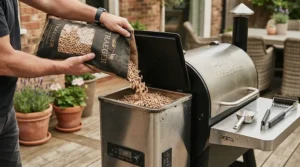
Pellet hopper capacity decides how long your grill runs unattended. Pellets burn slowly at smoking temperatures and quickly at high heat, so the same hopper might give you many hours of low-and-slow smoking or only a few hours of searing.
Published figures show the range. The Traeger Ranger holds 8 lb, which guides say lasts just a few hours at high heat. Mid-size hoppers hold 15-18 lb, and larger ones such as the Pit Boss 850 DX hold 21 lb. Smoked BBQ Source reports an 8-hour cook around 200°F needed no refill on that grill.
For an overnight pork shoulder, aim for at least 18-20 lb. For burgers and chicken, 8-15 lb is plenty. Pellet hopper capacity is useless without reliable feeding, which is why cleanout doors and well-designed hopper slopes matter. Also, a grill without a pellet sensor, like the Traeger Westwood, needs a quick visual check before long cooks.
Auger Feed System: The Quiet Engine Behind Set and Forget
If the controller is the brain, the auger feed system is the heartbeat. An auger is a motor-driven corkscrew that carries pellets from the hopper to the firepot, where a hot rod ignites them. According to Traeger’s support documentation, the motor turns the shaft at a set rate (typically around 2 RPM) and cycles on and off to match temperature demand.
That cycling is what makes an affordable set and forget smoker possible. At low temperatures the auger rests more, and at high temperatures it works harder. The controller times those pulses, and that’s how PID models keep smoke smooth.
Where do problems start? Moisture. Pellets that absorb water swell and can jam an auger feed system. Hopper design matters too. Weber’s older SmokeFire had a rear hopper that caused feed problems, which is why the Weber Searwood 600 moved to a side hopper. The practical lesson: store pellets dry, don’t leave a full hopper exposed to rain, and empty the hopper before long storage periods.
Digital Temperature Controller: PID vs. Basic
A digital temperature controller reads the grill’s temperature and adjusts the auger and fan to hit your target. Older budget grills used simple on/off logic, which could swing 25°F or more around the target. PID controllers (proportional-integral-derivative) feed fuel in smaller, more frequent pulses and anticipate changes instead of just reacting to them.
BBQ Ember’s review of the Z Grills 700D4E says its PID holds within about 10°F under stable conditions. Pit Boss owners reportedly see swings closer to 5°F after the grill stabilizes. Those are good numbers for this category.
Controllers also differ in features beyond accuracy. The Pit Boss 850 DX adds probe-triggered Keep Warm. The Traeger Westwood keeps its controller simple, with no Super Smoke or Keep Warm. The Weber Searwood 600 pairs its controller with the Weber Connect app. For a beginner, steady temperature and probe support beat every other digital temperature controller bell and whistle.
Entry Level Pellet Grill vs Traditional Alternatives
| Factor | Entry Level Pellet Grill | Gas Grill | Charcoal Smoker |
|---|---|---|---|
| Smoke flavor | Real wood smoke | Minimal | Strongest |
| Effort during a cook | Low (set and walk away) | Low | High (fuel and vent management) |
| Searing | Limited, unless flame-exposed | Excellent | Excellent |
| Needs electricity | Yes | No | No |
| Best For | Z Grills 700D4E, Pit Boss 850 DX | Weeknight burgers | Hobbyist pitmasters |
Looking at the table, the pellet grill’s edge is effort, not raw flavor. A charcoal smoker still produces the strongest smoke, but it demands attention, practice, and fuel management. A gas grill sears better and starts faster, but it won’t give you a wood-fired brisket. The Recteq RT-B380 Bullseye and Weber Searwood 600 narrow the searing gap, while the rest of the entry level pellet grill category stays happiest between 225°F and 450°F.
Budget Pellet Grill for Beginners: Your First 30 Days
Your first month sets your habits. Here’s a practical plan that works with any grill in this roundup.
Day 0: Assemble and season. Follow your manual’s burn-in procedure. Plug into a properly protected outlet (Recteq specifies a GFCI outlet), prime the auger, and let the grill run its first fire.
Days 1-7: Start forgiving. Cook chicken thighs, sausages, and burgers. Use the probe, and trust the thermometer over the clock.
Weeks 2-3: Try low and slow. Smoke a pork shoulder or chuck roast. Fill the hopper fully, check pellet levels, and keep the lid closed.
Week 4: Learn maintenance. Vacuum ash from the firepot, scrape the grease tray, and check the hopper for damp pellets. Many manufacturers recommend regular cleaning intervals, so check your manual.
Common first-30-day mistakes: opening the lid constantly, skipping the probe, using damp pellets, and cooking by time instead of temperature. A budget pellet grill for beginners rewards patience, and the learning curve is short.
Affordable Set and Forget Smoker: Real-World Scenarios
Specs only matter when matched to a life. Here are four profiles.
The weeknight family of four, around a $450 budget, cooking twice a week on a patio. The Z Grills 700D4E fits best. It has the space for family dinners and weekend ribs, and its PID control keeps results consistent.
The apartment dweller or RV traveler, small space, occasional use. The Traeger Ranger fits, assuming your building allows pellet grills. It stores easily and handles ribs, burgers, and breakfast on the included griddle.
The weekend pitmaster-in-training who also loves steak. The Pit Boss 850 DX handles long smokes and offers a flame-broiler lever, while the Weber Searwood 600 is worth the stretch if budget allows.
The brand-first, app-first buyer. The Traeger Westwood gives you the ecosystem and accessories, even if it costs more per square inch.
Treat any affordable set and forget smoker as an appliance, not a hobby, until you’ve done ten cooks. Then upgrade if you outgrow it.
Problem → Solution Guide: Common First-Year Headaches
Problem: temperatures swing in wind or cold. Solution: park the grill out of direct wind, keep the lid closed, and use the included rain cover when idle. Dual-wall models like the Z Grills 700D4E insulate better, though the Z Grills ZPG-450A2 reportedly struggles most in extreme cold.
Problem: the grill runs out of pellets mid-cook. Solution: check levels before every long cook. The Traeger Westwood and standard Weber Searwood 600 lack pellet sensors, so make this a habit.
Problem: weak smoke flavor. Solution: smoke at lower temperatures first, use quality hardwood pellets, and avoid opening the lid. Lower temperatures produce more smoke on pellet grills.
Problem: pellets won’t feed. Solution: empty damp pellets through the cleanout door, clear jams, and store pellets in a sealed bin. Stir the hopper on long cooks on grills like the Pit Boss 850 DX.
Problem: flare-ups. Solution: clean the grease tray and drip system regularly, because built-up grease is a common culprit.
Long-Term Cost and Value: What an Entry Level Pellet Grill Really Costs
| Tier | Grills | Price Range | Value Verdict |
|---|---|---|---|
| Budget | Z Grills ZPG-450A2 | Under $400 | Lowest-risk entry |
| Value | Z Grills 700D4E, Pit Boss 850 DX, Recteq RT-B380 Bullseye | ~$400-$650 | Best space or features per dollar |
| Portable | Traeger Ranger | ~$400-$450 | Pay for portability, lose space |
| Brand | Traeger Westwood | Around $700 | Pay for polish |
| Stretch | Weber Searwood 600 | ~$900-$1,000 | Replaces gas grill plus smoker |
The numbers show a clear sweet spot between roughly $400 and $650. Below that you give up space or features, and above it you’re paying for brand, searing, or connectivity. The Weber Searwood 600 may be better value than it looks if it replaces two appliances.
Upfront price isn’t total cost. Budget for pellets, a cover, a spare probe, and eventually wear parts like igniters. Warranty terms in this roundup range from two years to five, and shorter terms make parts support more important. Fuel use also varies: the Weber Searwood 600 burns pellets quickly at high heat, while the Traeger Ranger‘s small hopper means more frequent refills.
Common Mistakes When Buying an Entry Level Pellet Grill
Buying the cheapest grill without PID. An older on/off controller can swing widely, and swings ruin low-and-slow cooks.
Ignoring pellet hopper capacity. An 8 lb hopper is fine for burgers and a headache for brisket.
Overbuying size. A giant grill burns more pellets to heat an empty chamber. Be honest about how many people you feed.
Expecting steakhouse sear from a 450°F grill. Models like the Z Grills 700D4E, Z Grills ZPG-450A2, Traeger Westwood, and Traeger Ranger top out at 450°F. If searing matters, choose the Recteq RT-B380 Bullseye, Pit Boss 850 DX, or Weber Searwood 600.
Skipping availability checks. Some models are retailer-exclusive, like the Pit Boss 850 DX at Lowe’s, so verify where it’s sold before you plan around it.
Paying for features you won’t use. Wi-Fi, extra shelves, and brand names are nice. Controller quality and hopper design matter more.
Safety, Pellets and Food Safety Guide
Pellet grills are safe appliances when used sensibly. Keep the grill on a level, non-flammable surface and away from walls and overhangs. Use a properly protected electrical outlet. Never leave a hopper of damp pellets sitting, because it can jam the auger. Only use food-grade pellets made for cooking.
Food safety matters just as much as fire safety. The USDA’s grilling food safety guidance says poultry should reach 165°F, ground meats 160°F, and whole cuts of beef, pork, lamb, and veal 145°F with a short rest, all measured with a food thermometer. It also notes smoker temperatures of 250-300°F for safety. Many hobbyists smoke lower, which makes probe-based internal temperature checks even more important.
This is exactly why a built-in probe beats a clock. Pair it with a reliable controller, and your set and forget routine stays safe.

FAQ
❓ How much does a good entry level pellet grill cost?
❓ Can a budget pellet grill for beginners smoke brisket?
❓ Do I need Wi-Fi on an entry level pellet grill?
❓ How long does a bag of pellets last on an affordable set and forget smoker?
❓ Can I use a pellet grill in rain or winter?
Conclusion
The best entry level pellet grill is the one that matches your cooking habits, not the one with the longest spec sheet. For most households, the Z Grills 700D4E offers the most balanced mix of PID control, space, and price. If you want maximum room and a searing lever, the Pit Boss 850 DX is hard to ignore, while the Z Grills ZPG-450A2 is the cheapest respectable way in.
Choose the Traeger Westwood if the Traeger ecosystem matters to you, the Recteq RT-B380 Bullseye if small-batch searing is your thing, and the Traeger Ranger if you cook on the road. If your budget stretches, the Weber Searwood 600 earns its price by replacing both a gas grill and a smoker.
Whichever you choose, focus on the fundamentals: a good digital temperature controller, a feed system that works, and enough pellet hopper capacity for your cooks. Get those right, and your first entry level pellet grill will do exactly what it promises. You set the temperature and relax while it handles the rest.
✨ Ready to start smoking?
🔍 Compare current pricing and availability on your favorite pick above, and take the first step toward effortless wood-fired flavor. Your future ribs are waiting!
Recommended for You
- Charcoal Kettle Grill Review For Beginners: 7 Proven Picks (2026)
- Charcoal Grill For Searing Steaks: 7 Ultimate Picks For 2026
- Charcoal Grill For Apartment Balconies: 7 Smart Picks (2026)
Disclaimer: This article contains affiliate links. As an Amazon Associate, I earn from qualifying purchases. If you purchase products through these links, we may earn a small commission at no additional cost to you.
✨ Found this helpful? Share it with your friends! 💬🤗
