
In This Article
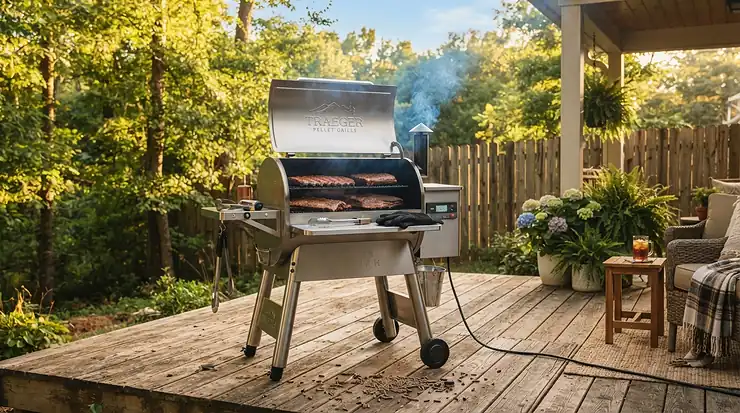
Picture a Saturday afternoon. Neighbors are drifting over, the smoker is holding steady, and your only job is holding a cold drink. That’s the promise of a mid range pellet grill for backyard cooks, and in 2026 the hardware can finally keep it.
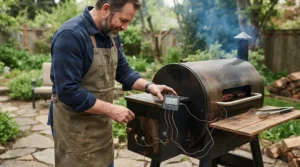
Quick refresher. Pellet grills burn compressed wood pellets that an auger feeds into a fire pot, while a controller manages fuel and airflow to hold your set temperature. Budget models do that job well enough. Premium models do it gorgeously, at prices that make your wallet whimper. The middle is where the real decisions live: better insulation, smarter controllers, thicker steel, and warranties that mean something.
Roundups this year place the whole category anywhere from roughly $500 to $3,500. That’s a spectacular spread. This guide narrows it to seven real, currently sold models: Weber Searwood 600, Camp Chef Woodwind Pro 24, Traeger Woodridge Pro, recteq RT-700, Pit Boss Navigator 850, Z Grills 700D6, and Grilla Grills Silverbac.
Instead of recycling spec sheets, we weigh each one against what decides whether you’ll still love it in year five. That means grill grate square inches, temperature consistency, probe ports and mid-range smoker build quality.
Everything here rests on published specifications and aggregated reviewer findings, framed as exactly that. No invented test drives, no made-up customer quotes. Just honest analysis, a pinch of humor, and a clear path to the right mid range pellet grill for backyard cooks like you.
Quick Comparison: 7 Mid Range Pellet Grills at a Glance
Here’s the 30-second version. The table lines up the seven grills on the numbers that shape a purchase: cooking area, top temperature, warranty and fit. Prices are ranges at the time of research and may vary, so check current price on the retailer’s page before you commit.
| Model | Cooking Area | Top Temp | Warranty | Price Range | Best For |
|---|---|---|---|---|---|
| Weber Searwood 600 | 648 sq in | 600°F | 5-year cookbox, 3-year electronics | Around $1,000 | Sear-first cooks |
| Camp Chef Woodwind Pro 24 | 811 sq in | 500°F (flame lever reportedly higher) | 3-year body | $1,000–$1,200 | Smoke-flavor chasers |
| Traeger Woodridge Pro | 970 sq in | 500°F | 10-year (per Traeger) | Around $1,100 | Big cookouts, app fans |
| recteq RT-700 | 702 sq in | 700°F | 6-year | Around $1,200 | Long-term owners |
| Pit Boss Navigator 850 | 932 sq in | 500°F (1,000°F flame broiler) | 5-year | $700–$900 | Space per dollar |
| Z Grills 700D6 | 697 sq in | 500°F | 3-year | Mid-$600s | Budget-minded first buyers |
| Grilla Grills Silverbac | 692 sq in | 500°F | 4-year | $900–$1,100 | Stainless-build seekers |
Read the table as a map, not a scoreboard. The Traeger Woodridge Pro offers the biggest grate and the longest listed warranty, while the recteq RT-700 is the only pick that reaches 700°F, with a smaller grate to match. Budget buyers should note that the Z Grills 700D6 sits at the bottom of the price range with a surprisingly close cooking area, but the savings come from a 3-year warranty and no Wi-Fi. For high heat, the Weber Searwood 600, Pit Boss Navigator 850 and Camp Chef Woodwind Pro 24 each take a different route to the same crust.
💬 Just one click — help others make better buying decisions too!😊
Top 7 Mid Range Pellet Grill Picks for Backyard Cooks: Expert Analysis
Every pick below is a real model sold today. Specs come from manufacturer and retailer listings plus published reviews. Where sources disagree, I say so.
1. Weber Searwood 600 — DirectFlame searing without a diffuser plate
Most pellet grills sear like a polite suggestion. The Weber Searwood 600 skips the large diffuser plate that mutes heat on many rivals, so flame energy reaches the food more directly.
The numbers: 648 square inches, a 180–600°F range and a 20 lb side-mounted hopper. In practice, 600°F means a thick ribeye can finish with real crust. The side hopper is also the direct fix for the rear-hopper feed jams that haunted Weber’s discontinued SmokeFire. One reviewer clocked about 13 minutes to reach full heat, which is quick for a pellet grill.
Based on the spec comparison, this is the grill for people who cook burgers, chicken and steaks three nights a week and smoke ribs on weekends. What the spec sheet won’t tell you is that shelves and some extras cost more, so budget a little beyond the sticker.
Reviewers consistently praise the sear and fast preheat. The recurring complaints are accessory costs and a grate that feels snug for crowds.
Pros:
- ✅ Real sear marks without a diffuser plate
- ✅ Fast preheat to 600°F
- ✅ Side hopper avoids the old feed-jam design
Cons:
- ❌ Shelves and extras cost more
- ❌ Compact grate for large crowds
Expect around $1,000, the upper edge of mid-range. With a 5-year cookbox warranty it’s solid value for sear-first cooks, but check current price.
2. Camp Chef Woodwind Pro 24 — smoke box adds stick-burner depth
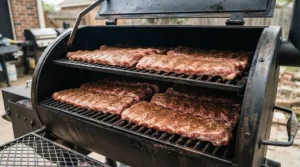
Pellet smoke is famously polite. The Camp Chef Woodwind Pro 24 turns the volume up with a slide-out Smoke Box where you add wood chunks, chips or charcoal, plus a 1–10 Smoke Number setting.
It offers 811 square inches, split into a 429-square-inch lower grate and a 382-square-inch upper rack. That two-tier layout lets you run ribs above and chicken below. A Wi-Fi PID controller handles temperature, and the grill accepts Camp Chef’s Sidekick add-ons, such as a propane griddle or sear box. One review roundup citing the spec sheet also credits a Slide and Grill lever with direct-flame searing up to 650°F.
My analytical take: if flavor intensity is your obsession, this may be the most adjustable smoke dial in the category. One experienced reviewer said it offers more smoke control than any pellet grill they’ve tested. It rewards tinkerers more than set-and-forget cooks.
Review themes lean positive on the smoke box and controller. Common gripes are the box blocking a front-shelf option and a two-piece upper rack that divides opinion.
Pros:
- ✅ Adjustable smoke via Smoke Number and Smoke Box
- ✅ 811 sq in across two tiers
- ✅ Sidekick expansion for griddle or sear
Cons:
- ❌ 3-year warranty trails several rivals
- ❌ Smoke box blocks front shelf option
List pricing runs about $1,000–$1,200, though retail discounts are common. It’s strong value if flavor is your priority.
3. Traeger Woodridge Pro — biggest grate and the longest warranty
Traeger’s mid-range play is refreshingly simple: more room, more tech, longer coverage. The Traeger Woodridge Pro delivers 970 square inches, a 24 lb hopper with a digital pellet sensor, Super Smoke Mode and WiFIRE app control.
Translated to real life, 970 square inches handles a brisket and a rack of ribs with space left over. The pellet sensor alerts you before an overnight cook runs dry. Max temperature is 500°F, so steaks want a cast iron assist. Traeger’s own product page lists a 10-year limited warranty, though some retailer listings show different terms, so verify at purchase.
Here’s what to weigh: this is a smoker-first, convenience-first machine. One 2026 review notes owners often report the built-in sensor reading high, with a 225°F display versus roughly 200°F on a third-party probe. The common workaround is trusting an external probe, and the base model ships with just one wired probe.
Reviewers praise the polished app and low-effort cooking.
Pros:
- ✅ 970 sq in for big cookouts
- ✅ Super Smoke Mode and pellet sensor
- ✅ Longest listed warranty in this group
Cons:
- ❌ Built-in sensor reportedly reads high
- ❌ Only one wired probe included
Launch pricing put the Pro around $1,100 (the base Woodridge, with 860 square inches, launched near $900). For hosts who value space and support, the value verdict is strong.
4. recteq RT-700 — stainless build and a 40 lb hopper
Some grills feel like appliances. The recteq RT-700 feels like equipment.
It offers 702 square inches of primary space, expandable to roughly 1,054 with the optional top shelf, a 180–700°F range, and a hopper that holds 40 lb. One reviewer reports an average burn near a pound per hour, which makes overnight smokes practical without midnight refills. The 700°F ceiling is real, though it’s a diffuser-plate sear rather than true open flame. The RT-700 carries a 6-year warranty on materials and workmanship, and reviewers describe two included meat probes.
For mid-range smoker build quality, this is the benchmark in this group: heavy stainless construction, tidy welds and an interior light for late-night checks. If you plan to keep a grill a decade, the cost per year starts to look sane.
Reviewers repeatedly praise construction and customer support. The complaints are a basic app, finicky Wi-Fi pairing, and no easy way to dump unused pellets.
Pros:
- ✅ Heavy stainless steel construction
- ✅ 40 lb hopper for marathon cooks
- ✅ 6-year warranty on materials and workmanship
Cons:
- ❌ Basic app and finicky Wi-Fi setup
- ❌ Pricier than similar-size rivals
Around $1,200 direct puts it at the top of the range. It’s the best long-haul value here for frequent cooks.
5. Pit Boss Navigator 850 — flame broiler muscle at a friendlier price
The party trick here is a lever. The Pit Boss Navigator 850 slides open its Flame Broiler for direct-flame searing, which Pit Boss rates up to 1,000°F, while the controller runs 180–500°F in 5-degree steps.
That’s 932 square inches over two tiers, a 30 lb hopper with a sight window, porcelain-coated grates and Wi-Fi plus Bluetooth. It has two probe ports with one probe included, and a 5-year warranty. Sear on the upper rack while a brisket idles below, and you’ve got dinner and dessert on one machine.
One 2026 reviewer found food near the hopper side and front finished faster, so placement matters and you’ll want to rotate. Flame-broiler setups also mean a bit more scraping at cleanup. The upside is strong, smoke-forward flavor and real open-flame grilling.
Reviewers generally rate it as sturdy and good for the money, with the app described as functional rather than polished.
Pros:
- ✅ Flame Broiler lever for direct-flame searing
- ✅ 932 sq in with 30 lb hopper
- ✅ 5-year warranty plus Wi-Fi and Bluetooth
Cons:
- ❌ Reviewers report uneven heat across the grate
- ❌ Only one probe in the box
Retailers varied at the time of research, roughly $700–$900. That makes it the best square-inches-per-dollar pick, so check current price.
6. Z Grills 700D6 — dual-wall insulation on a lean budget
Dual-wall insulation used to be a premium perk. The Z Grills 700D6 puts it on a budget pellet grill.
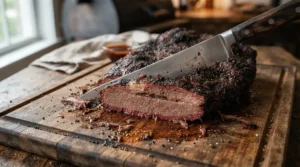
It gives you 697 square inches, a PID controller (listings cite V2.1 or 3.0, so confirm the version), a dual-wall insulated lower chamber, two meat probes, hopper cleanout and an included cover. Insulation matters because a wind-chilled firebox burns extra pellets to hold temperature. One reviewer reported a steady 225°F for over six hours on a single hopper load. Hopper size is listed inconsistently across retailers, from 18 to 28 lb, so verify before buying.
For first-time buyers, this is the lowest-risk way into pellet cooking. The trade-offs are no Wi-Fi on this version (the 700D4E adds it), a 3-year warranty, and tight clearance, about 3.5 inches, between racks on 700-series models.
Reviewers praise the value, the included cover and the easy pellet swaps.
Pros:
- ✅ Dual-wall insulation helps in cold weather
- ✅ Two meat probes included
- ✅ Cover included, easy hopper cleanout
Cons:
- ❌ No Wi-Fi on this version
- ❌ Tight clearance between the two racks
Prices land in the mid-$600s, the lowest here. If you don’t need an app, the value is hard to beat.
7. Grilla Grills Silverbac — stainless guts, family-owned underdog
Not every great grill has a famous logo. The Grilla Grills Silverbac is a lesser-known performer built around stainless steel where parts wear out.
You get 692 square inches (507 main plus 185 upper, expandable to 877 with the optional rack extension), a 180–500°F range, a 20 lb side hopper and the Alpha Connect Wi-Fi controller with PID and Pro modes. Quarter-inch stainless grates clean easily, a double-wall steel thermal jacket helps in cold weather, and a dump chute makes swapping flavors painless. The warranty is 4 years.
Here’s the honest read: it’s a build-quality play, not a feature-count play. The 500°F ceiling limits true searing, and the box includes one probe. One reviewer mentioned replacing the temperature probe several times, a reminder that sensors are wear items on any grill.
Reviewers consistently praise construction and customer service.
Pros:
- ✅ Stainless grates and interior parts
- ✅ Double-wall thermal jacket for cold weather
- ✅ Pellet dump chute for quick flavor swaps
Cons:
- ❌ 500°F ceiling limits true searing
- ❌ Only one meat probe included
Expect roughly $900–$1,100 depending on cart style. It’s fair value if you’ll keep it for years.
Top 7 at a Glance: Build and Feature Snapshot
| Model | Standout Build Trait | Probe Setup | Smart Control | Best For |
|---|---|---|---|---|
| Weber Searwood 600 | DirectFlame, side hopper | Two inputs; box contents reported differently | Weber Connect | Sear plus smoke |
| Camp Chef Woodwind Pro 24 | Smoke Box, Smoke Number | Controller and app monitoring; confirm included probes | Wi-Fi and Bluetooth | Flavor tinkerers |
| Traeger Woodridge Pro | Pellet sensor, Super Smoke | One wired probe | WiFIRE | Hosts, app lovers |
| recteq RT-700 | Stainless build, 40 lb hopper | Two probes reported | Wi-Fi app | Long-term owners |
| Pit Boss Navigator 850 | Flame Broiler lever | Two ports, one probe | Wi-Fi and Bluetooth | Space per dollar |
| Z Grills 700D6 | Dual-wall insulation | Two probes | None on this version | Budget first grills |
| Grilla Grills Silverbac | Stainless, thermal jacket | One probe | Alpha Connect Wi-Fi | Durability seekers |
Notice how the extras cluster. The recteq RT-700 and Grilla Grills Silverbac spend on materials, while the Traeger Woodridge Pro and Pit Boss Navigator 850 spend on size and connectivity. If you only remember one rule, remember this one: pay for the trait you’ll use every cook, not the one that looks good on a box.
Setup and First-30-Days Guide: Start Your Grill Right
A great grill can still be ruined by a sloppy first month. Here’s the playbook.
Assembly and Placement
Plan on an afternoon. Reviewers report anywhere from under an hour (Z Grills 700D6) to roughly three hours for the Woodridge line. Choose level, non-combustible ground near an outdoor outlet. The Weber Searwood 600, for example, ships with an 8-foot grounded cord, so measure before you commit to a spot.
Seasoning Run
Run the grill at about 350°F for 45 minutes before the first cook to burn off manufacturing oils and cure the finish, following your manual’s exact steps.
Your First Cook
Pick something forgiving, like chicken thighs or burgers. Calibrate your probe first by dunking it in ice water, which should read near 32°F. That one-minute test tells you whether to trust the dial.
Maintenance Rhythm
- After every cook: scrape grates and empty the grease tray.
- Every few cooks: vacuum ash from the fire pot.
- Monthly: check gaskets, hopper moisture and wiring. Pellets hate humidity.
- Always: cover the grill when idle.
Mistakes to Avoid in the First 30 Days
- Loading damp pellets.
- Blocking vents with foil.
- Skipping ash cleanout.
- Trusting a dome thermometer over a probe.
Treat these four rules like dental hygiene. Boring, but they prevent expensive problems.

Real-World Scenarios: Matching the Grill to Your Backyard
Specs are abstract. Backyards are not. Here are three realistic profiles.
Scenario 1: The Weeknight Family Cook
You cook four nights a week for a family of four, mostly burgers, chicken and the occasional steak, with a budget near $1,000. The Weber Searwood 600 fits because fast preheat and real sear marks suit short weeknight windows. If you’d rather save a couple hundred dollars and gain space, the Pit Boss Navigator 850 offers direct flame plus 932 square inches.
Scenario 2: The Weekend Brisket Obsessive
You smoke every other weekend in a cold, windy climate. The recteq RT-700 brings a 40 lb hopper and heavy stainless steel, so overnight cooks stay calm. On a tighter budget, the dual-wall Z Grills 700D6 cuts pellet waste when temperatures drop.
Scenario 3: The Host With a Crowd
You throw monthly cookouts for 12 and love checking the grill from the couch. The Traeger Woodridge Pro pairs 970 square inches with app alerts and a pellet sensor. If smoke flavor is the headline, the Camp Chef Woodwind Pro 24 adds Smoke Box depth plus Sidekick expansion.
✨ Ready to Upgrade Your Backyard?
🔍 Take your backyard cooking to the next level with these carefully selected pellet grills. Click on any highlighted product name to check current pricing and availability. The right grill will help you create authentic wood-fired meals your family and friends will love! 🔥
What Is a Mid Range Pellet Grill for Backyard Cooks?
A mid range pellet grill for backyard cooks is a wood-pellet smoker-grill priced roughly between $600 and $1,300 that pairs a PID controller, 600–1,000 square inches of cooking space, sturdier steel or insulation, a meaningful warranty and optional Wi-Fi, giving home cooks consistent smoke, sear and bake performance without premium-tier pricing.
Why does the label matter? Because the budget tier often trades away insulation, controller refinement or warranty length, while the premium tier adds extras like heavier materials and high-end tech that many backyard cooks never fully use. The middle is where pellet grill upgrade features start earning their keep: better temperature consistency, richer smoke control, stronger construction. It’s also where the confusing choices live, which is precisely why a framework helps.
How to Choose a Mid Range Pellet Grill for Backyard Cooks
- Match grate size to your guest count. Compare grill grate square inches honestly. A family of four rarely needs 970, while a monthly host might.
- Decide smoke-first or sear-first. A 500°F ceiling suits smoking and roasting. If steaks matter, favor 600–700°F or a flame lever.
- Check controller and insulation. PID control plus dual-wall or thermal-jacket construction is your best bet for temperature consistency.
- Count probe ports and what ships in the box. Two ports with one probe still means buying another.
- Inspect build and warranty. Compare materials (stainless versus powder coat) and coverage length, not just marketing adjectives.
- Budget for extras. Shelves, covers and Wi-Fi sometimes cost extra. Check current price and what’s included.
Mid-Range Smoker Build Quality: Where Your Money Actually Goes
Build quality is the hidden line item. It’s what separates a grill that looks great in year one from one still performing in year eight.
Materials and Finishes
The recteq RT-700 and Grilla Grills Silverbac lean on stainless steel in key areas, with quarter-inch stainless grates on the Silverbac. The Traeger Woodridge Pro and Pit Boss Navigator 850 use porcelain-coated cast iron grates, which retain heat well but need care to avoid chipping. The Weber Searwood 600 uses plated steel grates and heavy-gauge steel construction.
Warranty as a Confidence Signal
- Traeger Woodridge Pro: 10 years per Traeger
- recteq RT-700: 6 years
- Weber Searwood 600: 5 years cookbox, 3 years electronics, sensors and grates
- Pit Boss Navigator 850: 5 years
- Grilla Grills Silverbac: 4 years
- Camp Chef Woodwind Pro 24 and Z Grills 700D6: 3 years
A longer warranty signals confidence, but read what it covers. Electronics and finishes often get shorter terms. Manufacturers broadly claim 6 to 10 years of life with normal use, and routine cleaning does more for that number than any spec.
Temperature Consistency: What PID Control Delivers in Practice
PID controllers learn how long and how much fuel it takes to hit your target under current conditions, then tune the pellet feed accordingly. That’s the theory. In the real world, temperature consistency depends on insulation, wind, lid discipline and probe accuracy.
Independent testing is a useful reality check. One AmazingRibs review of the Weber Searwood 600 measured actual grate temperatures about 15°F below the set point at 225°F, 350°F and 600°F. That’s not a failure, it’s a consistent offset you can plan around. Reviews of the Traeger Woodridge Pro describe a different offset, with the built-in sensor reading high versus an external probe.
Insulation is the quiet hero. The Z Grills 700D6 and Grilla Grills Silverbac use dual-wall designs that help hold heat in cold, breezy weather. Meanwhile, the Pit Boss Navigator 850 shows why hot spots matter: one reviewer saw food near the hopper side finish first.
My advice: treat advertised tolerances as marketing until you verify them. Run a cheap two-probe check on your first cook and note the offset. After that, temperature consistency becomes a habit instead of a gamble.
Grill Grate Square Inches: How Much Cooking Space Do You Need?
Grill grate square inches are the headline number on every box, and also the most misunderstood.
Total vs. Primary vs. Upper Rack
The recteq RT-700 lists 702 square inches of primary space (1,054 with its optional top shelf). The Camp Chef Woodwind Pro 24 offers 429 lower plus 382 upper for 811 total. The Pit Boss Navigator 850 reaches 932 across two tiers, and the Traeger Woodridge Pro gives 970. The Weber Searwood 600 lists 648, though its XL sibling, the Weber Searwood XL 600 at around $1,300, stretches to 972 with a 630-square-inch lower grate.
Practical Sizing
As a rule of thumb, 600–700 square inches covers a family of four plus a few guests. Hosts who regularly cook for 10 or more should look at 900-plus. Remember that upper racks sit close to the lower ones, so tall cuts and whole turkeys may need the top rack removed. One reviewer noted just 3.5 inches of clearance on a Z Grills 700-series model.
Bigger isn’t free. More grate means longer preheats, more pellets and a heavier machine on your patio. Buy the space you’ll use at least monthly, not the space you’ll use once a year.
Pellet Grill Probe Ports: Small Detail, Big Payoff
Pellet grill probe ports let you track internal meat temperature without opening the lid. Opening the lid is the number one way to wreck temperature consistency.
The Pit Boss Navigator 850 offers two ports with one probe included. The Traeger Woodridge Pro ships with one wired probe, and the Grilla Grills Silverbac includes one as well. The Z Grills 700D6 and recteq RT-700 are described as shipping with two. For the Weber Searwood 600, reviewers disagree on whether one or two probes come in the box, so confirm what ships.
Two probes beat one because you can monitor two cuts, or one cut and the ambient temperature. A spare probe is a cheap insurance policy.
Don’t forget safety. The USDA’s safe minimum internal temperature chart lists 145°F for whole cuts of beef, pork and lamb, 160°F for ground meats and 165°F for poultry. Barbecue classics like brisket and pulled pork are cooked far past those floors for tenderness, but the chart is your safety baseline. Probes make hitting it easy.
Pellet Grill Upgrade Features Worth Paying For (And Those That Don’t)
Marketing loves adjectives. Here’s an expert filter for pellet grill upgrade features.
Worth Paying For
- Dual-wall insulation or a thermal jacket: the most reliable cold-weather and pellet-economy upgrade. See the Z Grills 700D6 and Grilla Grills Silverbac.
- Direct-flame access: the Pit Boss Navigator 850 and Camp Chef Woodwind Pro 24 let you sear without a separate grill.
- A hopper cleanout or dump chute: swapping flavors becomes a 30-second job.
- A pellet sensor: the Traeger Woodridge Pro warns you before the fire goes out mid-cook.
- Adjustable smoke: the Smoke Box and Smoke Number system on the Camp Chef Woodwind Pro 24.
Nice, But Not Essential
- Wi-Fi: fantastic if you travel between yard and kitchen, redundant if you hover nearby. The Z Grills 700D6 proves PID accuracy doesn’t require an app.
- Rotisserie and add-on ecosystems: the Weber Searwood 600 and Camp Chef Woodwind Pro 24 both support extras, but they’re wish-list items, not day-one needs.
- Extra storage: tidy, but easily replaced with a rolling cart.
The shopping rule: upgrade the parts that touch fire, fuel and temperature first. Convenience features come second.
Versatile Pellet Grill for Backyard Use: Smoke, Sear, Bake and Beyond
A versatile pellet grill for backyard use should handle low-and-slow ribs on Saturday, pizza night on Tuesday and a quick burger on a rushed Thursday. Not every model does all three equally.
Sear and High Heat
The recteq RT-700 reaches 700°F, the Weber Searwood 600 hits 600°F with DirectFlame, and the Pit Boss Navigator 850 offers an open-flame lever. Models capped at 500°F, like the Traeger Woodridge Pro and Grilla Grills Silverbac, are smoke-and-roast machines that pair well with a cast iron pan.
Baking and Beyond
Pellet grills behave like outdoor ovens, so bread, casseroles and pizzas are all fair game. The Camp Chef Woodwind Pro 24 goes further with Sidekick attachments that add a griddle or sear box.
| Factor | Pellet Grill | Gas Grill | Charcoal Grill |
|---|---|---|---|
| Flavor | Mild to moderate wood smoke | Minimal smoke flavor | Strongest smoky character |
| Convenience | Set temp, auto-fed, needs power | Fast start, propane | Hands-on fire management |
| Temperature Control | Automated PID (varies by model) | Knob control, quick response | Manual vent control |
| High-Heat Searing | Model-dependent | Strong | Strong |
| Best For | Low-and-slow plus easy weeknights | Quick, simple meals | Flavor purists |
Pellet grills win on convenience and versatility, but reviewers often describe their smoke flavor as milder than a true stick burner’s. If you crave bold smoke, look at the Smoke Box on the Camp Chef Woodwind Pro 24 or Super Smoke on the Traeger Woodridge Pro. If searing is non-negotiable, a gas or charcoal grill still wins on raw heat unless you choose a pellet model with direct flame.
Long-Term Cost, Maintenance and Safety
Sticker price is just the entry fee. The real cost is what you pay over a decade.
Pellets, Parts and Per-Year Math
Reviewers commonly cite roughly half a pound to a pound of pellets per hour at smoking temperatures, with cold weather and high heat burning more. Dual-wall insulation helps. As an illustration, a grill around $1,200 kept eight years averages $150 a year, while a $650 grill replaced after four averages about $162. Longevity can erase a price gap.
Expect to replace wear parts eventually: igniters, temperature sensors and gaskets. Keep spares if your grill is your weekend ritual.
Maintenance and Safety Habits
Scrape grates, empty grease and vacuum ash on a schedule. Store pellets dry. For placement, NFPA grilling guidance says to keep children and pets at least three feet from the grill and never leave it unattended while in use. Position it well away from the house, deck railings and overhanging branches. Many local fire codes use a 10-foot guideline, so check yours before choosing a spot.

FAQ: Mid Range Pellet Grill for Backyard Cooks
❓ Can a mid range pellet grill sear a steak properly?
❓ Do I really need Wi-Fi on a pellet grill?
❓ How many pellets does a pellet grill burn per hour?
❓ How long should a mid range pellet grill last?
❓ Are pellet grills safe to leave running overnight?
Conclusion
Here’s the honest bottom line. There’s no single winner, only the grill that matches your cooking.
Sear-first cooks should look hard at the Weber Searwood 600. Flavor chasers will love the adjustable smoke on the Camp Chef Woodwind Pro 24. Hosts who want room and a long warranty should shortlist the Traeger Woodridge Pro, while keep-it-for-a-decade buyers get the best long-haul build in the recteq RT-700. Value hunters will find the Pit Boss Navigator 850 hard to beat for space and open-flame cooking. The Z Grills 700D6 is the lean, low-risk first grill, and the Grilla Grills Silverbac is the stainless-steel dark horse.
Whatever you choose, let the fundamentals lead: grill grate square inches that fit your crowd, temperature consistency you’ve verified with a probe, enough probe ports, and mid-range smoker build quality you can trust. Prices change, so check current price and warranty terms before you click.
✨ Your Best Backyard Cookout Starts Here!
🔥 Click on any highlighted product name to check current pricing and availability, then fire up a grill that turns ordinary weekends into wood-smoked memories your family will talk about for years. 🍖
Recommended for You
- Entry Level Pellet Grill: 7 Best Picks That Won’t Disappoint (2026)
- Charcoal Kettle Grill Review For Beginners: 7 Proven Picks (2026)
- Charcoal Grill For Searing Steaks: 7 Ultimate Picks For 2026
Disclaimer: This article contains affiliate links. As an Amazon Associate, I earn from qualifying purchases. If you purchase products through these links, we may earn a small commission at no additional cost to you.
✨ Found this helpful? Share it with your friends! 💬🤗
