
In This Article
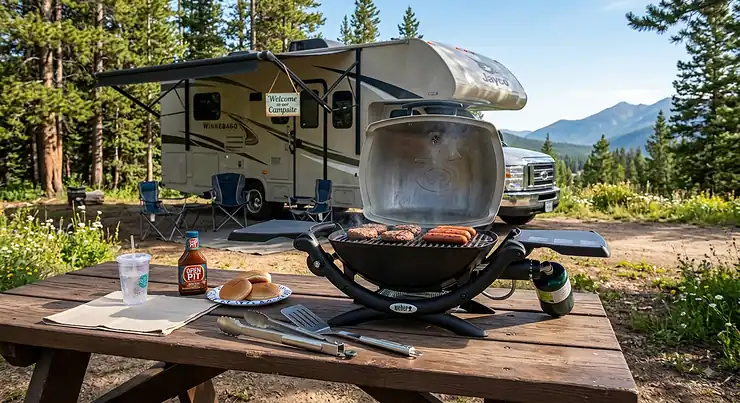
Somewhere between “let’s boondock this weekend” and “wait, what’s for dinner,” every RV owner runs into the same wall: your rig has a stove, sure, but nothing that gets you that char-marked, backyard-summer flavor without stinking up the cab. That’s the gap a good best portable grill for RV setup fills, and it’s a bigger decision than it looks. You’re not just picking a grill — you’re picking something that has to survive washboard roads, fit in a bay the size of a shoebox, and either mount to your low-pressure propane line or run happily on a one-pound bottle from the gas station.
We dug through real product listings, manufacturer spec sheets, and aggregated owner feedback across seven grills that actually earn their keep on the road — from a $70 wall-mount unit to a griddle-grill hybrid that could feed a whole campground potluck. This isn’t a rehash of an Amazon listing. It’s commentary grounded in what the specs mean once you’re standing at a campsite with tongs in one hand and a paper plate blowing away in the other.
Whether you’re outfitting a Class A motorhome, a teardrop trailer, or a truck camper, there’s a grill here sized and priced for your situation. We’ll walk through all seven contenders, break down how RV propane systems actually work (this trips up more first-timers than anything else), and hand you a decision framework so you’re not guessing at the store — or worse, returning a grill because it doesn’t fit your propane hookup.
Quick Comparison Table
| Grill | Fuel Type | Cooking Area | Price Range | Best For |
|---|---|---|---|---|
| Weber Q1200 | 1lb propane bottle | 189 sq in | $200-$260 | Best all-around portable grill |
| Camping World Low Pressure Gas Grill | RV low-pressure hookup | 214 sq in | Under $100 | Cheapest true RV-mount option |
| Flame King RV/Trailer Mounted BBQ | RV low-pressure hookup | 214 sq in | $100-$150 range | Permanent side-mount setups |
| Cuisinart CGG-180T Petit Gourmet | 1lb propane bottle | 145 sq in | Under $100 | Tightest storage bays |
| Blackstone Tailgater | 1lb propane bottle | 219 sq in | $150-$200 range | Grill-and-griddle combo cooking |
| Camp Chef Explorer 2X | 20lb tank or adapter | 604 sq in (with box) | $200-$300 range | Modular, expandable cook systems |
| Coleman RoadTrip 285 | 1lb propane bottle | 285 sq in | $200-$250 range | Full-size grilling on folding legs |
Here’s the thing the table above can’t tell you outright: cooking area and price don’t move together in a straight line. The Camping World Low Pressure Gas Grill beats grills twice its price on square inches simply because it skips the folding cart and legs that eat into a manufacturer’s budget. Meanwhile, the Camp Chef Explorer 2X looks expensive until you realize it’s really a modular cooking platform — the grill box is one of several interchangeable tops, which changes the math on long-term value. If your RV already has a low-pressure quick-connect port, the mounted options jump way up in convenience even though they’re the cheapest line items here.
💬 Ready to see which pick fits your rig? Scroll down for the full breakdown — or jump straight to your favorite below!
Top 7 Best Portable Grills for RV: Expert Analysis
1. Weber Q1200 — most trusted name in portable grilling
The standout here is simple: Weber has been refining this exact form factor for over a decade, and it shows in every hinge and knob. The single stainless steel burner puts out 8,500 BTU across a 189-square-inch porcelain-enameled cast-iron grate, which is enough heat to sear a burger properly but not so much that you’re fighting flare-ups on a 2×4 picnic table.
What that BTU number means in practice: you get consistent, even heat without the hot spots that plague cheaper single-burner units, and the cast-iron grates hold temperature well enough to handle a quick sear-then-move technique. Folding side tables give you actual prep space, which sounds minor until you’ve tried to butter corn on your knee.
Based on the spec comparison, this is the pick for RVers who grill often enough to care about build quality but don’t want to deal with mounting hardware or low-pressure conversions — it just screws onto a standard green 1lb bottle and goes. Reviewers consistently report that the porcelain finish resists rust far better than painted-steel competitors, even after years of being tossed in a truck bed. A recurring complaint in user reviews is that the small bottle only lasts a few hours of active cooking, so a spare canister or an adapter hose to a 20lb tank is worth budgeting for.
Pros:
- ✅ Even heat distribution with minimal flare-ups
- ✅ Porcelain-enameled body resists rust for years
- ✅ Folding side tables add real prep space
Cons:
- ❌ Single 1lb bottle burns through fuel quickly
- ❌ No low-pressure RV hookup compatibility out of the box
Expect to pay somewhere in the $200-$260 range depending on color and retailer promotions — pricier than the RV-mount options, but the resale value and reliability make it a reasonable long-term bet.
2. Camping World Low Pressure Gas Grill — cheapest true RV-mount option
This one skips the fancy branding and goes straight for function: a 10,000 BTU stainless burner under a 214-square-inch cooking surface, built specifically to connect to your RV’s existing low-pressure propane line via quick connect.
That low-pressure design matters more than it sounds. Your RV’s onboard regulator already steps propane down to about 11 inches water column, and this grill’s burner and orifice are sized for exactly that pressure — no aftermarket regulator swap required. The bracket doubles as a mount for the side of your rig or a stand for tabletop use, so you’re not locked into one setup style.
What most buyers overlook about this model is that it doesn’t come bundled with the hose and quick-connect fitting needed to actually tie into your RV — that’s a separate purchase, and skipping it is the single most common first-time mistake with mounted RV grills. Aggregated owner sentiment on this style of grill trends positive for the price point, though a common theme in feedback for budget mounted grills generally is thinner steel construction that dents more easily than premium alternatives.
Pros:
- ✅ Purpose-built for low-pressure RV propane systems
- ✅ Under $100, the least expensive mount-ready option
- ✅ Doubles as tabletop or side-mount grill
Cons:
- ❌ Hose and quick-connect fitting sold separately
- ❌ Lighter-gauge steel than premium mounted grills
At under $100, this is squarely the budget pick — ideal for weekend campers who want mounted convenience without a big upfront spend.
3. Flame King RV or Trailer Mounted BBQ — best for permanent side-mount setups
The standout advantage on this one is the hanging tool rack built right into the design, turning it into something closer to a scaled-down version of your home grill rather than a bare-bones camping accessory.
With 214 square inches of cooking space and a 10,000-BTU stainless burner, it’s built for the exact same low-pressure quick-connect system as the Camping World unit above, but with a heavier frame and an included upper warming deck. The temperature control knob is genuinely precise compared to the on/off feel of cheaper burners, which matters if you’re trying to keep chicken from drying out in a stiff campground breeze.
Here’s what the spec sheet won’t tell you, but reviewers note: the mounting hardware is sturdy enough to survive highway vibration over thousands of miles, which is the actual failure point on cheaper mounted grills — not the burner, but the bracket shaking loose. This is the pick for full-time RVers who plan to leave the grill mounted semi-permanently rather than stow it after every use. Aggregated review sentiment highlights the included carry bag as a nice touch for the rare occasions owners do remove it, though some buyers note the ignition can be finicky in windy conditions and benefits from a lighter as backup.
Pros:
- ✅ Heavy-duty mounting bracket built for highway travel
- ✅ Upper warming deck and hanging tool rack included
- ✅ Precise flame control for consistent temperatures
Cons:
- ❌ Electronic ignition can struggle in wind
- ❌ Heavier than tabletop-only alternatives
Priced in the $100-$150 range, it sits just above the budget tier but earns the extra cost through hardware that’s actually built for permanent installation.
4. Cuisinart CGG-180T Petit Gourmet — most compact for tight storage bays
This is the grill for RVers whose storage math simply doesn’t work out — the standout feature is a footprint small enough to slide into a wet bay alongside your hoses and leveling blocks without a second thought.
At 145 square inches of cooking space powered by a 1lb propane bottle, it’s not going to feed a dozen people, but the porcelain-enameled grate and lid retain heat well enough for two to four servings of burgers, sausages, or grilled vegetables in one pass. The folding stainless steel legs collapse flat, and the whole unit weighs light enough that packing it isn’t a two-person job.
What most buyers overlook about compact grills like this is that smaller cooking surface actually means faster preheat times — you’re often ready to cook in under five minutes, which matters on a rushed travel day. Reviewers consistently report solid heat retention for the size, though a recurring theme in feedback is that direct sunlight can make the black-lidded surface hot to the touch, so a heat-resistant glove is worth keeping in the same storage bin.
Pros:
- ✅ Small enough for the tightest RV storage bays
- ✅ Fast preheat time compared to larger grills
- ✅ Lightweight enough for single-person setup
Cons:
- ❌ Cooking surface too small for large groups
- ❌ Lid gets hot to the touch in direct sun
Expect to spend under $100 for this one, making it one of the most budget-friendly picks on the list without sacrificing build quality.
5. Blackstone Tailgater — best grill-and-griddle combo
The standout here is versatility: this unit ships with both a traditional grill grate and a flat-top griddle plate, letting you swap between seared steaks and Sunday-morning pancakes without buying two appliances.
Running on a 1lb propane bottle with roughly 219 square inches of usable surface, the griddle side in particular solves a problem RVers rarely think about until they’re camping: eggs, bacon, and pancake batter are a mess to cook on a standard grate. Based on the spec comparison, the two-in-one design effectively replaces both a camp stove griddle attachment and a separate grill, which is real storage savings even if the unit itself isn’t the smallest on this list.
What the spec sheet won’t tell you, but aggregated reviews suggest, is that the griddle plate holds heat impressively well for a portable unit, making it forgiving for beginners who tend to over- or under-cook things on thinner cookware. A common complaint in user reviews centers on the plastic side shelf feeling less durable than the metal cooking surfaces, so treat it as a light-duty prep spot rather than a place to set heavy cast iron.
Pros:
- ✅ Interchangeable grill grate and griddle plate
- ✅ Griddle side excels at breakfast and delicate foods
- ✅ Replaces two separate cooking appliances in one footprint
Cons:
- ❌ Side shelf feels flimsy under heavier cookware
- ❌ Larger footprint than dedicated compact grills
Priced in the $150-$200 range, it’s a genuinely smart middle-ground buy for RVers who cook more than just dinner outdoors.
6. Camp Chef Explorer 2X — best modular, expandable cook system
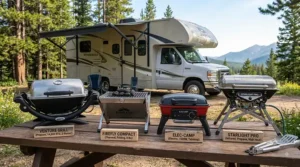
The standout advantage isn’t the grill box itself — it’s that the whole system is modular, meaning the same base stove accepts a griddle, a grill box, or even a pizza oven attachment depending on what you’re cooking that night.
Each burner puts out roughly 30,000 BTU, which on paper sounds enormous for a portable unit, and in practice it is — this thing sears steak restaurant-style in a way single-burner grills simply can’t match. That power comes with a caveat worth understanding before you buy: on a low-pressure RV hookup, lighting a second burner will noticeably drop the output of the first, since the RV regulator can’t flow gas as fast as a full-size 20lb tank feed can.
Here’s what most buyers overlook: this system shines brightest when run off a dedicated 20lb propane tank rather than your RV’s built-in line, so budget for that separate tank and an 8-foot connector hose if you want the full performance. Reviewers consistently rate the fold-out side tables and windscreen as genuinely useful in real campsite conditions, and a recurring theme in owner feedback is that the legs fold flat enough to store the whole unit under a truck bed cover.
Pros:
- ✅ Massive 30,000 BTU-per-burner output for fast searing
- ✅ Modular accessories expand into griddle or oven setups
- ✅ Sturdy fold-out legs and built-in windscreen
Cons:
- ❌ Full power requires a separate 20lb tank, not RV low pressure
- ❌ Heavier and bulkier than single-burner alternatives
In the $200-$300 range for the stove plus grill box, it’s an investment, but one that pays off for RVers who genuinely love cooking on the road.
7. Coleman RoadTrip 285 — best full-size grilling on folding legs
The standout feature is the wheeled cart design — this is the closest thing on our list to a real backyard grill, complete with legs that fold down and wheels that let you roll it from the bay to the campsite without lifting a thing.
With 285 square inches of cooking space across two burners, it’s the largest cooking surface among the true portable (non-mounted) options here, putting out enough heat to handle a full spread for a family of five or six. The swappable cooktop system — grill grate, griddle, or stove-top grate — mirrors the Camp Chef’s modularity, just in a lighter, more travel-friendly package.
Based on the spec comparison, the wheeled-cart form factor is what most buyers overlook as a real advantage: you’re not hauling a heavy grill body across gravel, you’re rolling it, which matters more than it sounds like after a long travel day. Aggregated owner sentiment consistently praises the stand-up height as easier on the back than tabletop grills, though a common theme in reviews is that the folded footprint is still bulkier than tabletop units, so it demands real storage space, not just a corner of a bay.
Pros:
- ✅ Rolling cart design eliminates awkward carrying
- ✅ Largest cooking surface among non-mounted portable options
- ✅ Swappable grill, griddle, and stove-top surfaces
Cons:
- ❌ Bulkier folded footprint than tabletop alternatives
- ❌ Two burners draw more fuel than single-burner grills
Expect to pay in the $200-$250 range, which is competitive given the cooking area and the cart convenience you’re getting for that money.
Understanding Your RV Propane Hookup: Low-Pressure vs High-Pressure Systems
This is the single most common point of confusion for anyone shopping for an RV propane hookup grill, and getting it wrong means a grill that either won’t light or floods with unburned gas. Your RV’s built-in propane system runs through a regulator that steps tank pressure down to roughly 11 inches of water column — what plumbers and RV techs call “low pressure.” Grills like the Camping World Low Pressure Gas Grill and the Flame King RV or Trailer Mounted BBQ are engineered specifically around that pressure, with wider gas orifices sized to flow enough fuel at the lower pressure to actually cook.
Standalone grills like the Weber Q1200 or Coleman RoadTrip 285, by contrast, are built with their own internal regulator designed to step down from a full-pressure 1lb bottle or 20lb tank. Connect one of these directly to your RV’s already-regulated low-pressure line, and you’re running two regulators in series — the gas essentially chokes to nothing, and the grill won’t reach temperature even with the valve wide open.
The fix, if you want a non-mount grill to run off your RV’s tank instead of separate bottles, is a dedicated adapter hose that bypasses the grill’s built-in regulator and taps directly into the RV’s quick-connect port before its own regulation stage. Several manufacturers, including Camp Chef, sell purpose-built RV connection hoses for exactly this reason. Skip this step, and you’ll be the person at the campground shaking a “dead” grill, convinced it’s broken when it’s actually a pressure mismatch. For a deeper technical breakdown of how propane pressure and regulation actually work, the Department of Energy’s propane fuel basics guide is a genuinely useful primer.
🔥 Don’t Get Stuck With the Wrong Hookup!
Match your grill to your RV’s propane system before you buy — check current listings and confirm low-pressure compatibility now.
Real-World Scenarios: Which Grill Fits Your Rig?
Picture three different RVers, because “best” genuinely depends on who’s asking. First, there’s the weekend warrior in a travel trailer, hitting three or four campgrounds a summer with the family. For this group, something like the Cuisinart CGG-180T Petit Gourmet or the Weber Q1200 makes the most sense — compact, no mounting commitment, and easy to stow between trips without dedicating permanent space to it.
Then there’s the full-timer living in a Class A or fifth-wheel year-round, who grills often enough that convenience trumps portability. This is exactly the situation the Flame King RV or Trailer Mounted BBQ was designed for — mount it once, connect it to the onboard propane line, and never think about fuel canisters again. It becomes as routine as the stove inside.
Finally, there’s the group camper — the family reunion or scout-troop leader hauling a fifth-wheel loaded with food for a dozen people. For that scenario, the Camp Chef Explorer 2X or Coleman RoadTrip 285 earns its bulk; both can realistically feed a crowd in one or two batches instead of standing at a single-burner grill for an hour straight. Matching the grill to the actual use case — not just the price tag — is the single biggest factor in whether you’ll love or resent the purchase six months in.
Compact Grill Storage: Fitting Cooking Gear Into Tight RV Bays
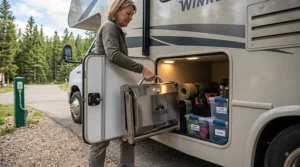
Compact grill storage is one of those problems nobody thinks about until they’re standing at the storage bay door realizing the grill they bought doesn’t actually fit next to the sewer hose and the folding chairs. A few practical fixes go a long way here. First, measure your intended storage spot before you buy — not after — accounting for the grill’s folded dimensions, not its open cooking footprint, since manufacturers rarely lead with the folded measurements on the product page.
Second, consider a dedicated storage bag or bin, even for grills that don’t ship with one. Loose grates and grease trays rattling around a bay is how you end up with scratched propane lines and a grill that smells like every meal you’ve ever cooked. The Cuisinart CGG-180T Petit Gourmet and similar compact units are popular specifically because their folded profile slides into narrow “basement” bays that swallow up hoses and cords anyway.
Third, if you’ve gone the mounted route with something like the Camping World Low Pressure Gas Grill, storage stops being a packing problem and becomes a protection problem instead — a simple weatherproof cover keeps road grime and rain off the burner when it’s not in use, extending its life significantly. Whatever you pick, keeping propane hardware, tools, and the grill itself organized in one dedicated kit saves real time at every single campsite setup.
How to Choose the Best RV Gas Grill
Picking the best RV gas grill for your situation comes down to weighing a handful of factors against how you actually camp, not how you imagine you’ll camp. Here’s the framework we’d use:
- Fuel compatibility first. Decide whether you want to tap your RV’s low-pressure line or run separate 1lb bottles — this single choice eliminates half the market immediately.
- Match cooking area to party size. A couple doesn’t need 285 square inches; a family reunion needs more than 145.
- Weigh storage space honestly. Measure the bay before falling for a feature list.
- Consider mounting vs. portability. Full-timers benefit from permanent mounts; weekend travelers usually prefer grab-and-go units.
- Check build materials. Porcelain-enameled and stainless steel resist road grime and rust far better than painted steel over multiple seasons.
- Factor in accessory ecosystems. Modular systems like Camp Chef’s cost more upfront but expand as your camp-cooking habits grow.
- Read aggregated review themes, not star averages alone. A 4.5-star grill with a recurring ignition complaint tells you more than the number itself.
Running through this checklist against the seven grills above should narrow things down fast — most RVers land on an answer within two or three of these criteria.
Best Grill for Travel Trailer vs Motorhome: What’s Different
The honest answer is that fuel system and available real estate matter more than the vehicle type itself, but there are real patterns worth knowing. A best grill for travel trailer pick often leans compact and low-pressure-compatible, since travel trailers are frequently towed to a single base camp and left connected for days — making a mounted option like the Flame King RV or Trailer Mounted BBQ genuinely convenient rather than overkill.
Motorhomes, on the other hand, tend to have slightly more generous storage bays relative to their propane tank capacity, which opens the door to bulkier, higher-output options like the Camp Chef Explorer 2X or Coleman RoadTrip 285 — especially for owners who tow a separate vehicle and don’t need to conserve every cubic inch of basement space. A propane grill for motorhome use also benefits more from a dedicated 20lb tank setup, since motorhomes often already carry auxiliary generators and larger onboard tanks that make running a second, separately-fed appliance simpler.
Fifth-wheels and truck campers split the difference — generally more storage than a travel trailer, less than a Class A — which is exactly the middle ground the Blackstone Tailgater and Weber Q1200 occupy nicely.
Common Mistakes When Buying a Propane Grill for Motorhome Use
Even seasoned RVers trip over the same handful of errors when shopping for a propane grill for motorhome or trailer use. The first, and most common by a wide margin, is buying a standalone grill and assuming it’ll connect straight to the RV’s quick-connect port — as covered above, mismatched regulation makes this a non-starter without an adapter hose.
The second mistake is underestimating fuel duration. A single 1lb bottle typically delivers one to two hours of active high-heat cooking, which sounds like plenty until you’re mid-cookout for a group and the flame starts sputtering. Carrying a spare bottle, or opting for a mounted grill tied into the RV’s larger tank, solves this permanently.
Third, buyers often skip checking the grill’s folded dimensions against their actual storage space, leading to returns or grills that end up strapped to a bike rack out of desperation. Fourth, some shoppers chase BTU numbers without considering that higher output on a low-pressure system can actually underperform — as the Camp Chef Explorer 2X section above explains, more burners on a limited-flow line means less heat per burner, not more.
Finally, plenty of first-time buyers skip reading the fine print on mounting hardware weight limits, then wonder why a bracket rated for a lighter unit starts to sag after a season of highway miles.
What to Expect: Real-World RV Outdoor Cooking Performance
Specs on a page rarely match the lived experience of RV outdoor cooking, so here’s the translation. Preheat times for compact single-burner grills like the Cuisinart CGG-180T Petit Gourmet typically run three to five minutes — fast enough that you can start prepping food and have working heat by the time you’re done chopping. Larger multi-burner units like the Coleman RoadTrip 285 take slightly longer, closer to five to eight minutes, simply because there’s more grate mass to bring up to temperature.
Wind is the variable nobody warns you about enough. Campsites are frequently more exposed than a suburban backyard, and even a modest breeze can knock 50-75°F off your effective cooking temperature on an ungaurded grill. This is where built-in windscreens, like the one on the Camp Chef Explorer 2X, earn their keep — and it’s worth angling any grill so its opening faces away from prevailing wind whenever possible.
Altitude matters too, more than most people expect. Propane grills lose some efficiency at higher elevations due to lower ambient oxygen levels, so mountain camping trips may mean slightly longer cook times across the board regardless of which grill you own. None of this makes any of the seven picks above a bad choice — it just means real-world results will vary a bit from the sterile conditions a spec sheet implies.
Long-Term Cost & Maintenance for RV Camping Grill Propane Systems
An RV camping grill propane setup isn’t a one-time purchase — it’s an ongoing relationship with fuel costs, replacement parts, and the occasional deep clean. On the fuel side, 1lb bottles run a few dollars each and are convenient but expensive per BTU over time; RVers who grill more than a couple times a month generally save money switching to a refillable adapter that taps a 20lb tank or the RV’s built-in supply instead.
Maintenance-wise, grease trap buildup is the most common failure point across every grill on this list, mounted or portable — a quick wipe-down after each use prevents the kind of caked-on residue that eventually clogs burner ports and causes uneven flames. Porcelain-enameled grates, like those on the Weber Q1200 and Flame King RV or Trailer Mounted BBQ, resist this buildup better than bare stainless and are worth the modest price premium over a multi-year ownership window.
Replacement parts — igniters, hoses, and regulators — typically run $15-40 depending on the brand, and keeping a spare igniter or lighter in your camping kit avoids the frustration of a dead grill on night one of a trip. Total cost of ownership over five years tends to favor mounted, RV-tank-fed grills once you factor out the recurring cost of disposable canisters, even though the upfront sticker price looks cheaper on the portable side.
Features That Actually Matter (And Those That Don’t)
Marketing copy loves to lead with numbers, but not all of them translate to a better cookout. BTU output matters, but only relative to cooking area — a grill pushing 30,000 BTU across 600 square inches isn’t necessarily hotter per square inch than one pushing 8,500 BTU across 189. What actually matters more: burner material (cast stainless resists warping better than thin steel), grate material (cast iron sears better than thin wire grates), and regulator/orifice sizing matched to your fuel source.
What doesn’t matter nearly as much as packaging implies: built-in thermometers on cheaper grills are frequently inaccurate by 25-50°F, so an independent probe thermometer is a better investment than trusting the lid gauge. Flashy color options and “designer” branding, seen on grills like certain Weber Q1200 variants, add cost without changing performance one bit — buy the color you like, but don’t pay extra expecting better cooking from it.
Side shelves and cart wheels, as seen on the Coleman RoadTrip 285, genuinely improve the real-world experience of using a grill at a campsite, even though they rarely show up as a headline spec. If you’re choosing between two similarly-specced grills, these convenience features are often the better tiebreaker than another 1,000 BTU on the burner rating.
Safety & Regulations Guide for RV Propane Grilling
Propane is safe when handled correctly, but the failure modes are serious enough that a few non-negotiable habits are worth building in. Always grill outdoors, at least several feet from your RV’s exterior wall, awnings, and slide-outs — heat and grease splatter can damage siding and awning fabric faster than most people expect, and enclosed spaces trap gas in the event of a leak. The Consumer Product Safety Commission’s grill safety guidance is a solid reference for pre-season inspection habits, including checking hoses for cracking or brittleness before every trip.
Before your first cookout each season, do a soap-and-water leak test on every connection — brush soapy water on hose fittings and watch for bubbles while the gas is on but the grill unlit. Bubbles mean a leak; tighten the connection or replace the hose before lighting anything. Never store a connected propane bottle inside your RV’s cabin or an enclosed vehicle interior, and always transport spare bottles upright with the valve closed. The National Fire Protection Association’s grilling safety resources cover additional seasonal fire-prevention practices worth reviewing annually, particularly around clearance distances and never leaving a lit grill unattended.
Finally, keep a fire extinguisher rated for grease and gas fires within reach anytime you’re cooking, and familiarize yourself with your specific RV model’s propane shutoff location before you ever need to use it in an emergency.
Frequently Asked Questions
❓ What is the best portable grill for RV camping?
❓ Can I hook a regular propane grill up to my RV's propane tank?
❓ How long does a 1lb propane bottle last on a portable grill?
❓ Are mounted RV grills better than portable tabletop grills?
❓ What size grill do I need for a small RV or travel trailer?
Conclusion
There’s no single best portable grill for RV life — there’s only the right grill for how, where, and how often you actually camp. Weekend travelers in a compact trailer will likely be happiest with something like the Cuisinart CGG-180T Petit Gourmet or the ever-reliable Weber Q1200, both of which pack down small and demand nothing more complicated than screwing on a bottle. Full-timers who want to stop thinking about fuel altogether should look hard at mounted, low-pressure options like the Flame King RV or Trailer Mounted BBQ or the budget-friendly Camping World Low Pressure Gas Grill.
For bigger groups, more ambitious cooking, or campers who genuinely love the ritual of a proper cookout, the Camp Chef Explorer 2X, Blackstone Tailgater, and Coleman RoadTrip 285 all deliver real firepower and flexibility, at the cost of a bit more bulk and a slightly steeper price range. Whichever direction you go, match the grill to your propane setup before you buy, measure your storage space honestly, and don’t skip the basic safety habits — a great cookout at a beautiful campsite is one of the actual points of RV life, and the right grill just makes it easier to get there.
✨ Don’t Miss These Exclusive Deals!
🔍 Take your outdoor cooking setup to the next level with these carefully selected RV grills. Click on any highlighted pick to check current pricing and availability, and start planning your next campground cookout with confidence!
Recommended for You
- Portable Grill for Tailgating: 7 Best Picks for Game Day 2026
- Portable Gas Grill for Camping: 7 Picks That Won’t Fail You (2026)
- Best Portable Gas Grill 2026: 7 Top-Rated Picks Reviewed
Disclaimer: This article contains affiliate links. As an Amazon Associate, I earn from qualifying purchases. If you purchase products through these links, we may earn a small commission at no additional cost to you.
✨ Found this helpful? Share it with your friends! 💬🤗
