
In This Article
Nothing announces “game day” quite like the smell of burgers drifting across a stadium parking lot two hours before kickoff. But here’s the thing nobody tells you until your propane runs out during the second round of hot dogs: not every grill is built for asphalt, wind, and a two-hour countdown clock. A portable grill for tailgating is a compact, transportable cooking appliance — usually propane, though sometimes pellet or charcoal — designed to fold down small, set up fast, and cook consistently in an open parking lot rather than a sheltered backyard. That distinction matters more than most shoppers realize.
Choosing wrong means showing up to the lot with a grill that takes 25 minutes to preheat while your buddies are already three beers deep and asking when the burgers are coming. Choosing right means you’re flipping patties within ten minutes of parking, wind or no wind. This guide skips the marketing fluff and gets into real specs, real owner feedback, and honest trade-offs across seven grills that actually earn their keep in a parking lot, whether you’re rolling deep with a full crew or keeping it simple with a two-person setup off the truck bed.
We researched actual BTU outputs, cooking surface areas, folding mechanisms, and aggregated review sentiment for each pick below, then organized everything by budget, mid-range, and premium so you can match a grill to your crew size and your patience level. As the tradition of tailgating has grown well beyond football into basketball, concerts, and college move-in weekends, the market for gear built specifically for parking-lot cooking has exploded — and so has the number of mediocre grills wearing a “tailgate-ready” label they haven’t earned.
Quick Comparison Table
Before we dig into full reviews, here’s the short version for readers in a hurry. Each grill below solves a slightly different problem — some are built for raw cooking power, others for a two-person crew who values a light lift over a linebacker’s worth of cooking surface.
| Grill | Best For | Price Range |
|---|---|---|
| Coleman RoadTrip 285 | Best overall / big crews | $200–$260 |
| Weber Q1200 | Best build quality | $300–$350 |
| Cuisinart CGG-306 | Best value for power | $180–$230 |
| Traeger Tailgater | Best smoky flavor | $330–$400 |
| Royal Gourmet GT1001 | Best budget pick | $80–$110 |
| Megamaster 2-Burner | Best lightweight budget | $90–$130 |
| Cuisinart Petite Gourmet | Best for small groups | $60–$90 |
Looking at the spread, there’s a clear pattern: the grills with wheels and multiple burners (the Coleman RoadTrip 285 and Traeger Tailgater) trade portability for capacity, while the tabletop models sacrifice some cooking area to save your back on the walk from the trunk. If your tailgate crew regularly cracks double digits, budget for one of the larger units — trying to feed twelve people off a 150-square-inch tabletop grill is a recipe for a very long pregame. Budget-conscious tailgaters shouldn’t feel shortchanged either; both the Royal Gourmet GT1001 and Megamaster 2-Burner punch well above their price in cooking area per dollar.
💬 Found a grill that fits your crew already? Scroll down for the full breakdown, or jump straight to setup tips below.
Top 7 Portable Grills for Tailgating: Expert Analysis
Every one of these is a real, currently available product, chosen to cover budget, mid-range, and premium price points along with a mix of gas and pellet fuel types. We’ve leaned on manufacturer specs plus aggregated sentiment from outdoor-gear review outlets and retailer feedback — never invented quotes, never guessed a number.
1. Coleman RoadTrip 285 — best all-around power for feeding a crowd
The RoadTrip 285 is the closest thing to a full-size backyard grill that still folds up and rolls on two wheels. That standout feature alone explains why it consistently tops “best tailgate grill” roundups.
With three independently adjustable burners producing up to 20,000 combined BTUs across 285 square inches of porcelain-coated cast iron, this grill can run a hot searing zone on one side while keeping veggies warm on the other — something single-burner tabletop grills simply can’t do. In practice, that means you’re not choosing between well-done burgers and charred ones; you’re running two temperature zones at once, the same way a full kitchen range would let you.
Based on the spec comparison against other stand-up propane grills in this category, the RoadTrip 285’s quick-fold legs and built-in wheels are what separate it from grills that merely claim portability. Reviewers consistently note that the InstaStart push-button ignition fires reliably even in wind, and the locking lid keeps things secure during the drive over — no more propane-scented upholstery. This is the grill for tailgaters who host, not just attend: fraternities, alumni groups, and families who show up with a folding table’s worth of sides expecting to feed fifteen people.
Aggregated owner feedback is largely positive on cooking performance and durability, though a recurring theme in user reviews is that heat distribution runs slightly hotter in the center than at the edges, and cold or windy conditions can chew through fuel faster than the spec sheet suggests. What most buyers overlook is the weight: at roughly 49 pounds, this is not a grab-and-go grill for someone parking three blocks from the stadium and hauling gear on foot.
Pros:
- ✅ Three independent burners create real hot and cool zones
- ✅ Folding legs and wheels make transport genuinely manageable
- ✅ Largest cooking surface in this lineup at 285 sq. in.
Cons:
- ❌ Heaviest of the wheeled options at around 49 lbs
- ❌ Heat can run uneven from center to edge in windy lots
In the $200–$260 range, the RoadTrip 285 delivers more cooking capability per dollar than anything else on this list if raw output and group size are your priorities.
2. Weber Q1200 — most consistent sear and build quality
The Q1200 doesn’t try to be the biggest grill in the parking lot — it tries to be the one that never lets you down, and that standout reliability is why it shows up on nearly every expert “best portable grill” list.
An 8,500 BTU U-shaped burner heats 189 square inches of porcelain-enameled cast iron grates, and reviewers who’ve tracked actual surface temperatures report it reaching 500°F-plus within 8–10 minutes of ignition — plenty hot for a proper sear on steaks or chicken thighs. The cast iron construction is the real differentiator here: it retains heat far more evenly than the thinner stamped-steel grates found on cheaper tabletop grills, which is why food cooked on a Q1200 tends to have more consistent grill marks edge to edge.
Here’s what to weigh: this is a single-burner grill, so you don’t get independent heat zones, and at 30-plus pounds it’s heavier than most tabletop competitors despite its compact footprint. What the spec sheet won’t tell you, but reviewers note repeatedly, is that the fold-out side tables genuinely change the cooking experience — having a stable surface for tongs, a spatula, and a plate of raw patties matters more in a crowded lot than it sounds like it would. This is the grill for tailgaters who cook for two to four people regularly and care more about doing it right than doing it big.
Reviewers who’ve owned the Q1200 for years frequently mention its durability as a standout, with the same unit surviving seasons of stadium lots and tailgate potholes without needing repairs. A recurring complaint in user reviews is that the single burner struggles a bit in strong wind, since there’s no second burner to compensate if flame gets pushed around.
Pros:
- ✅ Cast iron grates deliver even, consistent searing
- ✅ Reaches searing temperatures in 8–10 minutes
- ✅ Side tables add real usable prep space
Cons:
- ❌ Single burner means no independent heat zones
- ❌ Higher price for a smaller 189 sq. in. cooking area
At $300–$350, the Q1200 costs more than most tabletop rivals, but the value case is long-term durability rather than raw specs — this is the grill people tend to keep for a decade.
3. Cuisinart CGG-306 Chef’s Style — best value for the power you get
The CGG-306 pairs two 10,000 BTU burners with a price tag that undercuts most similarly powered grills, and that ratio of output to cost is exactly why it standouts in the mid-range category.
At 20,000 total BTUs spread across 275 square inches of stainless steel grating, this grill matches the Coleman RoadTrip’s total output while weighing roughly half as much — a meaningful trade-off if you’re hauling gear any real distance from your parking spot. Twin independently controlled burners mean you can sear on one side and hold food warm on the other, giving you zone cooking at a price point that typically only buys a single-burner unit elsewhere.
On paper this means faster group cooking without the bulk of a stand-up grill, and aggregated reviews back that up: the twist-start ignition is reported to fire reliably, and testers note the whole unit goes from box to burgers in under ten minutes with no tools required. Reviewers consistently mention that assembly is minimal compared to competitors, which matters if you’re the type who buys gear the morning of the game.
Where user feedback gets more mixed is on the folding legs, which several owners describe as feeling less rigid than the Coleman’s under a fully loaded grate — not unsafe, but noticeably less confidence-inspiring on uneven asphalt. This is the grill for tailgaters who want two-zone cooking without stand-up grill bulk, particularly smaller groups who still want the flexibility of separate burners.
Pros:
- ✅ 20,000 BTU across two zones at a mid-tier price
- ✅ Sets up and lights in well under 10 minutes
- ✅ Noticeably lighter than comparable stand-up models
Cons:
- ❌ Folding legs feel less sturdy under a full load
- ❌ Smaller review pool than more established competitors
In the $180–$230 range, the CGG-306 is arguably the best BTU-per-dollar pick in this entire lineup.
4. Traeger Tailgater — best for wood-fired flavor without a full smoker
If everyone else’s burgers taste like propane and yours taste like an actual backyard cookout, the Tailgater is why — its wood-pellet system is the standout that separates it from every other grill here.
This pellet grill uses an 8-pound hopper and a digital controller to maintain temperatures between 180°F and 450°F, generating heat output roughly equivalent to 19,500 BTUs while running entirely on hardwood pellets instead of gas. That distinction matters practically: instead of an open flame directly under your food, pellet grills use convection heat and wood smoke, which is why low-and-slow cooks like pulled pork or smoked chicken thighs come out with genuine smoke ring and bark, not just grill marks. The 300-square-inch cooking surface is the largest in this lineup, big enough for a dozen burgers or a few whole chickens at once.
Based on the spec comparison, the trade-off for that flavor is complexity and weight. Reviewers consistently praise the Digital Elite Controller for holding temperature within about 15°F of the setpoint, which beginners find far more forgiving than babysitting a charcoal fire — but at 62 pounds, this is meaningfully heavier than every gas option here, and testers report the EZ-Fold legs can be genuinely awkward to deploy solo. A recurring theme in owner feedback is that the 10-minute automatic shutdown cycle is a real convenience during a busy tailgate, letting you walk away and watch the game instead of monitoring a dying fire.
This is the grill for tailgaters who prioritize flavor over speed and don’t mind needing a 120V power source (or a portable battery) to run the auger and controller — a real logistical consideration in a stadium lot without outlets.
Pros:
- ✅ Genuine wood-fired flavor without full-smoker complexity
- ✅ Digital controller holds steady, forgiving temperatures
- ✅ Largest cooking surface in the lineup at 300 sq. in.
Cons:
- ❌ Heaviest pick here at roughly 62 lbs
- ❌ Requires 120V power, adding a logistics step for tailgates
Expect to pay in the $330–$400 range, positioning the Tailgater as the premium, flavor-first choice rather than the fastest or lightest.
5. Royal Gourmet GT1001 — best budget pick for occasional tailgaters
You don’t need to spend $300 to eat well before kickoff, and the GT1001’s price-to-cooking-area ratio is the standout reason it’s earned a spot on nearly every “best cheap tailgate grill” list.
A single 10,000 BTU U-shaped stainless burner heats 285 square inches split between a main grate and a warming rack — matching the Coleman RoadTrip’s total cooking area at less than half the price. What most buyers overlook is that this grill’s lockable lid does double duty: it keeps the internal components from rattling loose during transport and doubles as a basic wind shield for the flame, something budget grills often skip entirely.
Aggregated review sentiment from major retailers is generally favorable on value, with reviewers specifically calling out the fast four-step assembly and the fact that 285 square inches comfortably fits four large burgers plus a foil packet of vegetables simultaneously. Reviewers consistently note this is the grill that “does the fundamentals right” without pretending to be more than it is. Here’s what to weigh: a single burner means no independent temperature zones, so searing and holding food warm at the same time isn’t really possible, and the lighter-gauge steel construction is reasonably expected to show wear faster under heavy seasonal use than the Weber’s cast iron.
This is the grill for tailgaters who go a handful of times per season and don’t want to sink premium-grill money into something that’ll sit in a garage the other ten months of the year.
Pros:
- ✅ Lowest price-per-square-inch of cooking area in this lineup
- ✅ Lockable lid protects components during transport
- ✅ 285 sq. in. cooking area rivals grills twice the price
Cons:
- ❌ Single burner offers no independent heat zones
- ❌ Lighter-gauge steel wears faster than premium alternatives
At $80–$110, the GT1001 is hard to beat for anyone who tailgates a few times a year rather than every weekend.
6. Megamaster 2-Burner — best lightweight option with true zone cooking
Most sub-$150 grills force you to choose between a low price and a second burner. The Megamaster 2-Burner’s standout is refusing that trade-off.
Two stainless steel burners combine for 16,000 BTUs across a compact frame with foldable legs, giving budget-minded tailgaters something the single-burner competitors in this price range can’t offer: an actual hot zone and cool zone running simultaneously. Reviewers consistently frame this as the pick for people who’ve been burned (sometimes literally) by single-burner grills that force everything onto one flame.
What the spec sheet won’t tell you, but reviewers note, is that the stainless steel build resists the rust and pitting that plagues painted-steel grills after a season or two of being hauled in and out of a trunk. Here’s what to weigh: the cooking area runs smaller than the Royal Gourmet or Coleman, so this isn’t the grill for feeding a dozen people at once, and the thinner grates don’t retain heat quite as well as cast iron once the lid opens on a windy day. Based on the spec comparison, this model earns its “budget-mid” positioning by offering the feature (dual burners) that usually gets stripped out of grills at this price point, in exchange for a modest hit to overall cooking capacity.
This is the grill for smaller tailgate crews — three to five people — who still want to sear and hold food separately without paying premium prices for that flexibility.
Pros:
- ✅ Dual burners for real zone cooking at a budget price
- ✅ Stainless steel construction resists rust over seasons
- ✅ Foldable legs keep the footprint genuinely compact
Cons:
- ❌ Smaller cooking area than similarly priced single-burner rivals
- ❌ Thinner grates lose heat faster with the lid open
In the $90–$130 range, the Megamaster 2-Burner is the rare budget grill that doesn’t force a compromise on zone cooking.
7. Cuisinart Petite Gourmet — best for small crews and easiest carry
Not every tailgate needs to feed a small army. For two people grilling off a tailgate before a weeknight game, the Petite Gourmet’s standout feature is simply how little it asks of you to bring it along.
At just 17 pounds and roughly the size of a large briefcase, this is the lightest grill in the entire lineup by a wide margin — the RoadTrip 285 weighs nearly three times as much. A 5,500 BTU burner heats 150 square inches of porcelain-enameled grate, enough for about eight burgers or a comparable mix of smaller items, and the twist-to-start ignition means no fumbling with matches while balancing a cooler in your other hand.
Reviewers consistently praise the briefcase-style fold and carry handle as genuinely usable, not just a marketing bullet point — testers report actually preferring it for solo trunk-to-table trips over bulkier grills that need two hands and a wheelbarrow mentality. Based on the spec comparison, the trade-off for that portability is straightforward: 150 square inches and a modest burner output mean this grill is not built for cooking in volume, and reordering food in batches is part of the deal if your group grows past four or five people.
This is the grill for apartment dwellers, students, or couples who tailgate casually and value not needing a second trip to the car over having extra cooking capacity they’d rarely use anyway.
Pros:
- ✅ Lightest grill in this lineup at just 17 lbs
- ✅ Briefcase-style fold genuinely simplifies one-trip carrying
- ✅ Twist-start ignition works reliably with minimal fuss
Cons:
- ❌ 150 sq. in. surface limits how much cooks at once
- ❌ Lower BTU output means slower recovery between batches
Priced around $60–$90, the Petite Gourmet is the easiest entry point into tailgate grilling if your crew tops out around four people.
Practical Usage Guide: Tailgating Grill Setup From Parking Lot to Kickoff
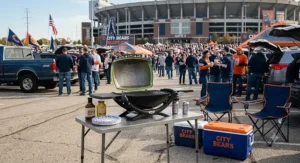
Getting a tailgating grill setup right is less about the grill itself and more about the fifteen minutes before you light it. Arrive, and before you even unfold the legs, check your venue’s specific policy — some stadiums cap propane tank size or restrict open flame entirely, and finding that out after you’ve already driven two hours is a bad time.
Once you’re cleared to cook, position the grill on level, stable ground away from your vehicle’s fuel tank and any nearby tents or canopies — wind-blown flare-ups are the single most common cause of tailgate mishaps. Connect your propane cylinder and do a quick soap-and-water check on the hose connection before your first light of the season; a slow leak is invisible until it isn’t. Most grills in this lineup reach cooking temperature within 8–12 minutes, so light the grill roughly 20 minutes before you plan to start cooking, giving yourself buffer time for wind, cold weather, or a stubborn ignition.
In the first 30 days of ownership, the most common mistake tailgaters make is skipping the manufacturer’s initial burn-off cycle, which removes manufacturing residue and seasons the grates. Run the grill empty on high for 10–15 minutes before your first cook. After each tailgate, disconnect the propane, let the grill cool completely, and wipe down the grates while they’re still slightly warm — grease hardens fast once it’s cold, turning a two-minute cleanup into a scraping project. Store your grill in a dry space between uses; even stainless steel models develop surface rust if packed away wet.
✨ Ready to build your kit? See the Tailgate Cooking Essentials section below for what else belongs in the trunk.
Real-World Tailgate Scenarios: Matching the Grill to Your Crew
Picking a portable grill for football tailgate season gets a lot easier once you think in terms of who’s actually eating, not just what the grill can technically do.
The Weekend Warrior Crew (8–15 people, every home game): A group hosting a rotating cast of friends and family every Saturday needs raw capacity and zone cooking more than portability. The Coleman RoadTrip 285 or Traeger Tailgater both make sense here — the former for speed and volume, the latter if smoked flavor is part of your tailgate’s identity. Budget for a full 20-lb propane tank adapter if you’re running the RoadTrip every week; those 1-lb disposable cylinders add up fast and generate a surprising amount of trash.
The Two-Person Road Trip (couples, students, casual fans): If you’re parking, grilling, and packing back up solo or in a pair, weight and setup speed matter more than square inches. The Cuisinart Petite Gourmet or Weber Q1200 both fit this profile — the former for minimal effort, the latter if you’d rather pay more once for a grill that lasts a decade.
The Budget-Conscious Regular (goes most weeks, watching the wallet): Someone tailgating six or eight times a season doesn’t need premium hardware sitting in a garage the rest of the year. The Royal Gourmet GT1001 and Megamaster 2-Burner both deliver real cooking capability without the premium price tag, making them the pragmatic choice for frequent-but-budget-minded fans.
Problem → Solution: Common Tailgate Grilling Headaches
Problem: The grill won’t hold a flame in windy conditions. Position the grill so the open side faces away from prevailing wind, and consider a grill with a lid that partially shields the flame, like the Royal Gourmet GT1001’s enclosed design. Multi-burner grills like the Coleman RoadTrip 285 also cope better, since losing one burner to wind doesn’t kill the whole cook.
Problem: You’re out of propane with food still on the grate. Always carry a backup 1-lb cylinder — they’re inexpensive and take up little trunk space. This is one of the most preventable tailgate disasters, and it’s also the easiest to solve with five dollars of planning.
Problem: Food is cooking unevenly, burnt outside and raw inside. This usually means the grill hasn’t fully preheated. Give any of these grills their full 8–12 minute warmup before the first patty goes on, and use a meat thermometer rather than guessing — a $10 thermometer prevents both undercooked chicken and charcoal-black burgers.
Problem: Setup and breakdown eat into your tailgate time. Practice the fold-and-unfold sequence once at home before game day. Grills with wheels, like the Coleman RoadTrip 285, cut transport time roughly in half compared to lifting and carrying, especially over gravel or uneven lot surfaces.
Problem: Grease and mess make cleanup a chore. Line removable grease trays with foil before cooking, and wipe grates down while still warm rather than letting them cool completely — a habit that saves real time across a full tailgating season.
How to Choose a Portable Grill for Tailgating
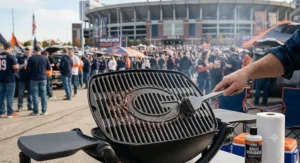
Picking the right portable grill for tailgating comes down to seven practical criteria, roughly in order of importance for most buyers:
- Group size. Match cooking-area square inches to your typical headcount — figure roughly 25–30 square inches per person if you’re cooking for everyone at once rather than in shifts.
- Weight and carry distance. If you’re parking far from your setup spot, a 17-pound tabletop grill beats a 49-pound stand-up model every time, regardless of specs.
- Number of burners. Two or more burners let you sear and hold food warm simultaneously — a real quality-of-life upgrade once you’ve cooked for a group on a single flame.
- Heat-up speed. Anything over 15 minutes to reach cooking temperature eats into limited pregame time; prioritize grills with documented 8–12 minute preheats.
- Fuel type. Propane wins on speed and convenience; pellet grills like the Traeger Tailgater win on flavor but add weight and power requirements.
- Build materials. Cast iron grates hold heat more evenly than stamped steel, while stainless steel resists the rust that comes from being packed wet after a rainy game.
- Stability features. Locking lids and wide folding leg grill stand bases matter more than they sound on a sloped or gravel parking lot — a grill that tips is a grill that ruins the whole cookout.
Best Gas Grill for Parking Lot Party: Gas vs Charcoal vs Pellet
Choosing the best gas grill for parking lot party use usually comes down to a simple trade-off: speed versus flavor versus flexibility, and each fuel type answers that differently.
Propane grills dominate tailgating for good reason — they light instantly, hold temperature predictably, and let you go from parked car to sizzling burgers in under fifteen minutes. Every grill in this lineup except the Traeger runs on propane, and that’s not an accident; a two-hour pregame window doesn’t leave room for the 20–30 minutes charcoal typically needs just to reach cooking temperature. Charcoal delivers a smokier, more traditional flavor that some purists insist propane can’t match, but the extra effort and the need to safely dispose of hot coals afterward make it a harder sell in a crowded parking lot where ash disposal options are limited.
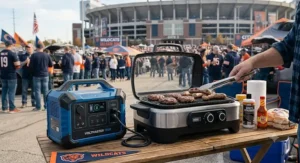
Pellet grills like the Traeger Tailgater split the difference: they’re not as fast as propane off the line, but they deliver genuine wood-fired flavor without the active fire management charcoal demands. The trade-off is a power requirement — most pellet grills need 120V AC to run the auger and digital controller, which means either finding an outlet (rare in a stadium lot) or bringing a portable power station. For most parking-lot scenarios, propane remains the pragmatic default; pellet is worth the extra logistics only if flavor is genuinely your top priority.
Rapid Heat-Up Time: What to Expect From Ignition to First Sear
Rapid heat-up time is arguably the single most tailgate-specific spec on this whole list, because unlike backyard grilling, you’re usually working against a hard deadline: kickoff.
Among the grills reviewed here, tabletop propane models like the Weber Q1200 and Cuisinart CGG-306 typically hit searing temperatures — 450°F to 500°F-plus — within 8 to 10 minutes of ignition, according to aggregated testing from outdoor-gear reviewers who’ve tracked actual surface temps rather than relying on manufacturer claims alone. Multi-burner stand-up grills like the Coleman RoadTrip 285 heat comparably fast, though testers note that reaching consistent temperature across all three burner zones can take a couple of minutes longer than a single-burner unit warming one contained area.
Pellet grills are the outlier here: the Traeger Tailgater’s digital controller needs to run its startup cycle — igniting pellets and stabilizing the internal temperature — which generally takes closer to 15 minutes before food should go on, longer than any propane option in this lineup. What most buyers overlook is that ambient temperature matters as much as the grill itself; cold weather slows every fuel type’s heat-up time, and propane cylinders can genuinely lose pressure in freezing conditions, which is why frequent late-season tailgaters often keep a spare cylinder wrapped in a towel inside the car rather than sitting exposed in the cold.
Folding Leg Grill Stands and Wheeled Bases: Stability on Asphalt
A folding leg grill stand sounds like a minor feature until you’re trying to flip burgers on a grill that’s rocking every time someone bumps the table it’s sitting on — which, in a crowded tailgate lot, happens constantly.
Grills built with wide-stance folding legs, like the Royal Gourmet GT1001 and Cuisinart CGG-306, distribute weight across a broader footprint than narrow tripod-style stands, which noticeably reduces wobble on gravel or sloped asphalt. The Coleman RoadTrip 285 and Traeger Tailgater take a different approach entirely: quick-fold legs paired with wheels, letting the whole unit function as a rolling cart rather than something you lift and carry. That wheeled design is a genuine advantage for anyone walking any real distance from a parking spot to a preferred tailgate location, though reviewers consistently note that both grills’ legs require a bit of practice to fold smoothly — it’s a two-hand operation that’s easier the second and third time you do it.
Here’s what to weigh: tabletop grills without their own stand, like the Cuisinart Petite Gourmet and Weber Q1200, depend entirely on whatever surface you set them on — a wobbly folding table undermines even the sturdiest grill. If you’re regularly grilling off uneven ground, either budget for a dedicated grill cart or prioritize one of the stand-up models with its own integrated legs.
Tailgate Cooking Essentials Beyond the Grill
A great grill is only half the equation. A genuinely complete list of tailgate cooking essentials includes a few items that don’t get nearly enough attention compared to the grill itself: a hard-sided cooler with several inches of ice for raw meat, a meat thermometer to confirm safe internal temperatures without guesswork, and a dedicated set of tongs and spatulas that never touch raw meat and cooked food interchangeably.
Cross-contamination is a real risk in a parking-lot setting without running water nearby, so pack extra clean plates — never put cooked food back on the plate that held raw meat — along with disposable wipes or a jug of water and soap for hand-washing. According to USDA food safety guidance for tailgating, perishable food should be carried in an insulated cooler packed with ice or frozen gel packs, and any raw meat that’s been sitting above 40°F for more than two hours should be discarded rather than risked. A cooking thermometer belongs in every tailgate kit for exactly this reason — visually judging “done” on a burger is notoriously unreliable, and undercooked poultry or ground beef is the fastest way to end a tailgate season early with food poisoning.
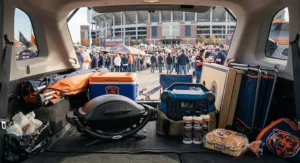
Round out the kit with a small fire extinguisher rated for grease fires, a folding table if your grill doesn’t have its own side shelves, and enough fuel — plus one spare cylinder — to outlast the longest pregame you’re planning.
🔥 Grab your grill, then check the safety and setup sections above so you’re covered before you even leave the driveway.
Safety, Regulations & Stadium Compliance Guide
Most stadium parking lots allow portable grills, but the specifics vary widely by venue, and rules can include restrictions on propane tank size, distance from vehicles, or prohibitions on open-flame charcoal entirely. Always confirm your specific venue’s tailgating policy before packing the car — a rule violation discovered at the gate is a frustrating way to start game day.
On general fire safety, NFPA grilling safety guidance notes that a leaking or damaged propane hose is the leading factor contributing to gas grill fires, which is why checking hose connections with a simple soap-and-water test before each season is worth the two minutes it takes. Never light a gas grill with the lid closed — built-up gas can ignite suddenly and forcefully when the lid is finally opened. If you ever smell gas while cooking, move away immediately rather than trying to locate the leak yourself, and keep children and pets at a reasonable distance from any open flame throughout the cook.
Propane cylinders should always be transported upright and secured so they can’t roll or tip during the drive, and never left in a hot, closed vehicle for extended periods, since pressure inside the tank rises with temperature. When you’re done cooking, let coals or grates cool fully before disposing of anything or packing the grill away — a still-warm grill packed into a trunk is both a fire risk and a good way to ruin whatever’s stored next to it.
Long-Term Cost & Maintenance
The sticker price on a portable grill for tailgating is only part of the real cost of ownership. Propane itself is cheap — a standard 16.4 oz. disposable cylinder typically runs a couple of dollars and provides roughly 1.5 to 2 hours of cooking time, plenty for a single tailgate, though heavy users switching to a refillable 20-lb tank will save meaningfully over a full season of weekly games.
Maintenance costs scale with build quality more than price point. Cast iron grates, like those on the Weber Q1200, need occasional oiling to prevent rust but otherwise last for years without replacement. Stainless steel components on the Cuisinart and Megamaster models resist corrosion well but can still develop surface rust if stored wet, so a $15 grill cover is a worthwhile investment regardless of which model you buy. Pellet grills carry an ongoing cost most buyers underestimate: an 8-pound hopper of hardwood pellets isn’t free, and while pellets are generally cheaper per hour of cooking than propane, the Traeger Tailgater’s need for occasional auger cleaning and igniter replacement over several years adds a maintenance line item propane grills simply don’t have.
Factoring in fuel, covers, and occasional part replacement, budget tabletop grills like the Royal Gourmet GT1001 typically have the lowest total cost of ownership over three to five seasons, while premium picks like the Weber Q1200 justify their higher upfront price through longevity — a grill that lasts a decade effectively costs less per season than a budget model replaced every two or three years.
FAQ
❓ What's the best portable grill for tailgating on a budget?
❓ How long does it take a tailgate grill to heat up?
❓ Can I bring a propane grill to a football stadium tailgate?
❓ How many people can a portable tailgate grill feed?
❓ Is a gas or pellet grill better for tailgating?
Conclusion
There’s no single best portable grill for tailgating — there’s only the best one for your crew size, your carrying capacity, and how much you value flavor over speed. If you’re feeding a rotating cast of a dozen friends every Saturday, the Coleman RoadTrip 285 earns its weight in wheeled convenience and real cooking zones. If you’d rather own one grill for the next ten years and don’t mind paying for that durability upfront, the Weber Q1200’s cast iron grates make a compelling case. Tight on budget but still want something that performs? Both the Royal Gourmet GT1001 and Megamaster 2-Burner prove that low price doesn’t have to mean low function.
Whatever you land on, the difference between a good tailgate and a stressful one usually comes down to preparation that has nothing to do with the grill itself: checking your venue’s rules ahead of time, packing a spare propane cylinder, and giving yourself the full preheat window instead of rushing the first batch onto a half-hot grate. Get those basics right, and any grill on this list will have you serving food well before kickoff.
✨ Don’t Miss These Exclusive Deals!
🔍 Take your tailgate to the next level with these carefully selected grills. Click on any highlighted item to check current pricing and availability. These picks will help you feed your crew hot, perfectly cooked food before every kickoff!
Recommended for You
- Portable Gas Grill for Camping: 7 Picks That Won’t Fail You (2026)
- Best Portable Gas Grill 2026: 7 Top-Rated Picks Reviewed
- Best Convertible Natural Gas Grill: 7 Top Picks for 2026
Disclaimer: This article contains affiliate links. As an Amazon Associate, I earn from qualifying purchases. If you purchase products through these links, we may earn a small commission at no additional cost to you.
✨ Found this helpful? Share it with your friends! 💬🤗
