
In This Article
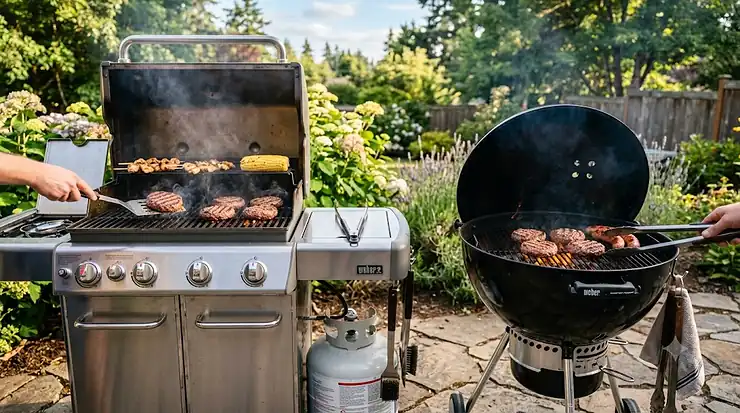
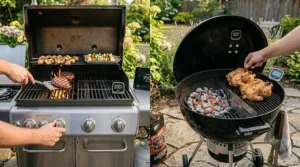
Every backyard eventually splits into two tribes. There’s the propane crowd, flicking a knob and getting dinner moving before the cooler’s even unpacked. And there’s the charcoal loyalists, fussing over a chimney starter like it’s a small ceremony, convinced that anyone who grills with gas is basically just using an outdoor stove. The gas grill vs charcoal grill debate has been simmering in driveways and comment sections for decades, and somehow nobody’s declared a winner yet.
Here’s the thing nobody tells you at the hardware store: there isn’t a winner. There’s a you, and you’ve got a specific life — a patio size, a Tuesday-night schedule, a taste memory of something your uncle grilled in 1998 that you’ve been chasing ever since. The right grill is the one that matches that life, not the one some forum insists is objectively superior.
This guide breaks down what actually separates gas grill and charcoal grill cooking — the science, the cost, the cleanup, the safety stats nobody mentions until something goes wrong — and walks through seven real, current grills spanning both camps and every budget tier. By the end, you’ll know exactly which side of the fence you belong on, or whether you’re the rare household that needs a foot in both.
What’s the Real Difference Between a Gas Grill and a Charcoal Grill?
Both are a combustion heat source designed to cook food over direct or indirect heat — that’s where the similarity ends. A gas grill burns propane or natural gas through metal burners, giving you instant ignition and a turn-the-dial kind of cooking temperature control. A charcoal grill burns lump charcoal or briquettes, producing higher peak heat, denser smoke, and a flavor profile that gas physically cannot replicate without help. One is an appliance. The other is closer to a campfire you’ve tamed just enough to trust with a ribeye.
Quick Comparison Table: Gas vs Charcoal at a Glance
| Factor | Gas Grill | Charcoal Grill | Best For |
|---|---|---|---|
| Time to cooking heat | 5–10 minutes | 15–25 minutes | Gas, for weeknight dinners |
| Peak searing temperature | ~500–600°F typical | 700–900°F+ achievable | Charcoal, for steak crusts |
| Temperature precision | Dial-controlled, repeatable | Vent and airflow management | Gas, for beginners |
| Typical upfront cost | $200–$1,000+ | $140–$500 | Charcoal, for budget buyers |
| Ongoing fuel cost | Lower over a season | Higher per cook | Gas, for frequent grillers |
| Cleanup | Wipe grates, empty grease tray | Dump ash, scrub grates | Gas, for low-maintenance cooks |
The numbers above aren’t arbitrary. Backyard charcoal setups can comfortably blow past 700°F at the grate, which is roughly why charcoal grills outsear gas because they produce superior direct infrared heat, while even rare gas grills with a dedicated sear burner top out around 900°F in a narrow zone that’s only wide enough for one or two steaks at a time. Cost tells a similar story in reverse — propane runs about $15 to $20 a tank and covers 15 to 20 cooking sessions, while regular charcoal grilling typically costs $150 to $300 more per year in fuel alone. So: speed and savings lean gas, raw heat and theater lean charcoal. Neither side is wrong, they’re just optimizing for different Tuesdays.
💬 Just one click — help others make better buying decisions too!😊
Top 7 Grills Worth Your Money: Expert Picks
Real models, real specs, no filler — here’s a lineup spanning both fuel types and every price tier, from a $150 starter to a grill that basically becomes a backyard appliance for life.
1. Weber Spirit II E-310 — Best Overall Gas Grill for Most Households
Weber Spirit II E-310 is the grill that ends grill-shopping anxiety for the average family. It runs on natural gas or propane, measures 27 inches deep by 52 inches wide by 44.5 inches tall with the lid open, packs three burners delivering a 26,500 BTU-per-hour input, and offers 450 square inches of total cooking area. What that means in practice: enough room for a full rack of ribs and a few burgers without playing Tetris with your tongs. In Taste of Home’s hands-on test, the tester seared a steak in two minutes per side at 500°F, smoked baby back ribs low and slow at 225°F for two hours, and grilled a whole cut-up chicken at 350°F for 45 minutes with light, even charring — that’s a grill that handles a Tuesday burger and a Sunday rib session equally well. What most buyers overlook: the compact footprint is the actual selling point, not a compromise — it’s small enough for a townhouse patio but still has real BTU output behind it.
✅ Even heat across the whole grate, snap-jet one-hand ignition, 10-year warranty
❌ Folding side tables feel a little flimsy, no rotisserie burner included
Price range: roughly $500–$600. Best for: small-to-medium families who want a “just works” grill without overthinking it.
2. Weber Genesis E-325s — Best Premium Gas Grill for Serious Backyard Cooks
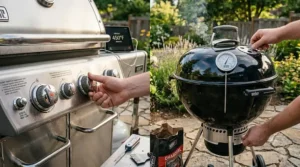
Weber Genesis E-325s is what happens when a Spirit grows up and gets a side hustle. It features Weber’s PureBlu burner system with tapered burner tubes for consistent flame pressure, an extra-large sear zone for cooking multiple steaks at once, an expandable top cooking grate that adds a second grilling level, and a pull-out grease management system. The sear zone is the real upgrade here — most mid-range gas grills fake a “sear burner” with a marketing sticker, but this one genuinely delivers a hotter, more concentrated zone you can rotate steaks through. Amazon shoppers shopping this model commonly land in a higher price bracket, with the typical filtered range sitting between $900 and $1,200. If you’re hosting more than four people regularly, the expandable grate alone justifies the jump from the Spirit line.
✅ Genuinely hot sear zone, expandable cooking surface, durable PureBlu burners
❌ Big footprint needs real patio space, premium price for a gas grill
Price range: roughly $900–$1,100. Best for: hosts who grill for crowds and want gas with steakhouse-level sear capability.
3. Cuisinart CGG-7400 — Best Budget Full-Size Gas Grill
Cuisinart CGG-7400 proves you don’t need to spend Weber money to get a real grill. It delivers 44,000 BTUs of cooking heat across 443 square inches of cooking surface, plus a 167-square-inch warming rack, with removable cast iron grates and two 18-by-13-inch side tables. The four-burner layout matters more than the BTU number suggests — independent control means you can run two burners hot for searing and two low for the veggies, all on the same grate. Amazon reviewers have been largely won over by the value math: the grill carries roughly a 4.3-star rating from nearly 1,400 reviews, with buyers praising fast, even ignition and easy cleanup, though a few noted some burners ignite less smoothly than others. What the spec sheet won’t tell you: at this price, the stainless lid and cast iron grates are doing a lot of heavy lifting that pricier grills charge extra for.
✅ Strong heat output for the price, easy-clean grates, two side tables
❌ Lighter-gauge steel cart than premium models, occasional ignition hiccups reported
Price range: roughly $190–$300. Best for: budget-conscious buyers who still want a full four-burner experience.
4. Nexgrill 4-Burner Propane Gas Grill (720-0925PA) — Best for Families on a Mid-Range Budget
Nexgrill 4-Burner Propane Gas Grill sits squarely between “starter grill” and “serious grill,” which is exactly the sweet spot most households actually live in. It runs an Even-Heat system across 52,000 BTUs of stainless steel burners with flame tamers and porcelain cast-iron grids, offering 562 square inches of cooking space, plus side tables, electronic ignition, and a built-in thermometer. The flame tamers are the unsung feature here — they catch drippings and vaporize them into the cooking surface instead of letting them flare up, which is the difference between “charred crust” and “accidentally torched burger.” For a household of four to six that grills weekly rather than daily, this hits the BTU and square-inch sweet spot without tipping into premium pricing.
✅ Generous 562 sq. in. cooking space, reliable electronic ignition, built-in thermometer
❌ Stainless finish shows fingerprints, side burner BTU is modest for sauce work
Price range: roughly $250–$350. Best for: families who grill often and want headroom without premium pricing.
5. Weber Original Kettle Premium 22-Inch — Best Classic Charcoal Grill
Weber Original Kettle Premium is the grill that invented the category, still doing the job better than most newcomers. It offers 363 square inches of cooking space, enough to hold up to 13 burgers at once, with a One-Touch cleaning system that uses a removable ash catcher, porcelain-enameled bowl and lid for heat retention, and a built-in lid thermometer for real-time temperature monitoring. The dampers are the real teaching tool for charcoal beginners — close them down and the fire calms; open them and it roars, and within a cookout or two you’ll have an intuitive feel for it that no gas dial can teach you. The standard sibling version of this kettle, near-identical in design, holds a 4.7-star rating from over 3,100 reviews on Weber’s own site — a track record this Premium version inherits almost entirely.
✅ Genuinely simple ash cleanup, excellent heat retention, iconic and easy to find parts for
❌ No side tables built in, charcoal management has a real learning curve
Price range: roughly $170–$220. Best for: anyone who wants authentic charcoal flavor without a steep learning cliff.
6. Char-Griller AKORN Kamado Charcoal Grill (E16620) — Best Value Kamado-Style Grill
Char-Griller AKORN Kamado brings ceramic-kamado performance into steel, at a fraction of the cost of the egg-shaped grills that started the trend. It features a triple-walled steel insulated design, 447 square inches of total cooking area, cast iron grates, a locking lid, 8-inch locking caster wheels, a removable warming rack, and an indexed dual-damper system paired with a built-in thermometer. That insulation lets it hold steady temperatures anywhere from 200 to 700 degrees Fahrenheit, which means one grill handles both a 30-minute weeknight sear and an all-afternoon pork butt. AmazingRibs.com, a respected independent BBQ review site, awarded it a Best Value Silver Medal, noting it performs remarkably close to traditional ceramic kamados despite using lightweight insulated steel instead of heavy ceramic. The catch most reviewers flag: once it’s hot, it stays hot, so overshooting your target temperature costs you real time waiting to cool back down.
✅ Exceptional fuel efficiency from insulation, true high-heat-to-low-and-slow range, locking lid for transport
❌ Slow to cool once overheated, build quality varies by unit
Price range: roughly $380–$480. Best for: grillers who want smoking versatility without ceramic-kamado prices.
7. Royal Gourmet CC1830S Charcoal Grill with Offset Smoker — Best Budget Smoker-Grill Combo
Royal Gourmet CC1830S is the grill that quietly punches several weight classes above its price tag. It offers 823 square inches of total cooking surface, built around 443 square inches of porcelain-enameled main grates, a 184-square-inch warming rack, and a 184-square-inch offset smoker chamber with a 2-level adjustable charcoal pan holding up to 4.4 pounds of coal and a lid-mounted thermometer. The offset smoker box is what separates this from a basic barrel grill — it lets smoke drift across food without direct flame contact, which is the entire trick behind real low-and-slow barbecue. Recent retail coverage notes the grill has racked up thousands of five-star Amazon reviews, with over 2,000 units purchased in a recent month alone, putting it among Amazon’s top five best-selling charcoal grills; the most common complaint is that the seams aren’t perfectly airtight out of the box, which leaks a bit of heat but doesn’t stop shoppers from reporting genuinely restaurant-quality smoked ribs and prime rib once they’ve sealed the gaps with basic gasket tape.
✅ Huge cooking space for the price, real offset smoking capability, adjustable charcoal pan
❌ Seams aren’t fully airtight stock, no side cart for prep space
Price range: roughly $140–$200. Best for: anyone curious about smoking who doesn’t want to spend smoker money to find out.
How to Choose Between Gas and Charcoal Grills
If you’re standing in an aisle right now, paralyzed, run through this in order:
- How much time do you actually have on a weeknight? If “fifteen extra minutes” sounds like a luxury, gas wins by default — it’s lighting and heating while charcoal is still catching.
- Is flavor your top priority, or convenience? Charcoal vs gas grill taste differences are real and measurable, not just nostalgia — more on that below.
- What’s your patio or balcony situation? Many condos and apartment complexes restrict charcoal or open-flame grills entirely for fire-code reasons, so check your HOA or lease before falling in love with a kettle.
- How often will you actually use it? A grill used twice a month doesn’t need premium BTU output; a grill used three nights a week absolutely benefits from faster ignition and easier cleanup.
- Do you want to smoke meat eventually? If yes, lean toward a charcoal or kamado-style unit now rather than buying twice.
- What’s your actual budget ceiling, fuel included? Charcoal grills are usually cheaper upfront but pricier per cook over a season; gas flips that math.
- Who’s doing the cooking? A nervous beginner thrives with a gas dial; someone who already enjoys the ritual of fire-tending will find charcoal more rewarding than fussy.
✨ Don’t Miss These Exclusive Deals!
🔍 Whether you’re leaning gas or charcoal, the seven grills above span every budget and skill level. Click through to check current pricing and availability before you commit to a backyard upgrade this season.
Which Type of Griller Are You? A Decision Framework
Here’s the shortcut version, no quiz required. If your idea of a perfect grilling night involves getting food on the table fast, a propane tank you can swap at the hardware store, and zero ash to dispose of afterward — you’re a gas griller, full stop, and something like the Nexgrill or Cuisinart will serve you well from day one. If instead you find yourself enjoying the process as much as the meal — building a charcoal pyramid, watching smoke curl off a vent, adjusting dampers like you’re piloting something — you’re a charcoal griller, and the Weber Kettle or Royal Gourmet smoker combo will reward that patience with flavor gas simply can’t fake. And if you genuinely can’t choose? That’s not indecision, that’s just correct. Plenty of serious home cooks keep one of each: gas for the Tuesday chicken thighs, charcoal for the Saturday brisket.
Real-World Scenarios: Matching the Grill to Your Life
Picture a young family in a townhouse with a tiny concrete patio and two kids who get hangry by 6 p.m. sharp. They need speed and a small footprint — the Weber Spirit II E-310 or the Cuisinart CGG-7400 fits that life without dominating the space. Now picture a weekend host who feeds a dozen people every other Saturday and considers brisket a personality trait. That person needs the cooking volume and smoke control of the Royal Gourmet offset combo or the temperature range of the Char-Griller AKORN — gas would just slow down their actual hobby. And somewhere in between sits the everyday backyard cook who grills three or four nights a week, wants reliable results without a learning curve, and would genuinely benefit from the extra burners and warming rack on the Nexgrill or the sear zone on the Genesis E-325s. None of these people are wrong about what they need — they just need different tools.
Gas Grill vs Charcoal Grill: The Real Flavor Difference
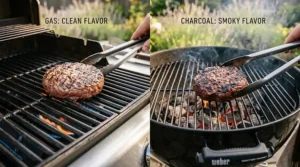
This is the argument that started the whole debate, so let’s settle the chemistry. Grilled flavor comes down to two processes: browning and smoke. When meat hits high heat, water boils off the surface and the proteins and sugars left behind undergo the Maillard Reaction, producing a complex mix of savory, “meaty” compounds that intensify with temperature — and since charcoal routinely runs hotter at the grate than a backyard gas burner, it triggers that reaction harder and faster. Then there’s smoke itself: burning wood or charcoal breaks down lignans into smaller molecules like syringol and guaiacol, which are largely responsible for that classic smoky flavor, and food absorbs those compounds especially well because it contains both the fats and water that smoke particles bind to. Gas grills aren’t entirely flavor-neutral — even on a gas grill, melting fat drips onto the heat source and produces some smoke — but it’s a fraction of what charcoal generates. The honest verdict: for a thin burger flipped in four minutes, the gap is small enough that most people can’t tell blind. For a thick steak, a whole chicken, or anything smoked for hours, charcoal’s flavor advantage becomes obvious and arguably unbeatable.

What to Expect: Real-World Performance
Numbers on a spec sheet don’t tell you what dinner actually feels like, so here’s the translation. A 450-square-inch gas grill like the Spirit II E-310 comfortably handles a weeknight meal for four to six people with room to spare for a few extra burgers if friends show up uninvited. A 26,500–52,000 BTU range across these gas models means preheat times of roughly 8–12 minutes — genuinely fast enough that “let’s grill” can mean dinner in 30 minutes flat. Charcoal flips that timeline: budget 15–25 minutes just to get coals ash-gray and ready, but you’re rewarded with sustained heat that holds steadier through a long cook than most people expect. The kamado-style AKORN in particular trades speed for staying power — that triple-wall insulation means it sips charcoal compared to an open kettle, so a single load can realistically carry you through a multi-hour smoke without constant refueling.
Common Mistakes When Buying (and Using) a Grill
The single biggest buying mistake is sizing wrong — people buy a six-burner monster for a household of two, then resent the propane bill and the counter space it eats. Match cooking area to how many people you actually feed on a normal week, not your biggest holiday gathering. The second mistake is ignoring fuel-type restrictions where you live; plenty of renters discover too late that charcoal grills are banned on their balcony. On the usage side, the most common error is trusting color instead of a thermometer — grill marks can make food look done before it actually is, so use a food thermometer and cook beef, pork, lamb, and veal steaks, roasts, and chops to 145°F, ground meats to 160°F, and poultry to 165°F, per USDA guidance. Skipping a thermometer is how good grills produce bad — or unsafe — dinners. Finally, new charcoal owners almost always under-fuel their first cook, running out of heat halfway through a long smoke; err generous on charcoal volume until you’ve learned your specific grill’s appetite.
Long-Term Cost & Maintenance: What You’ll Actually Spend
Upfront price is only half the math. A quality charcoal kettle typically runs $100 to $300, while comparable gas grills start around $200 to $400 and high-end gas models can exceed $2,000 — so charcoal usually wins the sticker price. But flip to fuel costs and gas pulls ahead over a season: propane averages $15 to $20 per tank and covers roughly 15 to 20 cooking sessions, while regular charcoal grilling tends to cost $150 to $300 more per year in fuel than propane does. Maintenance follows a similar split — gas grills need occasional burner cleaning and grease-tray emptying, while charcoal grills demand ash removal after every single cook and periodic grate scrubbing to prevent rust. Neither is expensive to maintain long-term, but charcoal asks for more frequent, hands-on upkeep in exchange for its lower entry price.
Grill Safety: What Federal Data Says You Need to Know
Grilling injuries aren’t rare, and the data skews in a direction most people don’t expect. Between 2020 and 2024, U.S. fire departments responded to an annual average of 12,141 home fires involving grills, hibachis, or barbecues, causing 15 civilian deaths, 171 reported injuries, and $241 million in direct property damage — and 76% of those fires involved gas grills, compared to just 13% involving charcoal or other solid fuel. Dig into the gas-specific numbers and the cause becomes clear: gas grills were involved in an average of 9,235 home fires per year, and leaks or breaks were the leading culprit, responsible for roughly 6% of gas grill structure fires and 13% of outdoor gas grill fires. The practical takeaway, straight from the National Fire Protection Association: check your propane hose for leaks with a simple soap-and-water test every season, keep the grill at least three feet from your house and any railings, and never move a lit charcoal grill. For food safety specifically, the USDA’s Food Safety and Inspection Service is unambiguous: a thermometer beats a guess every single time.
Features That Actually Matter (And the Marketing Hype That Doesn’t)
Side burners, rotisserie kits, and Bluetooth thermometers all sound great in a product photo, but here’s what actually moves the needle: cooking surface that matches your real household size, a grease management system that doesn’t require disassembly to clean, and — for gas grills specifically — independently controlled burners so you can run hot and cool zones at once. What doesn’t matter nearly as much as marketing suggests: total BTU count in isolation. A grill advertising 60,000 BTUs spread across 700 square inches isn’t necessarily hotter per square inch than one advertising 44,000 BTUs across 443 — it’s the BTU-to-cooking-area ratio that determines real heat intensity, not the headline number. If sustainability factors into your decision, it’s worth knowing that charcoal combustion has a carbon footprint roughly three times higher than liquefied propane gas, with an average grilling session releasing about 6.7 kilograms of CO2 equivalent — comparable to driving a car about 22 miles. That’s not a dealbreaker for most home cooks, but it’s a real data point if environmental impact is part of your buying criteria.
Frequently Asked Questions
❓ Is gas or charcoal better for flavor?
❓ How much more does charcoal cost than gas to run?
❓ Can you put charcoal in a gas grill?
❓ Are charcoal grills bad for air quality?
❓ What size grill do I need for a family of four?
Conclusion
There’s no universal winner in the gas grill vs charcoal grill debate, and honestly, anyone who tells you otherwise is selling something. Gas earns its place with speed, consistency, and a dial you can hand to a nervous teenager without worry. Charcoal earns its place with flavor that gas simply hasn’t figured out how to fake yet, plus a kind of backyard theater that makes the cooking itself part of the appeal. The seven grills above cover both camps at every price point, from a $140 smoker combo to a $1,000 gas setup with a genuine sear zone — so the real homework isn’t picking a side, it’s being honest about which kitchen, which schedule, and which Saturday-afternoon mood you’re actually shopping for.
✨ Don’t Miss These Exclusive Deals!
🔍 Ready to upgrade your backyard setup? Check current pricing on any of the seven grills above — availability shifts fast heading into peak grilling season.
Recommended for You
- 7 Best 2 Burner Gas Grills for Small Patios in 2026
- Best 2 Burner Gas Grills 2026: 7 Top Picks That Deliver
- Gas Grill for the Money: 7 Top Picks for 2026
Disclaimer: This article contains affiliate links. As an Amazon Associate, I earn from qualifying purchases. If you purchase products through these links, we may earn a small commission at no additional cost to you.
✨ Found this helpful? Share it with your friends! 💬🤗
