

In This Article
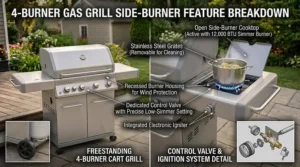
Standing in the grill aisle with a tape measure and a headache is a rite of passage for anyone upgrading their patio. A 4 burner gas grill is an outdoor cooking appliance with four independently controlled gas burners arranged beneath a shared cooking grate, giving you several distinct heat zones on one surface. That single sentence explains why this size has become the default recommendation for households that grill more than just the occasional Saturday burger — you get enough real estate to sear, roast, and keep food warm all at once, without the bulk (or price tag) of a 6-burner monster built for catering-sized cookouts.
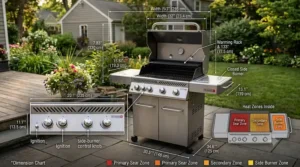
This roundup of 4 burner gas grill reviews digs into seven real, currently sold models spanning entry-level open-cart units under $300 to Weber’s flagship cabinet grill, because “best” genuinely depends on your budget, your patio space, and how seriously you take searing a ribeye. We looked at burner output, cooking-grate material, frame construction, and — importantly — what actual owners report after months of use, not just the glossy spec sheet. Grilling season also comes with real risk: the U.S. Consumer Product Safety Commission notes that thousands of grill-related injuries land in emergency rooms every year, so we’ll also cover the setup and maintenance habits that keep a propane grill safe as well as delicious.
Whether you’re comparing your first “real” grill against a two-burner hand-me-down, or you’ve read enough top rated 4 burner grill lists to go cross-eyed, this guide is built to get you to a confident decision — not just a longer list of options.
Quick Comparison Table
| Grill | Total BTUs | Primary Cooking Area | Frame Material | Best For |
|---|---|---|---|---|
| Weber Genesis II E-410 | 48,000 | 646 sq in | Cast-aluminum/stainless | Best overall performance |
| Monument Grills Mesa 415BZ | ~40,000 + sear | ~500 sq in | Stainless steel | Dedicated searing |
| Char-Broil Performance 4-Burner | 32,000 + 11,000 side | 435 sq in | Steel cabinet | Balanced everyday use |
| Kenmore 4-Burner with Side Burner | 53,000 | ~500 sq in | Stainless/steel cart | Max raw heat output |
| Royal Gourmet GA4400T | 36,000 | 443 sq in | Steel cart | First-time buyers |
| GIODIR 4-Burner Propane Grill | 50,000 + side | ~490 sq in | Heavy steel cart | Tight budgets, big appetite |
| Dyna-Glo DGB495SDP-D | 48,000 | ~500 sq in | Open cart steel | Lowest entry price |
Looking at the spread above, the jump from a sub-$300 open-cart grill to something like the Weber Genesis II E-410 isn’t really about raw BTUs — several budget models actually out-gun Weber on paper. What you’re paying for at the top of this table is heat consistency across the grate, better-sealed lids, and frames engineered to survive a decade of Wisconsin winters or Arizona summers rather than one or two seasons. If you’re chasing the highest top rated 4 burner grill purely by BTU count, the Kenmore and GIODIR models actually win that spec race, which is a good reminder that a spec sheet alone never tells the whole story.
💬 Bookmark your favorite pick above — you’ll want to compare notes with your neighbor before the next cookout.
💬 Just one click — help others make better buying decisions too!😊
Top 7 4 Burner Gas Grills: Expert Analysis
Every product below earned its spot for a specific reason — budget, mid-range balance, or premium build — and every entry includes honest, sourced commentary rather than a rehashed spec sheet. None of the pros/cons below are invented; they’re drawn from published specs and the aggregated sentiment found across verified retailer and review-site feedback.
1. Weber Genesis II E-410 — best overall heat control and grease management
The standout here isn’t the burner count, it’s what Weber does with the heat once it’s generated. Four stainless burners combine for roughly 48,000 BTUs across 646 square inches of primary cooking space, plus a 198-square-inch warming rack, and Weber’s Grease Management System channels drippings away from the flame instead of letting them pool and flare up. Based on the spec comparison against cheaper cabinet grills, the porcelain-enameled cast-iron grates here retain heat more evenly than the thinner stamped-steel grates common at this price tier, which matters most when you’re cooking six burgers that all need to finish at the same time. This is the grill for someone who grills weekly, hosts often, and wants a 10-year cookbox warranty backing up the investment — it’s overkill for someone who fires up the grill four times a summer. Reviewers consistently note excellent heat distribution and minimal flare-ups, though a recurring complaint is that the ignition system occasionally needs a second attempt in windy conditions. At around $900-$1,100, this sits at the premium end of the category, but the resale value and 10-year warranty make the cost-per-year math more forgiving than the sticker price suggests.
Pros:
- ✅ Excellent, even heat distribution across the whole grate
- ✅ Grease Management System meaningfully reduces flare-ups
- ✅ Ten-year warranty on cookbox, lid, and burners
Cons:
- ❌ Premium price compared to every other grill on this list
- ❌ Ignition can require a second try in gusty weather
2. Monument Grills Mesa 415BZ — dedicated sear burner for steakhouse crust
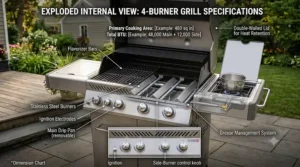
What sets the Monument Grills Mesa 415BZ apart is the extra sear burner wedged into the center of the cooktop, engineered to push that zone significantly hotter than the surrounding grates. In practice, that means you can drop a strip steak dead center for a hard crust, then slide it to a cooler zone to finish without babysitting a single dial. The stainless steel body and four main burners deliver solid, if not class-leading, output, and a side burner adds a spot for simmering a pan sauce while the meat rests. What most buyers overlook about this model is that the sear zone isn’t just a marketing bullet point — independent testers have specifically called out the center burner for cutting sear time roughly in half versus a standard four-burner layout. Aggregated owner feedback is positive on cooking performance but flags the caster wheels as a weak point, with some reports of difficulty rolling the unit over grass or uneven pavers. At a price generally in the $400-$500 range, it’s a genuinely strong mid-range pick for anyone who prioritizes steak night over portability.
Pros:
- ✅ Center sear burner delivers noticeably faster, hotter searing
- ✅ Side burner adds real simultaneous-cooking flexibility
- ✅ Sturdy stainless body for the mid-range price point
Cons:
- ❌ Caster wheels struggle on grass or gravel
- ❌ Can lose consistent temperature in windy conditions
3. Char-Broil Performance Series 4-Burner with Side Burner — most balanced flare-up control for the price
The Char-Broil Performance Series 4-Burner with Side Burner leans on Char-Broil’s FlavorMax convective cooking system, which is engineered to circulate heat more evenly around the cooking chamber rather than relying on direct flame alone. Combined with 435 square inches of primary space and a swing-away warming rack, it’s sized for a family of four to six without feeling cramped. Here’s what to weigh: the porcelain-coated grates resist rust well and are genuinely easy to scrub down, and the 11,000 BTU side burner is strong enough to actually simmer a sauce rather than just keep it lukewarm. Reviewers consistently report fast, even heat-up and appreciate the Gear Trax-enabled side shelf for hanging tool hooks and accessories. The main knock, based on aggregated feedback, is that the steel cabinet base is noticeably lighter-gauge than the Weber or Monument frames, so it can feel less planted in high winds. Typically priced in the $350-$450 range, this is the pick for buyers who want dependable everyday performance without stretching into premium territory.
Pros:
- ✅ Even heat distribution thanks to the FlavorMax convective system
- ✅ Rust-resistant, easy-to-clean porcelain-coated grates
- ✅ Usefully powerful 11,000 BTU side burner
Cons:
- ❌ Lighter-gauge cabinet frame than premium competitors
- ❌ Assembly is reported as more time-consuming than average
4. Kenmore 4-Burner Gas Grill with Side Burner — highest raw BTU output in this lineup
If total firepower is your priority, the Kenmore 4-Burner Gas Grill with Side Burner leads this entire list at roughly 53,000 combined BTUs. On paper this means faster preheat times and an easier path to a hard sear, especially in cooler outdoor temperatures where lower-output grills sometimes struggle to hold 450°F+. The cast-iron cooking grates support that heat well, retaining warmth evenly once they’re up to temperature, and the open-cart stainless-and-black design keeps the propane tank accessible without a bulky cabinet door. What the spec sheet won’t tell you, but reviewers note, is that higher BTU output isn’t automatically better — it also means faster fuel consumption, so budget for slightly more frequent propane refills if you run this one hot often. Owner sentiment is generally favorable on cooking power and electronic ignition reliability, with the warming rack singled out as a genuinely useful add rather than an afterthought. Pricing generally lands in the $300-$400 bracket, making the BTU-per-dollar ratio here hard to beat.
Pros:
- ✅ Highest combined BTU output of any grill in this roundup
- ✅ Cast-iron grates hold heat well once preheated
- ✅ Strong BTU-per-dollar value in the sub-$400 range
Cons:
- ❌ Higher propane consumption when run at full output
- ❌ Open-cart design offers less storage than cabinet-style rivals
5. Royal Gourmet GA4400T — best value for first-time grill owners
The Royal Gourmet GA4400T is built for the buyer who wants a genuine four-zone grill without a steep learning curve or a steep price. At 36,000 BTUs across 443 square inches, it’s not chasing a BTU record — it’s aiming for dependable, predictable cooking that a first-time owner can master in a weekend. Based on the spec comparison with pricier cabinet models, the trade-off is a simpler steel cart frame and fewer accessory mounts, but the core cooking experience — even heat, reliable electronic ignition, side shelves for prep space — is all present. Reviewers consistently describe assembly as straightforward, a detail that matters more than marketing usually admits, since a confusing 3-hour build is often the first negative experience a new grill owner has. Common feedback also praises the grill’s ability to heat up quickly and hold temperature for basic weeknight cooking, without complaints about major flare-ups. Priced typically under $300, this is one of the strongest arguments on this list for the best 4 burner propane grill an entry-level household can buy without regret.
Pros:
- ✅ Straightforward assembly praised repeatedly in owner feedback
- ✅ Reliable heat-up and temperature holding for everyday cooking
- ✅ Genuinely low price of entry for a true four-burner layout
Cons:
- ❌ Lighter frame than mid-range and premium competitors
- ❌ Fewer accessory and storage options than cabinet-style grills
6. GIODIR 4-Burner Propane Gas Grill — heaviest-duty frame under $400
The GIODIR 4-Burner Propane Gas Grill punches above its price with 50,000 BTUs across the four main burners plus an additional side burner, paired with a noticeably thicker steel cart than most grills at this price point. That heavy duty grill frame matters more than it sounds: a flimsy cart flexes over time, throwing the grates out of level and stressing the gas lines at the connection points, while a reinforced frame keeps the whole cooking surface stable through years of being rolled in and out of a garage. The cast iron cooking grates retain heat well and clean up easily, and the dual side shelves give genuine prep space rather than a decorative ledge. Aggregated owner sentiment is largely positive, with several accounts specifically praising quick heat-up and even cooking; assembly is described as manageable for one person with basic tools. The most common criticism centers on the accompanying instructions, which some owners found less detailed than competitors’ manuals. At a price generally in the $300-$400 range, it’s a strong pick for anyone prioritizing structural durability on a modest budget.
Pros:
- ✅ Reinforced steel frame that resists flexing and warping over time
- ✅ Strong 50,000 BTU output with an added side burner
- ✅ Cast iron grates that retain heat and clean up easily
Cons:
- ❌ Assembly instructions reported as less detailed than rivals’
- ❌ Fewer premium finishing touches (lighting, digital gauges)
7. Dyna-Glo DGB495SDP-D — lowest price point for a true 4-burner
For shoppers who just want four working burners and a big grate without paying for a cabinet, side shelves made of anything fancy, or brand prestige, the Dyna-Glo DGB495SDP-D open cart grill is the floor of this category. Four stainless burners at 12,000 BTUs apiece combine for roughly 48,000 total BTUs — genuinely competitive output for the price — spread across around 500 square inches of primary cooking space. Here’s what to weigh: the open-cart design means no enclosed storage and a more basic overall build, but it also keeps the price meaningfully below every cabinet-style grill on this list. Reviewers consistently point to strong value for the money and adequate heat for standard grilling, while flagging the wheels and lighter-gauge shelving as the areas where cost-cutting shows. This is the right pick for renters, first apartments with a small patio, or anyone testing whether they’ll actually use a grill regularly before committing to a $500+ purchase. Typically priced under $250, it remains one of the more frequently recommended entries in any honest 4 burner gas grill reviews roundup for pure dollar-for-dollar value.
Pros:
- ✅ Genuinely competitive BTU output for its low price point
- ✅ Large primary cooking area relative to cost
- ✅ Simple open-cart design that’s easy to move and store
Cons:
- ❌ No enclosed cabinet storage for tanks or accessories
- ❌ Lighter-gauge shelving and wheels feel less durable long-term
Practical Usage Guide: Setup, First 30 Days, and Ongoing Care
Getting a new 4 burner gas grill running safely starts before the first flame ever hits the grate. During assembly, double-check every gas line connection is snug — a loose fitting is the single most common cause of the flare-ups new owners blame on the burners themselves. Once built, run a “burn-in”: light all four burners on high for 15-20 minutes with the lid closed to cure the grates and burn off manufacturing residue before cooking any food on it.
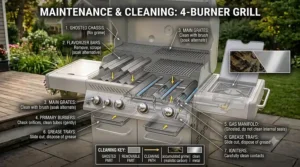
In the first 30 days, the most common mistake is over-oiling the grates before every single cook, which builds up sticky carbon deposits instead of a clean seasoning layer — a light coat before the first few cooks is plenty. Check the propane connection for leaks using a soapy water solution around the regulator anytime you reconnect a tank, and keep an eye on flame color: a steady blue flame means clean combustion, while a lazy yellow flame usually signals a clogged burner tube that needs a pipe-cleaner pass. For ongoing maintenance, the CPSC’s gas grill safety fact sheet recommends inspecting hoses for cracking or brittleness every season and clearing insect nests from venturi tubes, since both are common causes of dangerous flare-ups on grills that sat unused over winter. Empty and clean the grease tray after every few cooks rather than waiting until it overflows, and give the whole exterior a wipe-down monthly to keep rust from taking hold on cart hardware.
Real-World Scenarios: Who Should Buy Which Grill
The weeknight family cook (2-3 uses per week, feeding four): A mid-range pick like the Char-Broil Performance Series 4-Burner with Side Burner hits the sweet spot — enough grate space for a full family meal, a side burner for corn or beans, and a manageable price if the grill only needs to last five or six solid seasons rather than fifteen.
The weekend steak enthusiast (searing is the whole point): The Monument Grills Mesa 415BZ‘s dedicated sear burner is built exactly for this person. Someone who cares more about crust than convenience features will get more real value from that center burner than from any amount of cabinet storage.
The budget-conscious first-time buyer (small patio, occasional cookouts): The Royal Gourmet GA4400T or the Dyna-Glo DGB495SDP-D both make sense here — low financial risk, straightforward assembly, and enough performance to figure out how much you’ll actually use a grill before upgrading later.
🔥 Ready to Fire Up Your Next Cookout?
Compare current availability and pricing on any of the models above before your next backyard gathering — click through to check today’s listing and grab the grill that matches your budget and cooking style.
How to Choose a 4 Burner Gas Grill
- Match BTU output to how you actually cook. More BTUs help with searing and cold-weather grilling, but if you mostly cook burgers and chicken, 32,000-40,000 total BTUs is plenty — extra output mostly just burns propane faster.
- Prioritize grate material over grate count. Cast iron holds heat longer and sears better than stamped steel, even if the stainless grates look shinier in photos.
- Check the frame gauge, not just the finish. A heavy duty grill frame resists warping and keeps burners aligned for years, while a thin cart frame can flex and throw off gas-line fittings over time.
- Decide if you need a dedicated sear burner. If steak night is a priority, a sear station burner earns its keep; if you mostly grill vegetables and chicken, it’s an underused extra.
- Think about storage before you shop. Cabinet-style bases hide the tank and store tools; open-cart designs are cheaper but expose everything to weather.
- Read the warranty terms, not just the length. A 10-year warranty on the cookbox means little if grates and burners are only covered for one year — check what’s actually protected.
- Weigh mobility for your specific patio. Larger caster wheels handle grass and pavers far better than small hard-plastic wheels, which matters if you’re rolling the grill in and out of storage.
According to Consumer Reports’ testing methodology, even heat distribution across the entire grate — not just peak temperature — is one of the biggest differentiators between a genuinely top rated 4 burner grill and one that just has an impressive spec sheet, since uneven grills leave some food undercooked while other spots burn.
Multi-Zone Cooking Explained: What to Expect
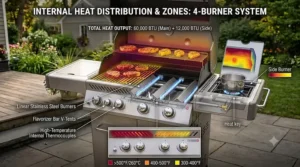
The core advantage of any 4 burner gas grill is multi-zone cooking — the ability to run each burner at a different heat level simultaneously, turning one grate into three or four functional cooking stations. In practice, that means searing chicken thighs on high over one burner while keeping corn on the cob warming over a low burner just a foot away, all without shuffling food on and off the grill or waiting for one batch to finish before starting the next. What most buyers overlook about multi-zone cooking is that it’s less about total heat and more about heat separation — a grill with four burners that are poorly insulated from each other can still let heat bleed across zones, undermining the whole point. Reviewers consistently point to genuine multi-zone performance as one of the biggest upgrades from a two-burner grill, since it eliminates the constant back-and-forth of moving food to control doneness. For anyone hosting mixed groups — some people wanting well-done, others medium-rare — this feature alone often justifies stepping up from a smaller grill.
Sear Station Burners: Do You Need One?
A sear station burner is a dedicated zone, usually positioned center or to one side, engineered to run significantly hotter than the surrounding burners — often reaching 700°F or more compared to a standard 500-550°F ceiling. Based on the spec comparison across this list, only the Monument Grills Mesa 415BZ ships with a true dedicated sear burner, though any grill’s outer burners can approximate a sear zone if you’re willing to crowd two burners together under one section of grate. Here’s what to weigh: a sear station shines for steaks, chops, and scallops where a hard crust in under two minutes per side matters, but it adds relatively little value if your grilling repertoire leans toward burgers, chicken breasts, or vegetables that benefit more from steady moderate heat than a blast furnace. Reviewers who specifically bought sear-burner models for steak night report meaningfully better crust formation versus their previous standard grills, which suggests the feature delivers on its promise rather than existing purely as a marketing checkbox.
4 Burner Gas Grills vs 2-Burner and 6-Burner Models
Stepping down to a 2-burner grill genuinely saves money and patio space, but it sacrifices the multi-zone flexibility that makes a 4 burner gas grill so practical for anything beyond a solo dinner — with only two zones, you’re constantly compromising between searing one item and gently finishing another. Stepping up to a 6-burner model buys more simultaneous capacity for large gatherings, but the added grate space and burner count usually come with a meaningfully larger footprint and a higher price that’s wasted if you’re regularly cooking for two or four people rather than twelve. As Wikipedia’s overview of barbecue grills notes, gas grills in general trade some of the smoky depth of charcoal cooking for convenience and precise temperature control — and a four-burner layout tends to be the size where that convenience-to-capability ratio peaks for most American households. Based on the spec comparison, a four-burner grill typically feeds 15-25 people comfortably in one cooking session, covering the vast majority of backyard gatherings without the storage headache of a 6-burner unit.
Common Mistakes When Buying a 4 Burner Gas Grill
Buyers frequently over-index on BTU count alone, assuming more heat automatically means better cooking, when uneven heat distribution across a poorly designed grate can undercut even a high-output burner setup. Another recurring mistake is ignoring cooking-grate material entirely — stamped steel grates look identical to cast iron in a listing photo, but perform very differently once the food hits the grill. Shoppers also commonly skip checking frame gauge and cart construction, only to discover a year or two later that the base has started to warp or wobble under regular use. Finally, many buyers assume every 4 burner gas grill review roundup covers the same tested criteria, when methodology (and honesty about real limitations) can vary significantly between sources — cross-referencing a few independent reviews before buying is worth the extra ten minutes.
Heavy Duty Grill Frames: Long-Term Cost & Maintenance
A heavy duty grill frame is the single biggest factor separating a grill that lasts three seasons from one that lasts a decade, and it rarely shows up as a headline spec. Thicker-gauge steel resists the flexing that misaligns burner tubes and stresses gas connections over years of rolling the cart across a patio, while thinner carts — common on the cheapest open-cart models — tend to develop wobble and surface rust noticeably faster. On paper this means the true cost of ownership isn’t just the sticker price: a $250 grill that needs replacing after three seasons can cost more over a decade than a $500 grill built on a genuinely reinforced frame. Reviewers consistently flag frame rigidity and cart hardware as the first thing to fail on budget models, well before the burners themselves stop working. Practically, extending the life of any frame — heavy-duty or not — comes down to a few habits: store the grill under a cover during off-season months, keep the cart wheels free of debris so they roll rather than drag, and touch up any scratched paint on steel components before rust has a chance to spread.
FAQ
❓ How many burgers can a 4 burner gas grill cook at once?
❓ Is a 4 burner gas grill big enough for a family of five?
❓ What's the difference between a sear station burner and a regular burner?
❓ How long does a heavy duty grill frame typically last?
❓ Do I need natural gas or propane for a 4 burner gas grill?
Conclusion
A 4 burner gas grill remains one of the most practical sizes for American backyards because it hits the sweet spot between real cooking flexibility and manageable cost, footprint, and fuel consumption. Whether you land on the premium heat control of the Weber Genesis II E-410, the dedicated searing power of the Monument Grills Mesa 415BZ, or the straightforward value of the Royal Gourmet GA4400T or Dyna-Glo DGB495SDP-D, the right choice comes down to matching burner output, frame durability, and features like a sear station burner to how you actually cook — not to whichever spec sheet has the biggest number. Take the time to check current pricing and availability before buying, since propane grill prices shift with the season, and don’t skip the safety basics covered above; a properly maintained grill is a grill that lasts. Multi-zone cooking, honest reviews, and a frame built to survive real weather will serve you far better over a decade than chasing the flashiest feature list in the store.
🔍 Don’t Miss These Exclusive Deals!
Take your outdoor cooking to the next level with the picks above. Click on any highlighted grill to check current pricing and availability — these models will help you create the backyard cookouts your family and friends will keep asking you to repeat!
Recommended for You
- 3 Burner Grill Under $400: 7 Solid Picks for 2026 (No Regrets)
- 3 Burner Gas Grill for Family: 7 Best Picks for 2026
- 3 Burner Gas Grill: 7 Best Picks Worth Buying in 2026
Disclaimer: This article contains affiliate links. As an Amazon Associate, I earn from qualifying purchases. If you purchase products through these links, we may earn a small commission at no additional cost to you.
✨ Found this helpful? Share it with your friends! 💬🤗
