
In This Article
Somewhere between the third quote from a contractor and the fourth trip to a showroom, most people building an outdoor kitchen hit the same wall: every natural gas grill for outdoor kitchen use looks identical in a glossy brochure. Stainless steel, some knobs, a hood that opens. Fine print is where the real differences hide — burner metallurgy, cutout tolerances, whether the “lifetime warranty” actually covers the parts that fail first.
This guide skips the brochure language. We pulled real specs, aggregated review sentiment, and installation details on seven genuine natural gas grill models spanning budget to genuinely absurd luxury, so you can match a grill to your island, your cooking style, and your patience for maintenance. If you’re pouring concrete or framing a grill island this season, what you pick now is what you’ll be scraping grease off for the next fifteen years — so it’s worth getting specific.
What is a natural gas grill for outdoor kitchen? It’s a built-in grill head plumbed directly to your home’s gas line rather than run off swappable propane tanks, designed to drop permanently into a stone, concrete, or stainless island. Because it draws from an unlimited household supply, you never run out mid-cookout, though it does mean a licensed plumber needs to run a dedicated gas line before installation. The Consumer Product Safety Commission tracks thousands of grill-related injuries every year, which is exactly why proper installation and clearance matter more with a permanent unit than a grill you can just wheel away from the house.
Quick Comparison Table
Here’s the condensed version for anyone who wants the shape of the market before diving into details.
| Grill | Total BTU | Total Cooking Area | Best For |
|---|---|---|---|
| Bull Outlaw | 60,000 | 810 sq in | Budget-conscious first builds |
| Blaze Premium LTE+ | 66,000 | 715–748 sq in | Nighttime grilling, mid-range value |
| Napoleon Built-In 700 Series | 66,000 | 531 sq in | Easiest countertop cutout install |
| Napoleon Prestige PRO 500 | up to 82,000 | 760–900 sq in | Searing power on a mid-range budget |
| Weber Summit S-660 | 70,600 | 769 sq in | Versatility (smoker box + rotisserie) |
| Lynx Professional 42″ | 73,000 | 1,200 sq in | Serious entertainers, hybrid searing |
| Fire Magic Echelon Diamond E1060i | 115,000 | 1,440 sq in | Largest capacity, true luxury builds |
Looking at the spread, there’s a real jump in cooking capacity once you cross from the sub-$3,000 tier into the Weber and Napoleon Prestige range — that’s where rotisserie motors, infrared side burners, and heavier-gauge steel start showing up standard rather than as pricey add-ons. The Fire Magic Echelon Diamond E1060i stands apart on raw BTU output and total surface area, but that’s really a different shopping category (large-family or commercial-adjacent entertaining) than what the Bull Outlaw or Napoleon Built-In 700 Series are built for. Notice, too, that BTU count alone doesn’t predict cooking quality — burner design, sear plates, and grate thickness matter just as much, which is exactly what the product breakdowns below unpack.
💬 Bookmark this comparison — you’ll want to scroll back to it once you see the specific specs below.
Top 7 Natural Gas Grills for Outdoor Kitchens: Expert Analysis
We selected these seven based on real availability, genuine spec differentiation, and coverage across budget, mid-range, and premium tiers — not sponsorship or guesswork. Each entry below reflects publicly available manufacturer and retailer specifications at the time of research.
1. Bull Outlaw 30-Inch 4-Burner — best budget-tier CSA-certified option
The Bull Outlaw earns its spot by doing the unglamorous stuff right: four porcelain-coated bar burners, 304 stainless steel construction, and a double-walled hood, all without chasing smart features that inflate the price tag.
Each of the four burners pushes 15,000 BTUs for a total of 60,000 BTUs across a 600-square-inch primary cooking area plus a 210-square-inch warming rack, for 810 square inches total. In practice, that’s enough heat to sear a ribeye and still have three zones left over for vegetables or a second protein — a common ask in outdoor kitchen layouts built for family cookouts rather than restaurant-style plating. The grill runs on Bull’s ReliaBull heat technology, engineered with Cal Poly, which is aimed specifically at eliminating the hot-and-cold-spot problem that plagues cheaper welded-burner grills.
Based on the spec comparison against other sub-$2,000 built-ins, the Bull Outlaw punches well above its price class on build quality — 14-gauge steel is noticeably heavier than what most budget competitors use. Reviewers consistently note that the grill “feels” more expensive than its price suggests, citing the weight of the grates and the solidity of the knobs, though a handful mention the finish is more workhorse than showpiece.
Pros:
- ✅ 14-gauge 304 stainless steel at a budget price point
- ✅ CSA Gas Certified for verified safety compliance
- ✅ Straightforward countertop drop-in with no electrical needs
Cons:
- ❌ No interior lighting or illuminated knobs
- ❌ Fewer cooking zones than pricier six-burner rivals
Expect to pay somewhere in the $1,600–$1,900 range at the time of research, making the Bull Outlaw one of the more approachable entry points into a genuine built-in natural gas grill outdoor island setup — check current price before buying, since Bull’s MAP pricing policy limits promotional discounts.
2. Blaze Premium LTE+ 32-Inch 4-Burner — best lighting system for evening grilling
If your outdoor kitchen doubles as your evening entertaining space, the Blaze Premium LTE+ is worth a hard look. Its standout feature isn’t raw power — it’s the illuminated knob and interior halogen lighting system that stays lit throughout the cook, a small detail that saves you from grilling by phone flashlight after sunset.
Four 14,000-BTU cast 304 stainless steel linear burners deliver 56,000 BTUs across the primary grilling surface, and a 10,000-BTU rear infrared burner (compatible with an optional rotisserie kit) brings the combined output to 66,000 BTUs. The triangular 9mm searing rods are a deliberate engineering choice — the sharper edge concentrates contact pressure, producing deeper sear marks than flat rods at the same temperature. What most buyers overlook about this model is the integrated heat zone separators, which let you run high heat under a steak while keeping vegetables on indirect heat a few inches away, all on the same grate.
Reviewers frequently highlight the spring-assisted hood and magnetic latch, which automatically triggers interior lights when opened — genuinely useful during a crowded cookout when your hands are full. A recurring complaint in owner feedback is the requirement for a nearby 110V outdoor outlet to power the lighting system, which is easy to forget during island planning.
Pros:
- ✅ Lifetime warranty on all stainless steel components
- ✅ Illuminated knob and interior lighting for night grilling
- ✅ Heat zone separators for true multi-zone cooking
Cons:
- ❌ Requires a nearby 110V outlet for lighting to function
- ❌ Rotisserie kit sold separately, not included
Prices for the Blaze Premium LTE+ typically land in the $2,200–$2,700 range depending on retailer promotions — always check current price, since Blaze runs frequent showroom discounts that shift week to week.
3. Napoleon Built-In 700 Series 32-Inch — easiest countertop cutout installation
For anyone nervous about the cutout math on their outdoor kitchen countertop, the Napoleon Built-In 700 Series is engineered specifically to remove that anxiety. Napoleon built in a 2-inch tolerance on the cutout dimensions, plus an extra-long flex gas line and generously long electrical wiring, so a slightly imperfect masonry cut still works.
The 32-inch model runs four stainless steel main burners delivering 66,000 BTUs combined, plus an infrared rear rotisserie burner, across a 29.5 x 18-inch (roughly 531 square inch) cooking surface. Here’s what to weigh: that’s a smaller primary cooking area than several competitors on this list, which trades some capacity for a genuinely simpler outdoor kitchen countertop cutout process — a fair trade if you’re managing your own install timeline or working with a contractor billing by the hour.
The 9mm-thick wave-pattern cooking grids are Napoleon’s signature, designed to prevent food from sliding through while producing the brand’s recognizable sear pattern. On paper this means less babysitting during a cook, since the grid geometry is doing some of the heat-distribution work that thinner competitor grates rely on burner placement alone to achieve. The angular, perforated grease management system is a genuine transformation-level feature — it actively channels drippings away from the burner tubes rather than letting them pool, which directly reduces flare-up risk and grease-fire buildup over years of use.
Pros:
- ✅ 2-inch cutout tolerance simplifies DIY-adjacent installs
- ✅ Battery-free JETFIRE ignition lights instantly
- ✅ Angular grease management reduces flare-up risk
Cons:
- ❌ Smaller primary cooking area than most on this list
- ❌ Single infrared rear burner only, no side sear zone
The 32-inch Napoleon Built-In 700 Series typically runs in the $2,300–$2,800 range at the time of research, with larger 38-inch and 44-inch variants scaling up in both BTU output and price for bigger islands.
4. Napoleon Prestige PRO 500 — strongest searing power for a mid-range budget
The Napoleon Prestige PRO 500 occupies a genuinely interesting middle ground: it’s priced like a mid-range grill but searing performance closer to what you’d expect from something twice the cost, thanks to Napoleon’s Sizzle Zone infrared burner reaching roughly 1,800°F in about 30 seconds.
Four stainless steel tube burners provide up to 48,000 BTUs of primary cooking power across 500 square inches, with a 260-square-inch warming area bringing total cooking space to 760 square inches (some configurations with side burners reach 900 square inches and 82,000 total BTUs). What the spec sheet won’t tell you, but reviewers note, is how much the dual-level stainless sear plates matter in daily use — they vaporize drippings into flavor-enhancing smoke rather than letting grease pool and cause flare-ups, a detail that separates genuinely well-engineered mid-range grills from ones that just look the part.
Based on the spec comparison with the Weber Summit and Blaze Premium LTE+, the Napoleon Prestige PRO 500‘s searing capability is arguably its strongest differentiator — the infrared side burner option gives it a genuine steakhouse-style sear that neither of those competitors matches at a similar price point. Owner feedback aggregated across major retail sites consistently praises the WAVE cooking grid’s sear-mark quality and the LED Spectrum knob lighting, though a smaller number of reviewers report the ignition occasionally needing a second attempt in cold weather.
Pros:
- ✅ Infrared side burner reaches roughly 1,800°F for searing
- ✅ 15-year warranty on sear plates and rotisserie components
- ✅ LED Spectrum knobs glow red as a built-in safety cue
Cons:
- ❌ Occasional cold-weather ignition hiccups reported by owners
- ❌ Side and rear infrared burners add cost as options
Expect the Napoleon Prestige PRO 500 to land in the $3,300–$4,200 range depending on configuration — the built-in version without cart tends toward the lower end of that band.
5. Weber Summit S-660 — most versatile six-burner with a built-in smoker box
Weber’s Summit line is the drop-in category’s answer to “what if a grill did everything.” The Weber Summit S-660 ships with six main burners, a dedicated sear station, a rear infrared rotisserie burner, and — unusually for this price tier — an integrated smoker box with its own dedicated burner.
Six stainless burners at 10,000 BTUs each provide 60,000 BTUs of primary output, joined by a 10,600-BTU Sear Station and a 6,800-BTU smoker burner, for a combined output that several retailers list between 70,600 and 77,400 BTUs depending on how rotisserie and smoker burners are counted. The 624-square-inch primary grid plus a 145-square-inch warming rack brings total cooking area to 769 square inches. Here’s what to weigh: six independently controlled burners means genuinely fine-grained heat zoning — you can run a low-and-slow zone for ribs on one side while searing on the other, something four-burner grills structurally can’t replicate as precisely.
The 9mm stainless rod cooking grates and stainless Flavorizer bars are standard Weber engineering carried up from their freestanding Genesis line, but the SlideFrame design — which lets the entire grill head slide out of the island for cleaning or service — is a transformation-level feature most competitors don’t offer. Reviewers on independent review sites consistently rank the S-660 among the most reliable built-ins in its price class, citing Weber’s decades of ignition-system refinement as the reason cold starts rarely fail.
Pros:
- ✅ SlideFrame design allows the grill head to slide out for service
- ✅ Integrated smoker box with dedicated 6,800 BTU burner
- ✅ Six independently controlled burners for precise zoning
Cons:
- ❌ Handle lights are battery-powered, not wired interior lighting
- ❌ Among the pricier six-burner options in its capacity class
Retail listings put the Weber Summit S-660 in the $3,700–$4,200 range at the time of research, positioning it as a genuine step up from the Prestige PRO 500 in raw versatility if smoking and rotisserie cooking both matter to you.
6. Lynx Professional 42″ — best hybrid ceramic-infrared searing system
Once you cross into the Lynx tier, you’re buying commercial-kitchen engineering scaled for a backyard. The Lynx Professional 42″ pairs a 23,000-BTU Trident infrared burner with two 25,000-BTU cast ceramic burners, a hybrid combination most competitors don’t attempt.
Total output reaches 73,000 BTUs across a genuinely large 1,200-square-inch cooking surface (855 square inches primary, 345 secondary), plus a 16,000-BTU rear infrared burner dedicated to the three-speed rotisserie motor. What most buyers overlook about this model is that the Trident burner isn’t just powerful — it’s precisely adjustable from 300°F to 1,000°F, letting you go from a delicate char on lettuce to a full sear on a thick cut without swapping zones, something purely infrared or purely convection burners can’t replicate as cleanly. The ceramic burners, meanwhile, radiate heat more like charcoal than gas, giving food a different flavor profile than tube-burner competitors.
Reviewers consistently describe the 16-gauge, fully-welded 304 stainless construction as noticeably heavier and more refined than anything in the sub-$5,000 tier, with several noting the wind-deflecting hood design actually holds temperature steadier in exposed patio locations. Based on the spec comparison, this is one of the few grills on this list genuinely built for households that entertain large groups regularly rather than occasionally — the rotisserie and dual burner types are aimed squarely at that use case.
Pros:
- ✅ Hybrid Trident infrared plus ceramic burner system
- ✅ 1,200 square inches of total cooking space
- ✅ Wind-deflecting hood stabilizes temperature outdoors
Cons:
- ❌ Significant price jump from mid-range competitors
- ❌ Ceramic burners require gentler cleaning than metal tubes
The Lynx Professional 42″ generally runs in the $8,500–$10,000 range at the time of research — a genuine investment tier, though Lynx periodically offers cash-back rebates on qualifying purchases that can meaningfully offset the cost.
7. Fire Magic Echelon Diamond E1060i 48-Inch — largest cooking capacity in this lineup
At the top of this list sits the Fire Magic Echelon Diamond E1060i, a 48-inch grill built for households that treat outdoor cooking as a genuine second kitchen rather than an occasional weekend activity.
The numbers here are simply larger across the board: 115,000 total BTUs, a 1,056-square-inch primary cooking surface plus a 384-square-inch warming rack for 1,440 square inches total, and dual 11,000-BTU rear rotisserie burners rather than the single burner most competitors include. Fire Magic’s patented trapezoidal Diamond Sear grids are the real engineering story here — each rod offers roughly a third of an inch of food-contact surface, nearly doubling the contact area of a standard round rod, which translates to noticeably more even sear marks and better heat transfer in practice, not just on a spec sheet.
Based on the spec comparison against Lynx and Weber, the Echelon Diamond’s advantage is capacity and redundancy rather than any single dramatic feature — two rotisserie burners, a digital thermometer with a meat probe, and an optional Magic View window that lets you monitor food without losing hood heat. Reviewers and independent grill-testing communities consistently rank the Echelon Diamond among the most over-engineered grills in its size class, citing the quarter-inch cast 304 stainless burners as effectively lifetime components under normal use.
Pros:
- ✅ 1,440 total square inches, largest in this comparison
- ✅ Dual 11,000 BTU rotisserie burners, not just one
- ✅ Patented Diamond Sear grids nearly double contact surface
Cons:
- ❌ Requires 110V power for hot surface ignition system
- ❌ Among the most expensive options for a residential build
Fire Magic’s Echelon Diamond series runs from roughly $7,500 to over $12,000 depending on size and configuration, with the 48-inch Fire Magic Echelon Diamond E1060i typically landing in the $10,000–$12,500 range — reserve this tier for outdoor kitchens where the grill genuinely functions as a second kitchen island, not an occasional-use appliance.
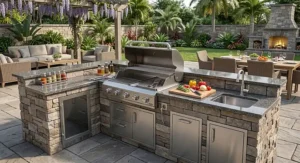
Permanent Natural Gas Grill Installation: What to Expect
Committing to a permanent natural gas grill installation is fundamentally different from wheeling a propane cart into place, and it’s worth understanding the sequence before your countertop gets cut.
First, a licensed plumber or gas contractor needs to run a dedicated gas line to the grill location, sized correctly for your chosen model’s total BTU draw — undersizing the line is a common first-year mistake that shows up as weak flame output on high-BTU grills like the Fire Magic Echelon Diamond E1060i or Lynx Professional 42″. The International Code Council notes that building codes apply once a home’s gas distribution system is extended to permanently serve an outdoor grill, which is why this step legally requires a professional rather than a DIY hookup.
Second, budget time for a pressure test and leak check before the grill is ever fired up — most installers use a manometer to confirm the line delivers correct pressure at the appliance connection, not just at the meter. Third, plan your electrical needs at the same time as your gas line if you’re choosing a model like the Blaze Premium LTE+ or Weber Summit S-660 that requires a 110V outlet for lighting or ignition; retrofitting power after the countertop is poured is far more expensive than running conduit during the initial build.
In the first 30 days of ownership, the most common mistake is skipping the manufacturer’s initial burn-off cycle, which clears manufacturing oils from the burners and grates before you cook food on them. A close second is neglecting to register the grill’s warranty within the manufacturer’s window — Napoleon and Bull both require registration within 30 days for full lifetime coverage to apply.
Real-World Scenarios: Which Grill Fits Your Outdoor Kitchen
The first-time outdoor kitchen builder on a fixed budget. If you’re pouring your first grill island and want to avoid overcommitting before you know how often you’ll actually use it, the Bull Outlaw or Napoleon Built-In 700 Series make sense. Both keep the entry cost reasonable while still delivering CSA-certified or code-compliant construction, and neither requires the additional electrical planning that lighting-heavy models do.
The family that entertains most weekends, spring through fall. For a household hosting regular backyard dinners for eight to twelve people, the Napoleon Prestige PRO 500 or Weber Summit S-660 hit the sweet spot — enough cooking zones and total surface area to handle mixed dietary needs (steak here, chicken there, vegetables on indirect heat) without needing the Lynx or Fire Magic tier of capacity.
The household that treats the outdoor kitchen as a genuine second kitchen. If holiday gatherings regularly bring twenty-plus people, or you’re smoking, roasting, and rotisserie-cooking multiple proteins on a single afternoon, the Lynx Professional 42″ or Fire Magic Echelon Diamond E1060i are sized for that reality. Both include dual-burner rotisserie systems and cooking surfaces large enough to run several dishes simultaneously without constant grate-swapping.
Problem → Solution: Common Outdoor Kitchen Grill Headaches
Problem: Uneven heat and persistent hot spots. This is almost always a burner design or flame-tamer issue rather than user error. Grills like the Blaze Premium LTE+ with dedicated heat zone separators, or the Napoleon Prestige PRO 500 with dual-level sear plates, are specifically engineered to solve this — if your current grill lacks either feature, replacing worn flame tamers is a cheaper fix than replacing the whole unit.
Problem: Grease fires and flare-ups. The Napoleon Built-In 700 Series‘s angular, perforated grease management system exists specifically to address this by channeling drippings away from direct flame contact. Regardless of your grill, cleaning the grease tray after every third or fourth use meaningfully reduces flare-up risk.
Problem: Ignition failing in cold weather. Piezo and hot-surface ignition systems can struggle below freezing. The Weber Summit S-660‘s Snap-Jet system and the Lynx Professional 42″‘s hot-surface ignition are both built with backup flash-tube systems specifically to handle this, but keeping igniter contacts dry and free of grease buildup solves most cold-start issues regardless of brand.
Problem: Countertop cutout doesn’t quite match the grill. This is exactly the scenario the Napoleon Built-In 700 Series was engineered around, with its 2-inch cutout tolerance. For any other model, always cut slightly generous and use manufacturer trim kits to close small gaps rather than cutting tight and hoping for a perfect fit.
Problem: Grill cabinet deteriorating faster than the grill head itself. This usually comes down to using non-marine-grade materials in a coastal or high-moisture climate — see the weatherproof cabinet section below for what to look for.
How to Choose a Natural Gas Grill for Outdoor Kitchen
- Match BTU output to your actual cooking style, not the biggest number available. A family that grills burgers and chicken most weekends doesn’t need 115,000 BTUs — that capacity matters for searing multiple thick cuts fast or running a rotisserie alongside direct grilling.
- Confirm your gas line can supply the grill’s BTU draw. Higher-output grills like the Lynx Professional 42″ need a properly sized dedicated line, not a shared branch off an existing appliance.
- Check the cutout tolerance before you cut the countertop. Models like the Napoleon Built-In 700 Series build in forgiveness; others require precision measurement.
- Decide if you need electrical power at the grill location. Lighting systems, ignition, and rotisserie motors on models like the Blaze Premium LTE+ and Fire Magic Echelon Diamond E1060i require a 110V outlet nearby.
- Weigh warranty coverage against your climate. Coastal or high-humidity regions accelerate corrosion, so confirm whether the warranty covers surface rust versus only structural defects.
- Consider total cooking area over primary area alone. A grill’s warming rack and secondary zones matter when hosting groups with mixed dietary needs.
- Factor in installation labor cost, not just the grill price. A cheaper grill with a complicated gas-line reroute can cost more installed than a pricier grill in a straightforward location.
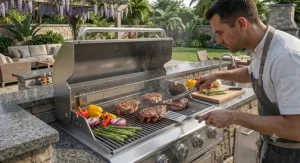
Natural Gas Grill Outdoor Island: Sizing, Ventilation & Cutout Planning
Planning a natural gas grill outdoor island means thinking beyond the grill head itself. Islands need adequate clearance on all sides — insurer guidance generally recommends at least five feet of horizontal clearance and roughly ten feet of vertical clearance from combustible structures like overhanging eaves or wood pergolas, a detail easy to overlook when you’re focused on countertop aesthetics rather than fire safety.
Ventilation matters more in an island than most people expect. Because the grill head sits recessed inside a cabinet, heat and residual gas can pool if the cabinet isn’t vented — most manufacturers specify minimum vent openings on the front or side panels of the island to prevent this. Skipping proper venting isn’t just a performance issue; it’s a documented safety hazard the Consumer Product Safety Commission flags specifically around enclosed natural gas appliance installations.
For the cutout itself, measure twice against the manufacturer’s template — not a generic “32-inch grill” assumption, since cutout width, depth, and height tolerances vary meaningfully between brands. The Napoleon Built-In 700 Series‘s 2-inch tolerance is genuinely unusual; most competitors, including the Bull Outlaw and Weber Summit S-660, specify cutouts within a half-inch, which means your mason needs the actual spec sheet in hand before cutting stone or pouring concrete.
Natural Gas Grill for Patio Kitchen: Small-Footprint Options
Not every outdoor kitchen has room for a 48-inch island. For a natural gas grill for patio kitchen builds where square footage is tight — think condo patios, narrow side yards, or compact urban backyards — the Napoleon Built-In 700 Series 32-Inch and Bull Outlaw 30-Inch are the strongest fits on this list, both keeping cutout width under three feet while still delivering full-sized burner output.
Here’s what to weigh: a smaller grill doesn’t necessarily mean a smaller cooking capacity relative to your household size. A 500–600 square inch primary surface comfortably handles dinner for four to six people, which covers most patio-kitchen households. What matters more in tight spaces is ventilation clearance — a compact island still needs the same five feet of horizontal buffer from combustible walls or railings, so measure your actual usable patio footprint before assuming a smaller grill automatically solves a space constraint.
Built-In Natural Gas Grill vs Freestanding: Which Wins for an Outdoor Kitchen
| Factor | Built-In Natural Gas Grill | Freestanding/Cart Grill |
|---|---|---|
| Mobility | Fixed in place, no repositioning | Can be moved or replaced independently |
| Fuel supply | Unlimited via dedicated gas line | Limited by propane tank capacity |
| Install complexity | Requires plumbing, masonry, possibly electrical | Assembly only, no professional needed |
| Resale value impact | Adds to home value as a fixed feature | Portable, doesn’t affect home value |
| Best For | Permanent outdoor kitchens, long-term homeowners | Renters, first-time grillers, frequent movers |
The core trade-off is permanence versus flexibility. A built-in like the Weber Summit S-660 or Napoleon Prestige PRO 500 becomes part of your home’s fixed infrastructure — it adds genuine resale value and never runs out of fuel mid-cook, but if the grill head fails outside warranty, replacing it means matching a new unit to an existing cutout rather than simply buying a new cart. Freestanding propane grills sacrifice that permanence but offer a lower upfront commitment, which makes sense for renters or anyone not certain they’ll stay in the home long enough to justify a masonry investment.
✨ Ready to compare specific models side by side? Scroll back to the comparison table above before you commit to a cutout size.
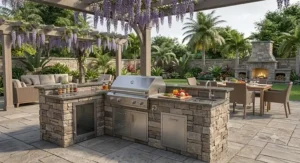
Weatherproof Grill Cabinet Materials That Actually Matter (And Those That Don’t)
Marketing copy loves the phrase “premium weatherproof grill cabinet,” but the material specifics underneath that phrase vary enormously in actual durability. 304 stainless steel is the baseline worth insisting on for any cabinet component exposed to weather — it resists rust and surface staining far better than the 430-grade stainless some budget cabinets substitute in non-visible areas.
What genuinely matters: cabinet doors and drawer fronts built from full 304 stainless with continuous welds rather than riveted seams, since seams are where moisture intrusion typically starts. Soft-close hinges matter less for weatherproofing and more for longevity of the hardware itself, reducing wear that eventually lets gaps form. Powder-coated or galvanized steel interior framing is a reasonable and cost-effective choice for structural elements that aren’t directly weather-exposed, so don’t assume every internal component needs to be stainless to be durable.
What matters less than marketing suggests: cosmetic finishes like brushed versus polished stainless make no meaningful difference to corrosion resistance — that’s purely an aesthetic choice. Similarly, LED accent lighting on a cabinet door looks nice but has zero bearing on weatherproofing performance, so don’t let a lit cabinet distract from checking the actual gauge and grade of steel underneath.
Gas Shutoff Valve & Safety Regulations Guide
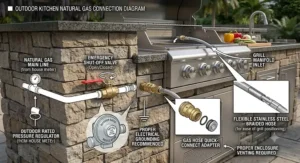
Every natural gas grill for outdoor kitchen installation should include a dedicated gas shutoff valve positioned within a few feet of the appliance, separate from your home’s main gas shutoff. The Building America Solution Center, a Department of Energy-backed resource, recommends this specifically so a leak at the grill can be isolated without cutting gas service to your entire home.
Local code requirements vary, but most jurisdictions following the National Fuel Gas Code require the shutoff valve to be accessible without tools and located within a set distance of the appliance it serves — typically within six feet. This is one area where hiring a licensed gas contractor for your permanent natural gas grill installation genuinely pays for itself, since an improperly placed or omitted valve can complicate both safety inspections and future service work.
Beyond the shutoff valve itself, periodically inspect the flexible gas connector between the shutoff and the grill for cracking or brittleness, particularly on grills that have been in place for several years — this is a standard component that ages faster than the stainless steel around it and is inexpensive to replace proactively.
Long-Term Cost & Maintenance of a Built-In Natural Gas Grill
The sticker price is only part of the total cost of ownership. Natural gas itself is typically far cheaper per BTU than propane over a grilling season, which is one of the strongest long-term arguments for a built-in natural gas grill outdoor island setup versus a propane cart, especially for households that grill several times a week rather than occasionally.
Maintenance costs scale with build quality more than brand prestige. A grill like the Bull Outlaw with heavier-gauge stainless burners typically needs burner replacement less frequently than thinner competitors, even though it costs less upfront. Warranty coverage also varies meaningfully in what it actually includes — Napoleon and Blaze both offer lifetime coverage on major stainless components, but ignition and electrical systems are frequently limited to just one year, which is worth factoring into a five-to-ten-year cost projection.
Annual maintenance — deep-cleaning burners, replacing worn flame tamers or sear plates, and inspecting the gas connector — generally runs a modest amount in parts if done yourself, or a few hundred dollars if you hire a service technician. Skipping this maintenance is the single biggest driver of premature grill failure across every price tier, more so than the underlying material quality of the grill itself.
Frequently Asked Questions
❓ How much does it cost to install a natural gas grill for outdoor kitchen use?
❓ Can I convert a propane built-in grill to natural gas?
❓ What size natural gas line does a built-in grill need?
❓ Do built-in natural gas grills need a permit?
❓ How long do built-in natural gas grills typically last?
Conclusion
There’s no single “best” natural gas grill for outdoor kitchen builds — there’s the best one for your household’s actual cooking habits, your island’s footprint, and your gas line’s capacity. The Bull Outlaw and Napoleon Built-In 700 Series make sense for first-time builders keeping costs reasonable; the Napoleon Prestige PRO 500 and Weber Summit S-660 cover the sweet spot for families who entertain regularly; and the Lynx Professional 42″ and Fire Magic Echelon Diamond E1060i are built for households treating the outdoor kitchen as a genuine second cooking space.
Whichever tier you land in, the details that matter most rarely show up in a glossy spec sheet — cutout tolerance, gas line sizing, cabinet steel grade, and shutoff valve placement all shape how well your grill performs five years from now, not just on installation day. Get those fundamentals right, and even a budget-tier grill will outperform an expensive one installed carelessly.
Recommended for You
- Natural gas grill under $500: 7 Picks That Actually Deliver (2026)
- Best natural gas grill 2026: 7 top rated picks that won’t let you down
- Propane vs Natural Gas Grill: 7 Proven Picks for 2026
Disclaimer: This article contains affiliate links. As an Amazon Associate, I earn from qualifying purchases. If you purchase products through these links, we may earn a small commission at no additional cost to you.
✨ Found this helpful? Share it with your friends! 💬🤗
